Scientific Imaging Solutions
ScientificCMOS & sCMOS Cameras
Meticulously engineered cameras featuring high-performance Gpixel GSENSE sCMOS and Sony Exmor large-format CMOS sensors. Optimized for deep-sky observation, ultraviolet imaging, cell biology research, and industrial inspection.
Choose by measurement
Compare scientific CMOS cameras by sensor and application
Start with the light level, wavelength, field of view and acquisition speed your experiment needs. Each sensor link below opens a comparison of camera models, specifications and datasheets.
Swipe across the table to compare sensors and selection checks.
| Your measurement | Compare cameras using | What decides the configuration |
|---|---|---|
| Low-light fluorescence | Compare quantum efficiency at the emission wavelength, read noise at the selected gain, and dark current at the operating temperature. | |
| Larger pixels and optical sampling | Match pixel size and sensor area to magnification, optical resolution and the usable image circle. | |
| Large-area sCMOS imaging | Compare sensor illumination, full-frame readout, cooling and synchronization options for the same exposure conditions. | |
| UV or VIS window selection | Choose the sMAX6504B UV or VIS window first, then compare the USB, 10GigE and CoaXPress model configurations. | |
| Large-format and APS-C CMOS imaging | Check monochrome or colour capture, image-circle coverage and sustained throughput at full resolution. | |
| Fast, synchronized acquisition | Specify frame rate, region of interest and bit depth together, then confirm the trigger and acquisition hardware. |
Specify the camera together with the microscope
Send the wavelength, objective magnification and NA, exposure time, required frame rate, camera mount and acquisition software. Precisometer can help shortlist a camera and confirm the configuration for a quotation.
Read the sCMOS selection guide
Planning automated Z-stacks or sample scanning? Compare piezo objective and sample scanners alongside the camera.
sMAX04BM Series
Ultra-High Sensitivity & High Frame Rates
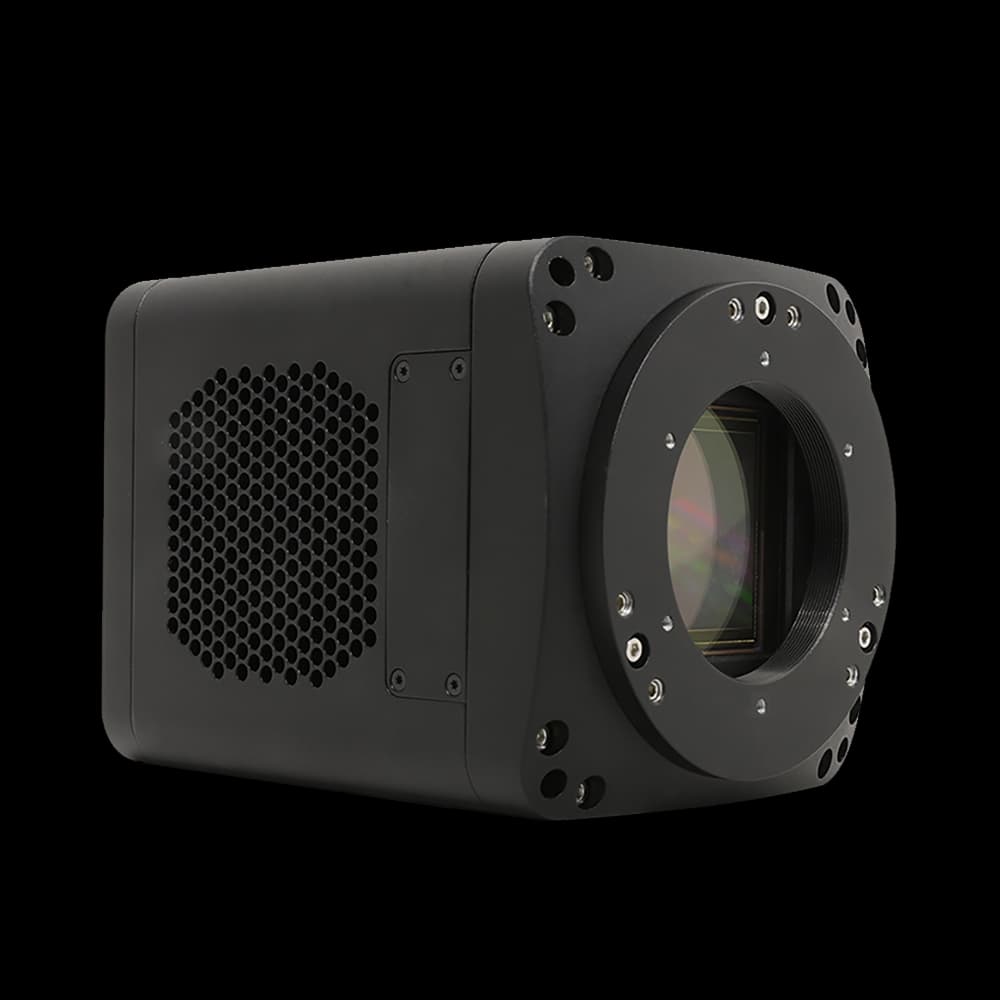
The sMAX04BM series scientific sCMOS camera is optimized for weak-light imaging applications. Utilizing the back-illuminated GSENSE2020BSI sensor, it achieves an incredible 95% quantum efficiency. Supported by high-speed CameraLink and USB 3.0 interfaces, it outputs up to 108 fps at full 4.2MP resolution, making it ideal for bioluminescence, fluorescence microscopy, and fast physical dynamics.
Key Technical Advantages
- Back-illuminated GSENSE2020BSI sensor with 95% Peak QE
- Ultra-high frame rates: 108 fps (CameraLink) / 89 fps (USB 3.0)
- Dual cooling system reducing thermal noise (35-40°C below ambient)
- High dynamic range mode (91.8dB) with 16-bit digitizer
- Anti-fog heating structure for low-temperature environments
- Precision external 7-Pin I/O trigger synchronization
Thermoelectric Cooling (TEC) & Heated Anti-Fog
Equipped with an advanced thermoelectric cooling structure to achieve a temperature drop of up to 40°C. An integrated heated glass anti-fog window prevents sensor surface condensation in cold or humid environments.
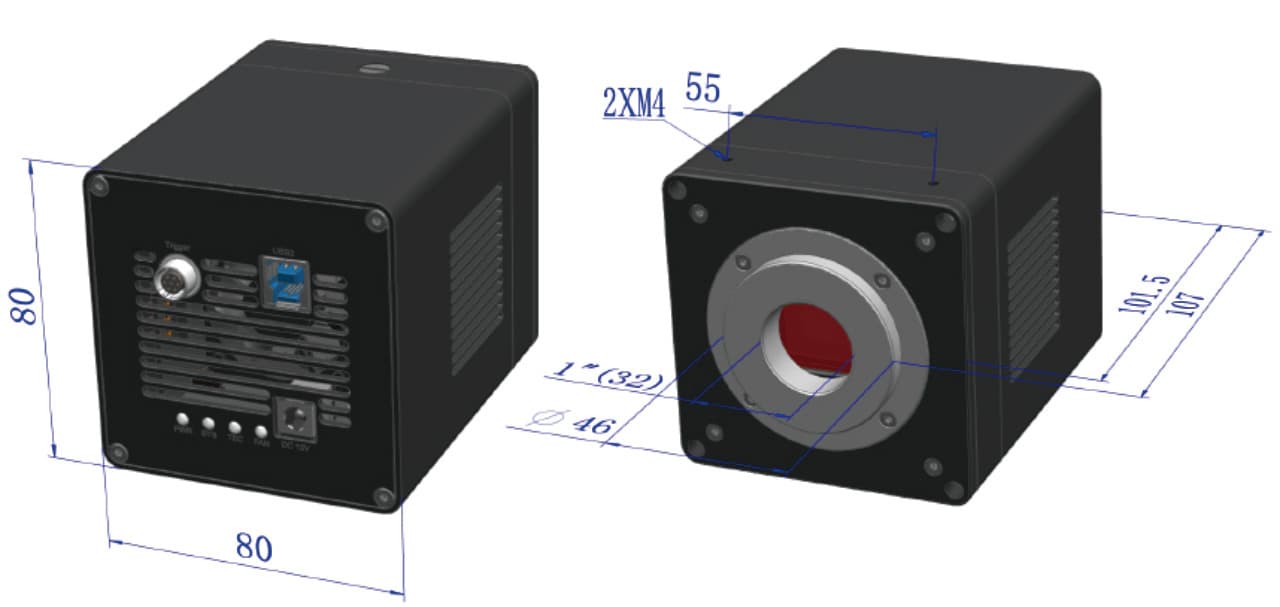
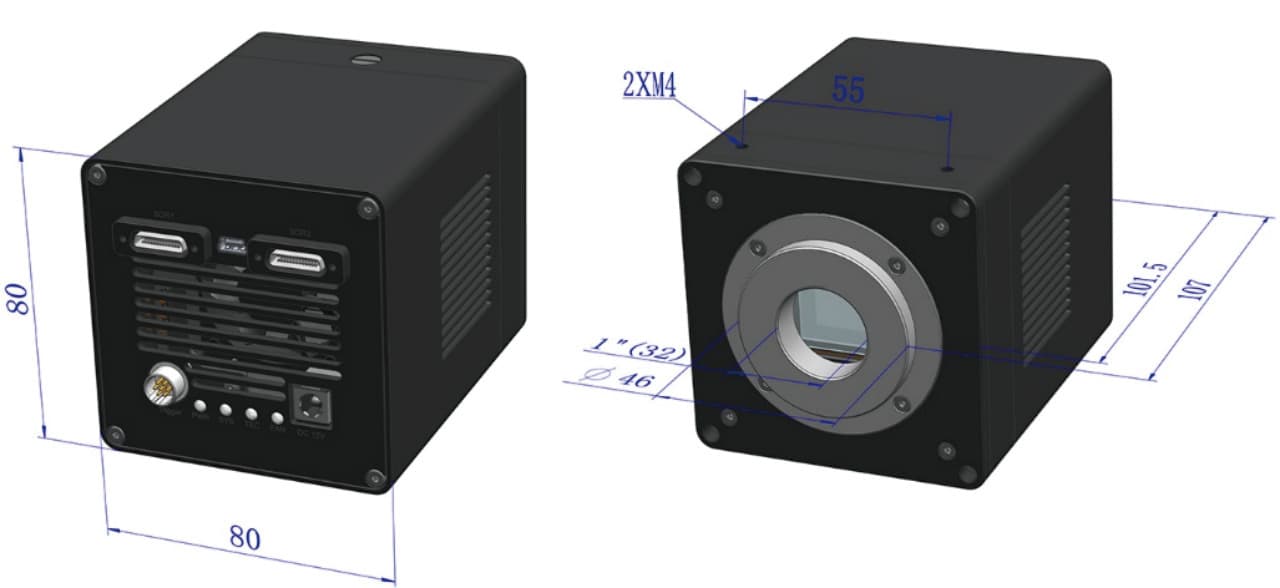
Mechanical Drawings
Interactive Educational Lab
Scientific Camera Parameter Simulator
Understanding technical camera specs is essential for optimizing setups. Select a parameter below to dynamically simulate its optical and physical effects.
Back-Illuminated (95% Peak QE)
Quantum Efficiency (QE) & Noise
Quantum Efficiency (QE) measures a sensor's effectiveness in converting incoming photons into electronic signals (photoelectrons).
Traditional Front-Illuminated (FI) cameras have wires on top of the silicon, blocking light and reducing QE to ~50%.
High-end Back-Illuminated (BSI) cameras flip the silicon substrate to expose it directly to light, raising QE to an incredible 90%–95%. This enables detection of faint fluorescence and astronomy subjects that would be lost under the noise floor of low QE sensors.
Simulator Controls
💡 Scientific Impact
A 95% QE camera halves the required exposure time or excitation laser intensity compared to a 50% QE sensor, reducing sample phototoxicity and photobleaching.
Comprehensive Specifications
sMAX Series Camera Comparison
Detailed parameter breakdown for scientific camera models. Standard SDKs support Windows, Linux, macOS, and Android.
| Technical Parameter | sMAX04BM Series | sMAX16AM-GPS | sMAX16BM / 81BM-GPS |
|---|---|---|---|
| Image Sensor | Gpixel GSENSE2020BSI (Mono, UV, Rolling Shutter) | Gpixel GSENSE4040 (Mono, UV, Rolling Shutter) | Gpixel GSENSE4040BSI (Mono, UV, Rolling Shutter) |
| Spectral Range | 200nm – 1100nm | 200nm – 1100nm | 200nm – 1100nm |
| Resolution (Pixels) | 4.2 Megapixels (2048 x 2048) | 16.0 Megapixels (4096 x 4096) | 16.0 Megapixels (4096 x 4096) |
| Pixel Size (μm) | 6.5 x 6.5 | 9.0 x 9.0 | 9.0 x 9.0 |
| Sensor Format / Size | 1.2" (13.31mm x 13.31mm) | 3.2" (36.8mm x 36.8mm) | 3.2" (36.8mm x 36.8mm) |
| A/D Conversion | 8-Bit / 11-Bit / 12-Bit / 16-Bit (HDR) | 8-Bit / 12-Bit / 16-Bit (HDR) | 8-Bit / 12-Bit / 16-Bit (HDR) |
| Frame Rate (USB 3.0) | 72.5 fps @ 2048x2048 (U3) 89 fps @ 2048x2048 (U100) | 20 fps @ 4096x4096 80 fps @ 2048x2048 | 20 fps @ 4096x4096 20 fps @ 2048x2048 |
| Frame Rate (CameraLink) | 108 fps @ 2048x2048 (CL100) | 23 fps @ 4096x4096 90 fps @ 2048x2048 | 23 fps @ 4096x4096 23 fps @ 2048x2048 |
| Peak Quantum Efficiency | 95% @ 560nm | 73.94% @ 600nm | 90% @ 550nm |
| Dark Current | 0.45 e-/s/pixel @ -30℃ | 0.2 e-/s/pixel @ 0℃ | TBD (Extremely Low) |
| Dynamic Range / SNR | 47.3dB (LCG Mode) 91.8dB (HDR 16-bit) | 49.3dB (LCG 2.8x Mode) 83.4dB (HDR 16-bit) | 45.9dB (LCG 3x Mode) 85.0dB (HDR 16-bit) |
| Exposure Range | 12μs – 3600s (Standard) 12μs – 10s (High Speed) | 12μs – 3600s | 12μs – 3600s |
| Cooling Performance | 35℃ – 40℃ below ambient | TEC cooling, up to 40℃ temperature drop | TEC cooling, up to 40℃ temperature drop |
| Data Interfaces | USB 3.0 / CameraLink | USB 3.0 / CameraLink | USB 3.0 / CameraLink |
| Anti-Fogging mechanism | Yes (Heated window prevents condensation) | Yes (Heated window prevents condensation) | Yes (Heated window prevents condensation) |
| Trigger Options | 7-Pin External IO trigger control | 7-Pin External IO trigger control, GPS support | 7-Pin External IO trigger control, GPS support |
Connectivity & Layout
Camera Panel Ports & Dimension Layout
These scientific cameras are designed with standard scientific high-speed transmission interfaces, providing rapid transfer of image and video data. Supported with multiple hardware options including CameraLink, USB 3.0, 10GigE, and CXP (CoaXPress) connections.
High-Speed Video Preview
Multiple output data lines allow concurrent high-speed visual pipelines for real-time adjustments.
GPS Sync Option
Provide geographical location and millisecond timing synchronization for astronomy KOC/observatory collaboration and research.
Find the Perfect Camera for Your Setup
Our specialists help research laboratories, industrial inspection lines, and astronomy groups select, configure, and integrate high-end scientific camera solutions.
Full model list
All scientific cameras
Every sCMOS, sCCD, and NIR-II model in the range, with sensor, resolution, and interface at a glance. Open any model for the full specification and datasheet.
39 models · 7 series
E2V
1 modelsMAX GSENSE
3 models| Model | Sensor | Resolution | Pixel Size | Frame Rate | Interface | Datasheet | |
|---|---|---|---|---|---|---|---|
| MAX04AM | GSENSE2020e (M, NIR, RS) | 4.2 MP (2048×2048) | 6.5 µm × 6.5 µm | 45 fps @ 2048×2048; 45 fps @ 1024×1024 | USB3.0 | Details → | |
| MAX04BM | GSENSE2020BSI (M, UV, RS) | 4.2 MP (2048×2048) | 6.5 µm × 6.5 µm | 45 fps @ 2048×2048; 45 fps @ 1024×1024 | USB3.0 | Details → | |
| MAX04CM | GSENSE400BSI (M, UV, RS) | 4.2 MP (2048×2048) | 11 µm × 11 µm | 44 fps @ 2048×2048; 44 fps @ 1024×1024 | USB3.0 | Details → |
MAX Sony
15 models| Model | Sensor | Resolution | Pixel Size | Frame Rate | Interface | Datasheet | |
|---|---|---|---|---|---|---|---|
| MAX102AC-10G | IMX461AQR (C, RS) | 102 MP (11648×8742) | 3.76 µm × 3.76 µm | 8.7 fps @ 11648×8742; 8.7 fps @ 5824×4370; 27.8 fps @ 3872×2912; 82.5 fps @ 1280×970 | 10GigE | Details → | |
| MAX102AC-U3 | IMX461AQR (C, RS) | 102 MP (11648×8742) | 3.76 µm × 3.76 µm | 3.5 fps @ 11648×8742; 8.7 fps @ 5824×4370; 27.8 fps @ 3872×2912; 82.5 fps @ 1280×970 | USB3.0 | Details → | |
| MAX102AM-10G | IMX461ALR (M, RS) | 102 MP (11648×8742) | 3.76 µm × 3.76 µm | 8.7 fps @ 11648×8742; 8.7 fps @ 5824×4370; 27.8 fps @ 3872×2912; 82.5 fps @ 1280×970 | 10GigE | Details → | |
| MAX102AM-U3 | IMX461ALR (M, RS) | 102 MP (11648×8742) | 3.76 µm × 3.76 µm | 3.5 fps @ 11648×8742; 8.7 fps @ 5824×4370; 27.8 fps @ 3872×2912; 82.5 fps @ 1280×970 | USB3.0 | Details → | |
| MAX151AC-10G | IMX411AQR (C, RS) | 151 MP (14176×10640) | 3.76 µm × 3.76 µm | 6.1 fps @ 14176×10640; 6.9 fps @ 7072×5320; 20.8 fps @ 4704×3546; 61.9 fps @ 1568×1178 | 10GigE | Details → | |
| MAX151AC-U3 | IMX411AQR (C, RS) | 151 MP (14176×10640) | 3.76 µm × 3.76 µm | 2.4 fps @ 14176×10640; 6.9 fps @ 7072×5320; 20.8 fps @ 4704×3546; 61.9 fps @ 1568×1178 | USB3.0 | Details → | |
| MAX151AM-10G | IMX411ALR (M, RS) | 151 MP (14176×10640) | 3.76 µm × 3.76 µm | 6.1 fps @ 14176×10640; 6.9 fps @ 7072×5320; 20.8 fps @ 4704×3546; 61.9 fps @ 1568×1178 | 10GigE | Details → | |
| MAX151AM-U3 | IMX411ALR (M, RS) | 151 MP (14176×10640) | 3.76 µm × 3.76 µm | 2.4 fps @ 14176×10640; 6.9 fps @ 7072×5320; 20.8 fps @ 4704×3546; 61.9 fps @ 1568×1178 | USB3.0 | Details → | |
| MAX24AC | IMX410 (C, RS) | 24 MP (6064×4040) | 5.94 µm × 5.94 µm | 15.3 fps @ 6064×4040 (14-bit); 41 fps @ 3024×2012; 114 fps @ 2016×1342 | USB3.0 | Details → | |
| MAX251AC-10G | IMX811AQR (C, RS) | 251 MP (19200×12800) | 2.81 µm × 2.81 µm | 1.5 fps @ 19200×12800 | 10GigE | Details → | |
| MAX251AC-U3 | IMX811AQR (C, RS) | 251 MP (19200×12800) | 2.81 µm × 2.81 µm | 1.5 fps @ 19200×12800 | USB3.0 | Details → | |
| MAX251AM-10G | IMX811ALR (M, RS) | 251 MP (19200×12800) | 2.81 µm × 2.81 µm | 1.5 fps @ 19200×12800 | 10GigE | Details → | |
| MAX251AM-U3 | IMX811ALR (M, RS) | 251 MP (19200×12800) | 2.81 µm × 2.81 µm | 1.5 fps @ 19200×12800 | USB3.0 | Details → | |
| MAX62AC | IMX455 (C, RS) | 61 MP (9568×6380) | 3.76 µm × 3.76 µm | 6.1 fps @ 9568×6380 (16-bit); 19.1 fps @ 4784×3190; 55.6 fps @ 3184×2124; 191 fps @ 1040×706 | USB3.0 | Details → | |
| MAX62AM | IMX455 (M, RS) | 61 MP (9568×6380) | 3.76 µm × 3.76 µm | 6.1 fps @ 9568×6380 (16-bit); 19.1 fps @ 4784×3190; 55.6 fps @ 3184×2124; 191 fps @ 1040×706 | USB3.0 | Details → |
SR
1 modelsSS
6 models| Model | Sensor | Resolution | Pixel Size | Frame Rate | Interface | Datasheet | |
|---|---|---|---|---|---|---|---|
| SS02MMA-U3-CXP | GSPRINT4502-AVM (sCMOS) | 2.5 MP (2048×1216) | 4.5 µm × 4.5 µm | Available on request | USB3.0/CXP | Details → | |
| SS02MPA-U3-CXP | GSPRINT4502-AVC (sCMOS) | 2.5 MP (2048×1216) | 4.5 µm × 4.5 µm | Available on request | USB3.0/CXP | Details → | |
| SS10MMA-U3-CXP | GSPRINT4510-AVM (sCMOS) | 10.0 MP (4608×2176) | 4.5 µm × 4.5 µm | Available on request | USB3.0/CXP | Details → | |
| SS10MPA-U3-CXP | GSPRINT4510-AVC (sCMOS) | 10.0 MP (4608×2176) | 4.5 µm × 4.5 µm | Available on request | USB3.0/CXP | Details → | |
| SS21MMA-U3-CXP | GSPRINT4521-AVM (sCMOS) | 21.0 MP (5120×4096) | 4.5 µm × 4.5 µm | Available on request | USB3.0/CXP | Details → | |
| SS21MPA-U3-CXP | GSPRINT4521-AVC (sCMOS) | 21.0 MP (5120×4096) | 4.5 µm × 4.5 µm | Available on request | USB3.0/CXP | Details → |
sMAX
11 models| Model | Sensor | Resolution | Pixel Size | Frame Rate | Interface | Datasheet | |
|---|---|---|---|---|---|---|---|
| sMAX04BM | GSENSE2020BSI (sCMOS) | 4.2 MP (2048×2048) | 6.5 µm × 6.5 µm | 72.5 fps @ 2048×2048; 72.5 fps @ 1024×1024 | USB 3.0 | Details → | |
| sMAX04BM-CL100 | GSENSE2020BSI (sCMOS) | 4.2 MP (2048×2048) | 6.5 µm × 6.5 µm | 108 fps @ 2048×2048; 108 fps @ 1024×1024 | Camera Link | Details → | |
| sMAX04BM-U100 | GSENSE2020BSI (sCMOS) | 4.2 MP (2048×2048) | 6.5 µm × 6.5 µm | 89 fps @ 2048×2048; 100 fps @ 1024×1024 | USB 3.0 | Details → | |
| sMAX16AM-U3-CL | GSENSE4040 (sCMOS) | 16.8 MP (4096×4096) | 9 µm × 9 µm | 20 fps @ 4096×4096 (USB3); 23 fps @ 4096×4096 (Camera Link); 80 fps @ 2048×2048 (USB3); 90 fps @ 2048×2048 (Camera Link) | USB3/Camera Link | Details → | |
| sMAX16AM-U3-CL-GPS | GSENSE4040 (sCMOS) | 16.8 MP (4096×4096) | 9 µm × 9 µm | 20 fps @ 4096×4096 (USB3); 23 fps @ 4096×4096 (Camera Link); 80 fps @ 2048×2048 (USB3); 90 fps @ 2048×2048 (Camera Link) | USB3/Camera Link | Details → | |
| sMAX16BM-U3-CL | GSENSE4040BSI (sCMOS) | 16.8 MP (4096×4096) | 9 µm × 9 µm | 20 fps @ 4096×4096 (USB3); 23 fps @ 4096×4096 (Camera Link) | USB3/Camera Link | Details → | |
| sMAX16BM-U3-CL-GPS | GSENSE4040BSI (sCMOS) | 16.8 MP (4096×4096) | 9 µm × 9 µm | 20 fps @ 4096×4096 (USB3); 23 fps @ 4096×4096 (Camera Link) | USB3/Camera Link | Details → | |
| sMAX6504B-VIS-U10-10G | GSENSE6504BSI (sCMOS) | 4.2 MP (2048×2048) | 6.5 µm × 6.5 µm | 248 fps @ 2048×2048 (10GigE, 8-bit); 224 fps @ 2048×2048 (USB3.2 Gen 2x1, 8-bit) | USB3.2 Gen 2x1 / 10GigE | Details → | |
| sMAX6504B-UV-U10-10G | GSENSE6504BSI (sCMOS) | 4.2 MP (2048×2048) | 6.5 µm × 6.5 µm | 248 fps @ 2048×2048 (10GigE, 8-bit); 224 fps @ 2048×2048 (USB3.2 Gen 2x1, 8-bit) | USB3.2 Gen 2x1 / 10GigE | Details → | |
| sMAX6504B-VIS-U20-CXP | GSENSE6504BSI (sCMOS) | 4.2 MP (2048×2048) | 6.5 µm × 6.5 µm | 298 fps @ 2048×2048 (CoaXPress 2.0 ×4 or USB3.2 Gen 2x2, 8-bit/12-bit); 170 fps @ 16-bit | USB3.2 Gen 2x2 / CoaXPress 2.0 ×4 | Details → | |
| sMAX6504B-UV-U20-CXP | GSENSE6504BSI (sCMOS) | 4.2 MP (2048×2048) | 6.5 µm × 6.5 µm | 298 fps @ 2048×2048 (CoaXPress 2.0 ×4 or USB3.2 Gen 2x2, 8-bit/12-bit); 170 fps @ 16-bit | USB3.2 Gen 2x2 / CoaXPress 2.0 ×4 | Details → |
sNIRII640B
2 models| Model | Sensor | Resolution | Pixel Size | Frame Rate | Interface | Datasheet | |
|---|---|---|---|---|---|---|---|
| sNIRII640A-U3-10G | China-made InGaAs image sensor | 0.33 MP (640×512) | 15 µm × 15 µm | Available on request | USB 3.0 / 10GigE | Details → | |
| sNIRII640B-U3 | China-made InGaAs image sensor | 0.33 MP (640×512) | 15 µm × 15 µm | Available on request | USB 3.0 | Details → |
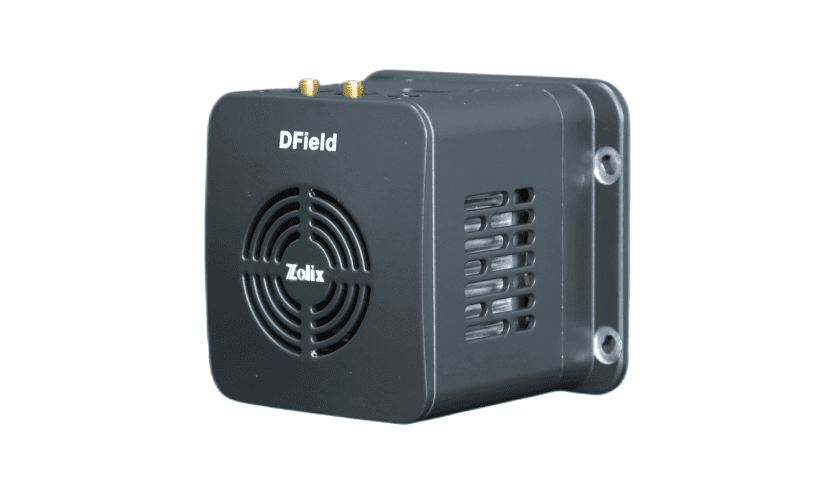
Spectroscopy CCD detector
DField-VS-A4 for spectrograph readout
Alongside the imaging-camera families above, the DField-VS-A4 is a dedicated 2048 × 264 spectral CCD detector head. Its 30.7 mm active spectral axis, 15 µm pixels and 95% peak quantum efficiency at 800 nm suit low-light Raman, fluorescence and photoluminescence acquisition.
Before you specify
Guides that make this an easier decision
Sensor technology, read noise and sampling explained against the same MAX and sMAX specifications used on this page.
 Scientific cameras
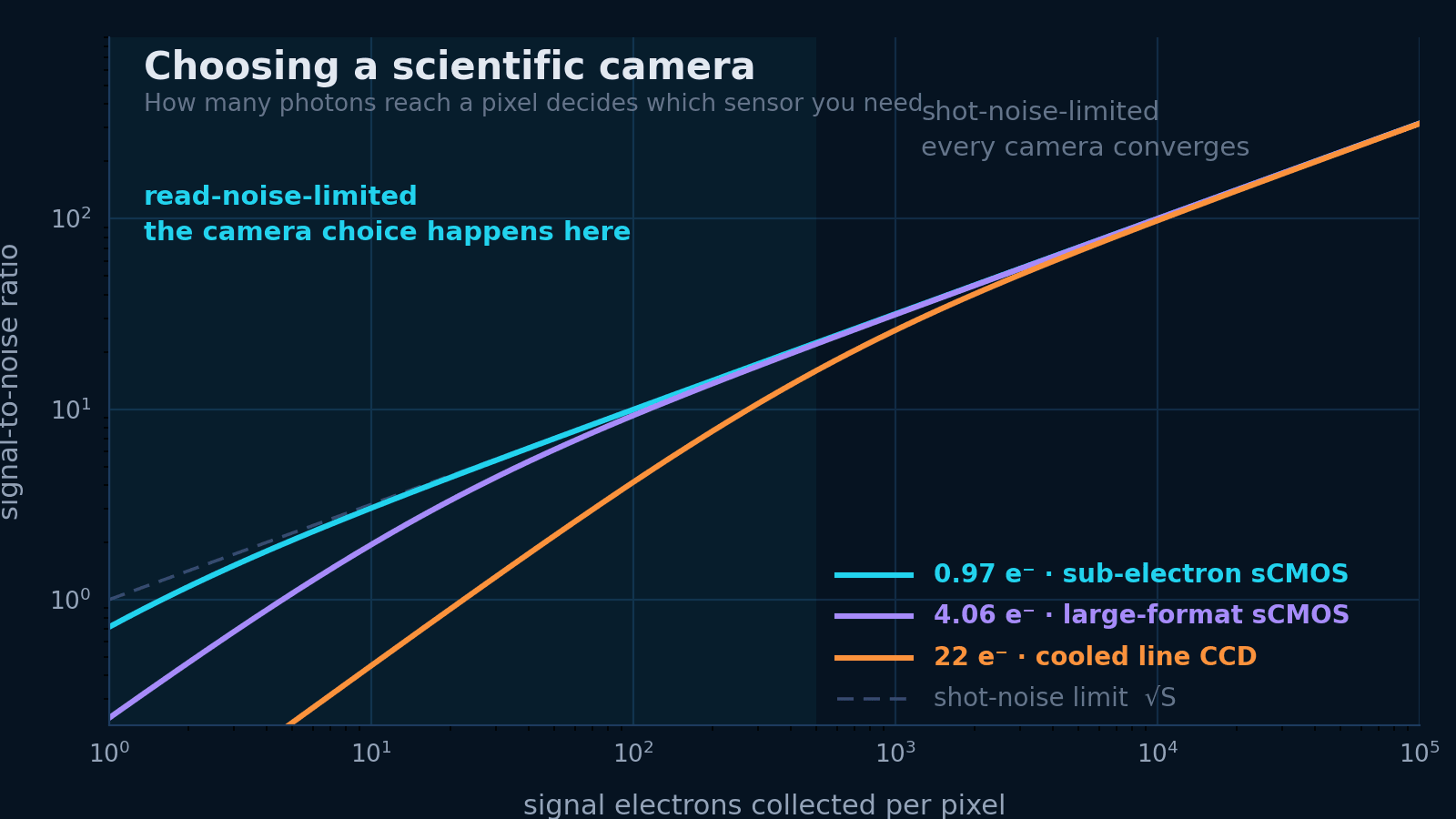
Choosing a scientific camera
Which sensor technology your photon budget actually needs, why rolling and global shutter answer different questions, and how to check the data can leave the camera at all.
Open guide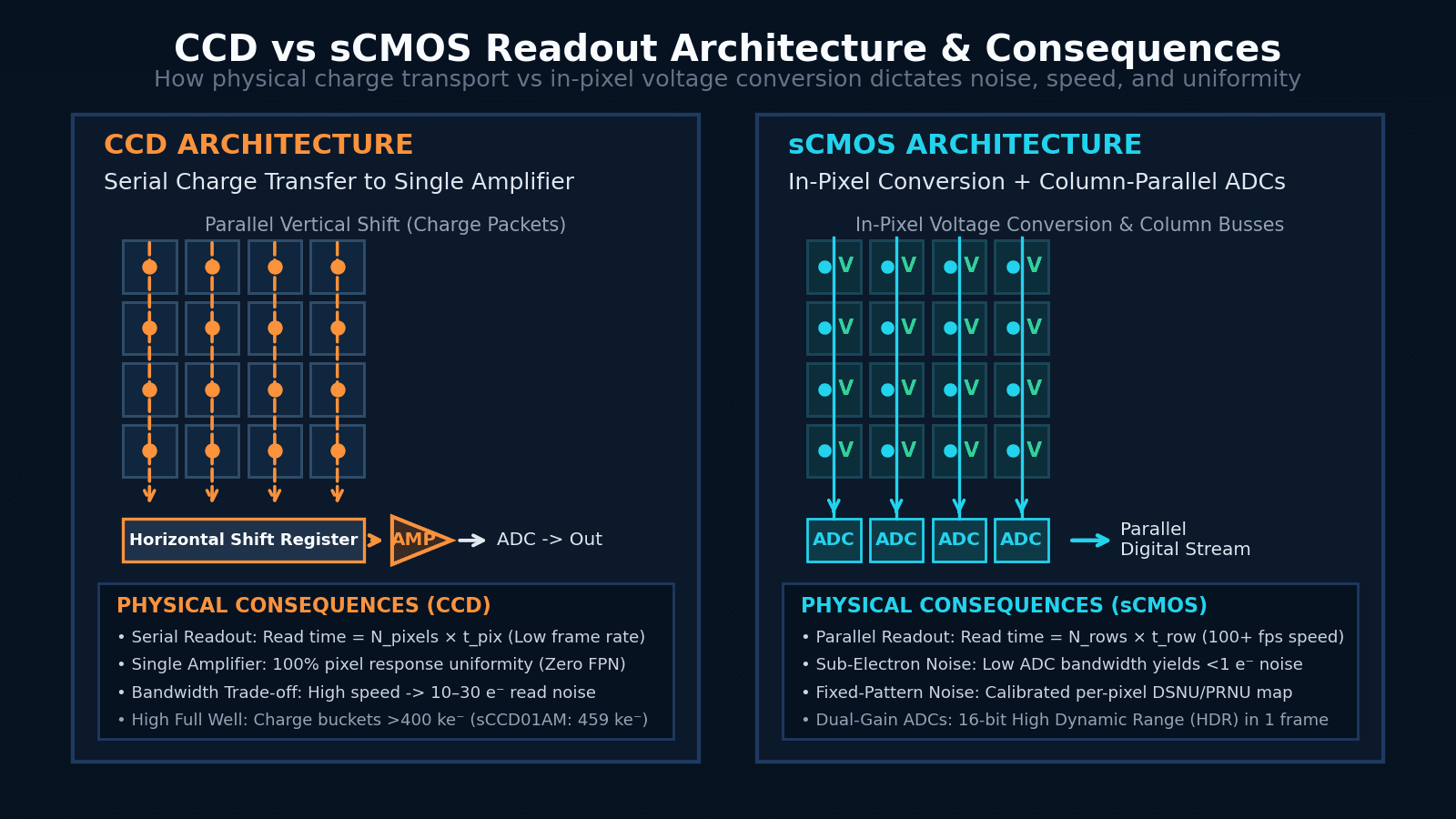 Scientific cameras
CCD vs CMOS: Readout Architectures & Physics
How physical charge transport versus in-pixel voltage conversion dictates readout speed, read noise, blooming, fill factor, and fixed-pattern noise in scientific detectors.
Open guide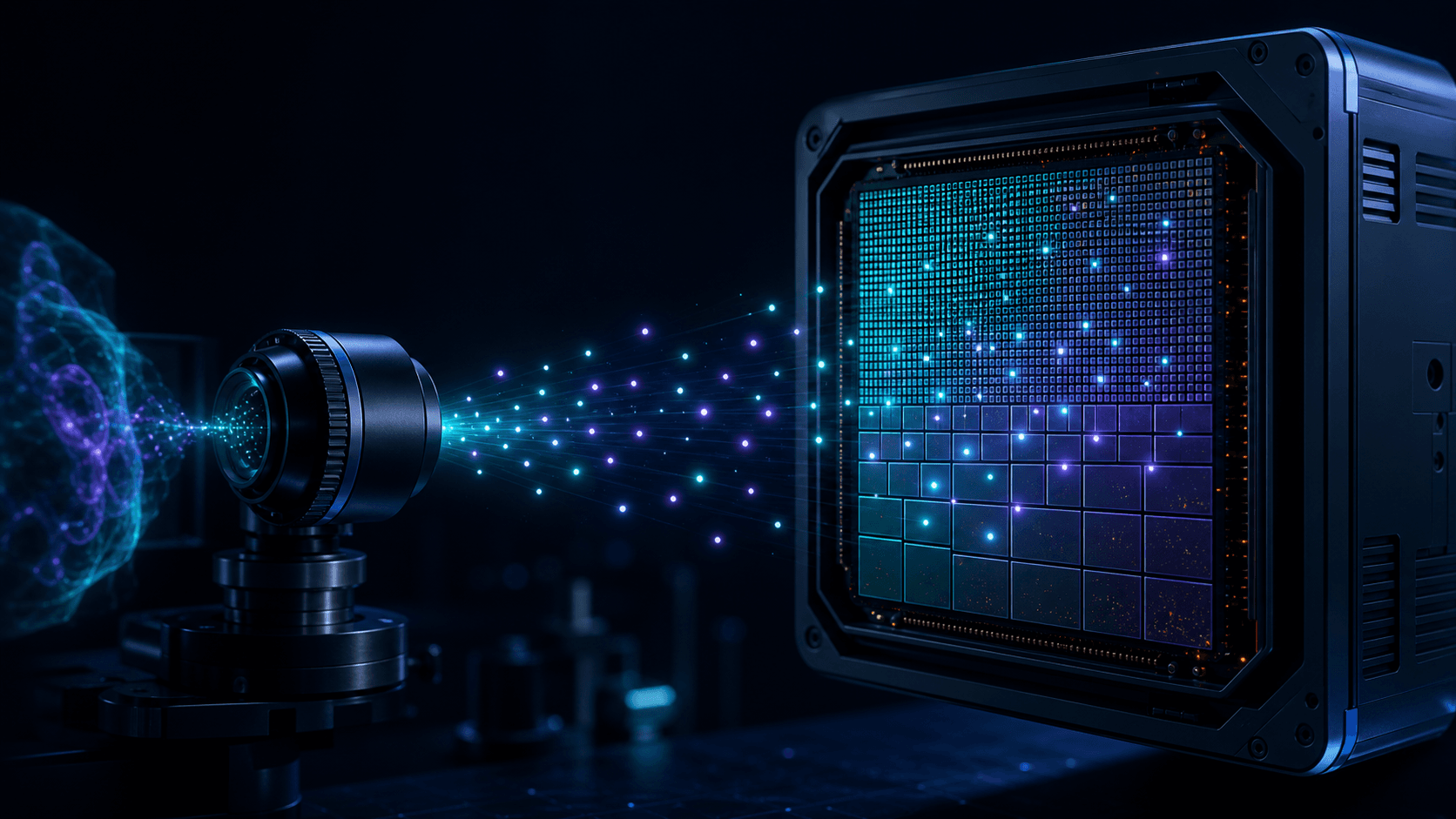 Scientific cameras
How to select an sCMOS camera
Understand quantum efficiency, read noise, pixel size, SNR, and optical sampling using real MAX and sMAX specifications.
Open guide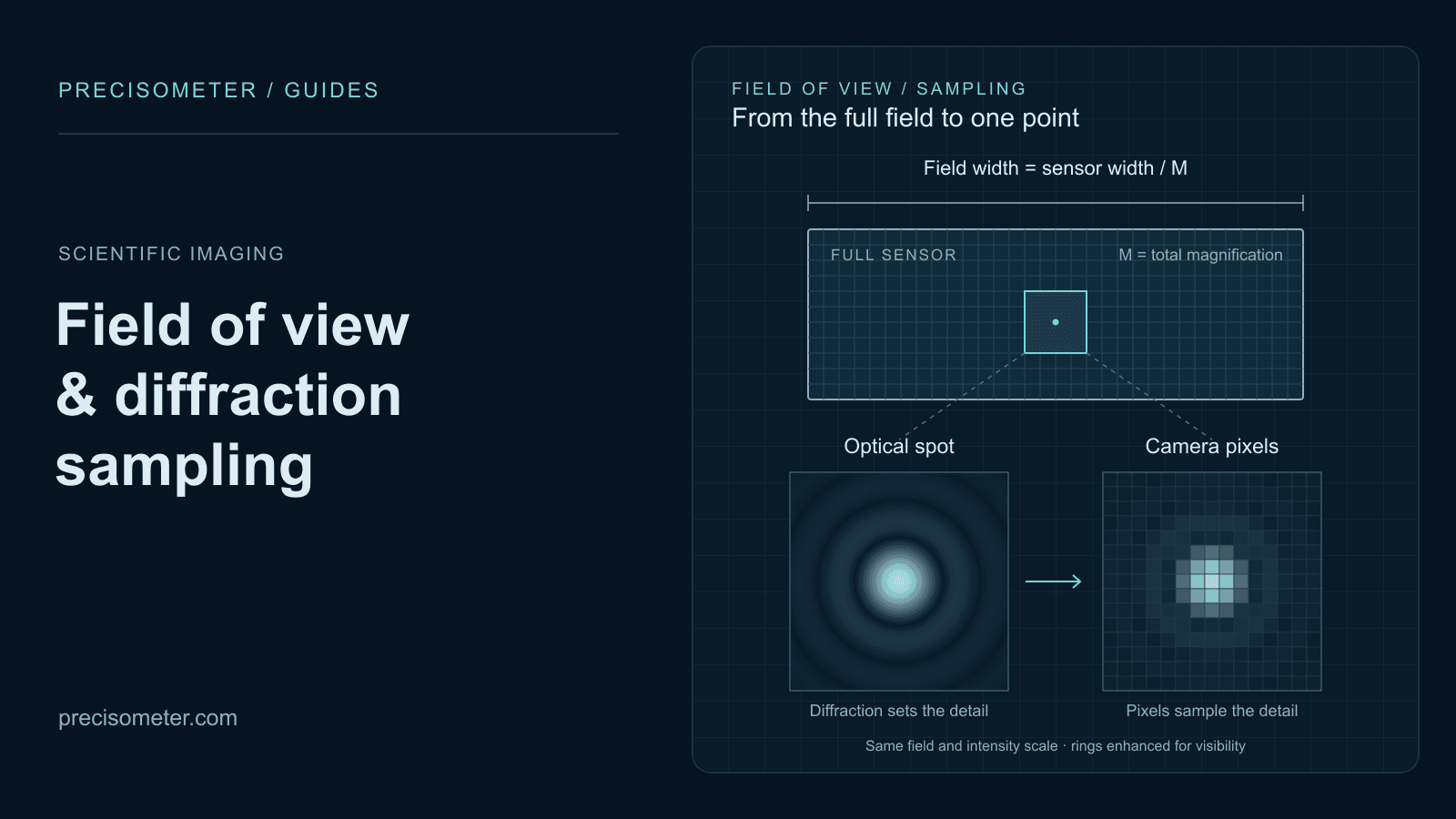 Scientific imaging
Calculating camera field of view and diffraction sampling
Calculate object-space pixel size, field of view, Rayleigh resolution, and sampling using real MAX and sMAX sensor formats.
Open guide