Back to Home
← All guides

Agricultural lasers · 18 min

How to choose a laser for weed control

You are not burning the weed. You are depositing a few joules into a growing point smaller than a grain of rice, through tissue that absorbs your wavelength either very well or hardly at all. Which one you picked decides everything downstream.

Wavelength vs absorberDose by growth stageHectares per hourBeam deliveryClass 4 safety

Start here

Burning the leaf is pruning. You have to reach the meristem.

A weed that has been scorched across its leaves looks convincingly dead for about four days. Then it regrows, because the apical meristem — a few hundred micrometres of dividing tissue at the shoot tip — was never heated above the temperature at which its proteins denature. Every serious result in the laser-weeding literature is about getting energy into that structure, and almost every disappointing field trial is about failing to.

That reframes the whole specification. The question is not how many watts will burn a plant; it is how much energy arrives inside the first millimetre of tissue at the growing point, which depends on how strongly your wavelength is absorbed there and how much of it bounced off the surface first. A 500 W fibre laser at 1080 nm can deliver less useful dose than a 50 W blue diode, because a green leaf reflects nearly half the near-infrared and lets most of the rest pass straight through.

And once the coupling is right, the constraint moves again — this time off the laser entirely. At cotyledon stage the beam-on time is tens of milliseconds, while finding the plant and aiming at it takes just as long. Beyond a modest power, you are buying vision latency and scanner speed, not watts.

The four things that decide the design

Only one of them is the laser.

The target is the meristem, not the leaf

Burning foliage prunes a weed; it does not kill it. Control requires enough energy at the apical meristem — the growing point — to denature it. This single fact explains why laser weeding works well on small broadleaf seedlings with an exposed shoot tip and works badly on grasses, whose growing point sits at or below the soil surface behind leaf sheaths where no beam reaches.

Wavelength is a choice of absorber

Plant tissue is water and pigment. Water absorbs in the mid-infrared and is nearly transparent in the visible; chlorophyll does the opposite. Around one micrometre neither absorbs much, which is why a 1080 nm fibre laser — the cheapest high power you can buy — is close to the worst choice for this job. Buy the wavelength your target actually absorbs.

Throughput is limited by targeting, not power

On a cotyledon-stage weed the beam may only need to dwell for tens of milliseconds. Detecting the plant, deciding it is a weed, slewing a galvo to it and letting the mirror settle takes just as long or longer. Past a modest power level, extra watts stop buying field capacity and faster vision and scanning start to.

It is a Class 4 beam in an open field

Hundreds of watts, pointed at the ground, on a moving vehicle, near people and animals, over dry material that burns. The hazard distance for an unterminated beam runs to hundreds of metres. This is not a footnote to the design — enclosure, interlocking and beam termination are the design, and the laser is chosen partly to make them tractable.

The first decision

Six wavelengths, three absorbers, one bad idea.

Plant tissue is water plus pigment. Water absorbs in the mid-infrared, chlorophyll absorbs in the blue and the red, and in the near-infrared gap between them neither does. Penetration depth is the 1/e distance over which energy is deposited — it decides whether you ablate a surface or heat a volume.

WavelengthWhat absorbs itPenetrationUseful couplingDeliveryVerdict
450 nm blueChlorophyll — Soret band~100 µmExcellent (~90 %)Fibre, 200–600 µm coreThe best coupling available on a fibre, at the lowest cost per watt. The penalty is that it is visible and retinal-hazard, which makes the safety engineering harder.
660 nm redChlorophyll — Q band~110 µmExcellent (~85 %)Free-spaceAlmost identical coupling to blue. Mostly available as Q-switched heads, which swap thermal damage for pulsed ablation — a different mechanism with different dose behaviour.
1080 nm fibreNeither, effectively~1 cmPoor (~5 %)FibreThe cheapest kilowatts and the worst match. Chlorophyll has stopped absorbing, water has not started, and a green leaf reflects nearly half of it straight back. Avoid unless you are cutting rather than heating.
1470 nm diodeWater~550 µmGood (~60 %)Fibre, 200–400 µm coreThe cheapest entry into the water bands, and the deposition depth is a good match to a seedling growing point. Retina-safe classification shortens the hazard distance by a factor of six.
1940 nm thuliumWater — strong band~105 µmExcellent (~90 %)Fibre or collimatorCO₂-like coupling that still travels down a fibre, plus the corneal-absorption safety band. The most interesting technical option on this list if fibre delivery matters to your machine.
10.6 µm CO₂Water — very strong~15 µmExcellent (~95 %)Mirrors and ZnSe opticsWhat every commercial laser weeder currently uses. Superb at severing a stem; reaches anything below the surface only by conduction. No fibre — the delivery path is mirrors, a galvo head and a ZnSe f-theta lens.

Penetration depths are computed from tabulated water absorption and published leaf optical properties, then treated as an effective attenuation in green tissue. Coupling combines surface reflectance with absorption in the first millimetre. Both are modelling estimates for comparing options, not measurements on your species in your conditions.

Interactive

Turn watts into hectares per hour.

This is the calculation that decides whether a machine is viable, and it almost never comes out where people expect. Set your wavelength, growth stage and channel count, then watch what happens to field capacity when you push the power up — and what happens when you cut the targeting overhead instead.

Dose and throughput lab

From watts to hectares per hour

Power alone tells you almost nothing. Coupling decides how much of it reaches the growing point, growth stage decides how much is needed, and the targeting overhead decides how often you can do it. Field capacity is what falls out.

Source and wavelength

Sits on a strong water absorption band, so it couples into wet tissue almost as efficiently as a CO₂ laser while still travelling down a fibre. The closest functional substitute in this catalogue for what commercial laser weeders use.

Growth stage

Still comfortable. Most published trials achieve reliable control here.

Weed habit

The apical meristem sits above ground at the shoot tip, where a beam can reach it. This is the case laser weeding was designed for.

50 W

Catalogue fibre-coupled heads run from a few watts to several hundred.

3 mm

Smaller spots raise irradiance but demand proportionally better targeting.

80 ms

Detection, galvo slew and settle. On small weeds this dominates the cycle.

Commercial implements parallelise heavily — this is the main throughput lever.

20 plants/m²

Field capacity is inversely proportional to this.

2 m

Wider covers more ground but needs proportionally more channels.

Useful coupling

90 %

Absorber: Water

Penetration depth

105 µm

1/e depth of energy deposition

Energy to deliver

8.9 J

8 J absorbed at the meristem

Irradiance at the spot

707 W/cm²

3 mm spot

Exposure per weed

178 ms

Beam-on time only

Cycle per weed

258 ms

31 % of it is overhead

Field capacity with 4 channels

0.28 ha/h

Weeds treated

16/s

all channels together

Forward speed

1.4 km/h

to keep up with arriving weeds

Optical energy

0.49 kWh/ha

beam only, excludes vehicle and cooling

What this configuration is telling you

A workable configuration. Note where the energy actually goes: at 0.49 kWh per hectare the beam itself is nearly free — the cost of laser weeding is time, targeting hardware and the vehicle carrying it, not the photons.

Dose figures are order-of-magnitude values consistent with the published CO₂ laser-weeding trials and vary widely with species, moisture, temperature and time of day; treat them as a starting point for your own trials rather than a specification. Coupling is modelled as surface reflectance followed by exponential attenuation over the first millimetre of tissue, which ignores scattering and the fact that a real seedling is neither flat nor uniformly wet. Field capacity assumes every weed is detected and reachable, so it is an upper bound.

The second decision

Scanned beam, or moved machine?

There are two architectures, and the choice drives cost, mass and reliability far more than the laser specification does.

Galvo scanning

One source covers a whole scan field, hopping between targets in milliseconds. Highest throughput per laser and the standard commercial approach. The cost is a scan head, an f-theta lens matched to your wavelength, a calibration between camera and scanner coordinates that has to survive vibration, and a moving mirror assembly outdoors.

Fixed head per row

The implement positions the beam. No scanner, no f-theta, no camera-to-galvo calibration — and no single point of failure that takes the whole boom out. Works when the weeds are in known positions relative to the row and the vehicle can index over them. Cheaper and far more robust; less flexible when weed distribution is irregular.

Spot size follows targeting

d_spot ≳ 2 × σ_targeting

Irradiance falls as the square of spot diameter, so a tight spot is tempting. But a spot smaller than twice your combined targeting error — vision, calibration, scanner, vehicle motion — starts missing. Fix the error budget first; the spot size falls out of it.

The latency budget nobody costs

On a machine moving at 1 m/s, every 10 ms of pipeline latency is 10 mm of ground travel — several times your spot diameter. Camera exposure, readout, inference, coordinate transform, scanner slew and settle all add up, and the target has moved by the time the beam arrives unless the system predicts forward. This is why global-shutter cameras and deterministic timing matter more here than raw sensor quality, and why the vision chain deserves as much specification effort as the laser.

Interactive · safety

How far the hazard reaches.

Wavelength changes the exposure limit by roughly a factor of forty between the visible and the water-absorbing bands, and the hazard distance by about a factor of six. Both are worth having. Neither is remotely enough on its own — which is the point this panel is built to make.

Hazard distance lab

How far an unterminated beam stays dangerous

A field machine points a Class 4 beam at the ground in the open air. The nominal ocular hazard distance is how far away someone can still be injured by it, and it is the number that decides whether your design is a skirt or a sealed enclosure.

Wavelength band

Same corneal absorption, same 1000 W/m² planning limit. This is the strongest safety argument for the water-absorbing wavelengths, and it shortens the hazard distance by roughly a factor of six against a visible beam.

50 W

Per channel, at the output of the delivery optics.

7 mm

A larger exit aperture spreads the same power and shortens the hazard distance.

2 mrad

A focusing head that diverges rapidly past the working plane is a genuine safety feature, not just an optical one.

Nominal ocular hazard distance

123 m

Beyond this distance the beam has spread below the planning exposure limit. Inside it, an unprotected eye can be injured — including from a specular reflection off a wet leaf, a stone, an irrigation pipe or a machine surface, which is why the hazard zone is not simply the cone in front of the head.

Planning MPE

1000 W/m²

corneal absorption band

Irradiance at the aperture

1299 kW/m²

1,299× the MPE

Beam at a 1 m skirt

9 mm

size a guard against this

The conclusion this lab is built to reach

Move the wavelength selector through all four bands at the same power. The hazard distance changes by roughly a factor of six — real, worth having, and nowhere near enough. At 50 W the beam is still 1,299 times over the exposure limit where it leaves the head.

No wavelength choice makes an open beam safe at these powers. Every workable field machine terminates the beam mechanically — full skirts to the soil, interlocked guards, beam-block detection, tilt and lift cut-outs, and an enclosure that keeps the working zone inaccessible while the laser can fire. Choose the water-absorbing band because it shortens the distance your engineering controls have to cover, not because it removes the need for them.

Simplified planning figures only. Real exposure limits depend on exposure duration, pulse structure, apparent source size, wavelength within the band and repeated-exposure corrections, and a machine that fires repeatedly at a scanned pattern is not the simple CW case modelled here. Fire risk in dry crop residue is a separate hazard that this panel does not address at all. A formal classification and hazard analysis to IEC 60825-1 by a qualified laser safety officer is mandatory before any field trial.

Configurations we supply

Three architectures that actually get built.

These are configured for the application rather than sold as bare heads, so the specifications below are the shape of the system rather than a fixed part number. Tell us the crop, the growth stage and the working width and we will size the rest.

CO₂ scanning weeding head

The industry-standard configuration Industry standard
  • 10.6 µm
  • 60–150 W typical
  • Galvo + ZnSe f-theta
  • RF-excited sealed tube

The configuration every commercial laser weeder on the market is built around, and the one with the most field evidence behind it. Water absorbs 10.6 µm so strongly that essentially all the energy lands in the first few tens of micrometres, which makes it very efficient at severing a seedling stem. Delivery is mirrors rather than fibre — a galvo scan head with ZnSe optics — so the optical path is a mechanical design problem as much as an optical one, and the head has to travel with the beam. Specify the power against your target growth stage and the number of heads against your target field capacity.

450 nm 100 W scanning head

Fibre-fed galvo system
  • 450 nm
  • 100 W
  • Galvo scan head + f-theta
  • Fibre-fed, 200–600 µm core

A hundred watts of blue delivered down a fibre into a galvo scan head. Blue couples into chlorophyll about as efficiently as CO₂ couples into water, and because the source is fibre-coupled you can put the laser in the vehicle body and only the scan head on the boom — a real mechanical advantage over a CO₂ path that has to fold mirrors all the way. The trade is safety class: 450 nm is a visible retinal hazard, so the enclosure and interlocking have to cover a longer hazard distance than an equivalent infrared system.

200 W fibre-coupled source

Static beam, no scanner
  • 450 nm
  • 200 W
  • Fibre-coupled, SMA905 / QBH
  • No scanner

Where the machine positions the beam rather than the beam positioning itself — a fixed head per crop row, an implement that indexes mechanically, or a rig where a robot arm does the aiming. Removing the galvo removes cost, mass, alignment and a failure mode, and for a row-following implement with a modest weed density it can be the better architecture. Two hundred watts also gives you the headroom to work later in the growth stage, where dose requirements climb steeply.

We have done this before

We have hands-on experience with laser weeding systems.

This is not a catalogue page written from a datasheet. We have worked on thermal weed control directly — source selection, beam delivery, scanning and targeting hardware, and the safety engineering that has to wrap around all of it — and we can tell you early which parts of a concept will work and which will quietly fail in a field.

If you are scoping a machine, running trials, or trying to work out whether the economics close for your crop and growth stage, send us the details. It is usually a short conversation that saves a long detour.

Catalogue sources

Bare heads, if you are integrating yourself.

Every figure below is from the model’s own specification sheet. Ordered by how well the wavelength couples into plant tissue rather than by price — including one that is on the list specifically to be argued against.

YL-I-450

Fibre-coupled blue, wide power range
  • 1–200 W
  • 450 nm
  • 200 / 400 / 600 µm core, 0.22 NA
  • TTL and analog, DC–30 kHz

The most useful single line in the catalogue for this application: fibre-coupled blue across the whole power range you would plausibly want, with SMA905 termination and modulation options up to 30 kHz. The modulation matters more than it looks — gating the beam per weed is how you avoid dumping energy into bare soil between targets.

Full specifications

FC-W-445H-II

High-power blue, fully specified
  • 50–200 W
  • 445 nm
  • Water cooled
  • Stability <2 %, <1 %, <0.5 %

The documented high-power blue option, with power stability graded and the fibre interface published — 200, 400 or 600 µm core at 0.22 NA, SMA905, FC or QBH. Water cooling at this power is not optional, and on a field machine that is a real design constraint: a radiator, a pump and a coolant volume that has to survive vibration and frost.

Full specifications

FL-1940-CW

Thulium fibre, water absorption
  • 1–100 W
  • 1940 nm
  • M² < 1.5
  • Air cooled ≤30 W, water above

The technically most interesting alternative to CO₂ on this page. At 1940 nm water absorbs strongly enough to give near-CO₂ coupling, but the light still travels down a fibre and sits in the corneal-absorption band where the exposure limit is roughly forty times higher than in the visible. Air cooling up to 30 W is a genuine advantage on a vehicle.

Full specifications

FC-W-1908B

Fibre-coupled 1900 nm
  • 10–60 W
  • 1908 nm
  • 400 / 600 µm core, 0.22 NA
  • TTL or analog to 30 kHz

The same water-absorbing band as the thulium fibre laser, delivered as a fibre-coupled diode with SMA905 termination and a 2 m lead. Lower power, lower cost, and modulation to 30 kHz for per-weed gating. A sensible source for a first prototype before committing to a full-power architecture.

Full specifications

FC-W-1470H

Lowest-cost water band
  • 10–50 W
  • 1470 nm
  • Fibre-coupled system
  • Retina-safe band

The cheapest way into a water-absorbing wavelength. Coupling is lower than at 1940 nm because the absorption band is weaker, but the deposition depth of roughly half a millimetre is arguably a better match to a seedling meristem than CO₂ surface ablation. Good value for trials where you want to characterise dose before buying power.

Full specifications

FL-1080-CW

Highest power, worst coupling
  • 1–500 W
  • 1080 nm
  • Fibre laser
  • Cheapest per watt

Included as the honest counter-example. Half a kilowatt is available here for less than a hundred watts costs elsewhere on this page, and it is still the wrong tool: a green leaf reflects around 45 % of it and what enters is deposited over centimetres rather than micrometres. Consider it only for stem-cutting geometries where you genuinely want penetration, not surface heating.

Full specifications

The rest of the machine

The laser is the cheapest problem.

Grouped by subsystem, with the reason each belongs in an agricultural laser budget rather than a generic description.

Beam delivery and scanning

Everything between the source and the plant. This chain sets your spot size, your targeting speed, and whether the beam can be shut off fast enough between weeds.

  • F-theta scanning lens

    Keeps the focus flat across the scan field so the spot size at the edge matches the centre. Specify the coating for your wavelength — ZnSe for CO₂, fused silica for blue.

  • AOM and shutter

    Gates the beam between targets. Without it you paint a continuous burn line across the bed and waste most of the energy on soil.

  • Fibre couplers and collimators

    The interface that lets the source live in the vehicle and only the head travel on the boom. Not available for CO₂, which is a large part of why CO₂ machines look the way they do.

  • Beam expander

    Sets the spot at the working plane and, with it, the irradiance. It also controls how fast the beam diverges past the target, which is a safety parameter.

  • Precision optics

    Mirrors and windows rated for the power and the wavelength, and for an environment with dust, moisture and vibration.

  • Signal and pulse generator

    Synchronises detection, scanner position and beam gating. In a moving implement the timing between these three is the whole targeting problem.

One constraint that shapes the entire machine: CO₂ at 10.6 µm cannot be delivered down a conventional fibre. The source has to sit near the head, or the beam has to be folded there through mirrors that must stay aligned on a vibrating vehicle. Every fibre-deliverable wavelength on this page — 450 nm, 1470 nm, 1940 nm — buys you the freedom to put the heavy, hot, power-hungry part of the system somewhere convenient.

Detection and targeting

The laser is the easy half. Finding the weed, classifying it against the crop, and hitting a millimetre-scale target from a moving vehicle is where these machines are actually won or lost.

  • Scientific and machine-vision cameras

    Global shutter matters here: a rolling shutter on a moving implement skews the geometry you are about to aim at.

  • Camera selection finder

    Filter by frame rate, shutter type, resolution and interface against the ground speed and spot size you need to hit.

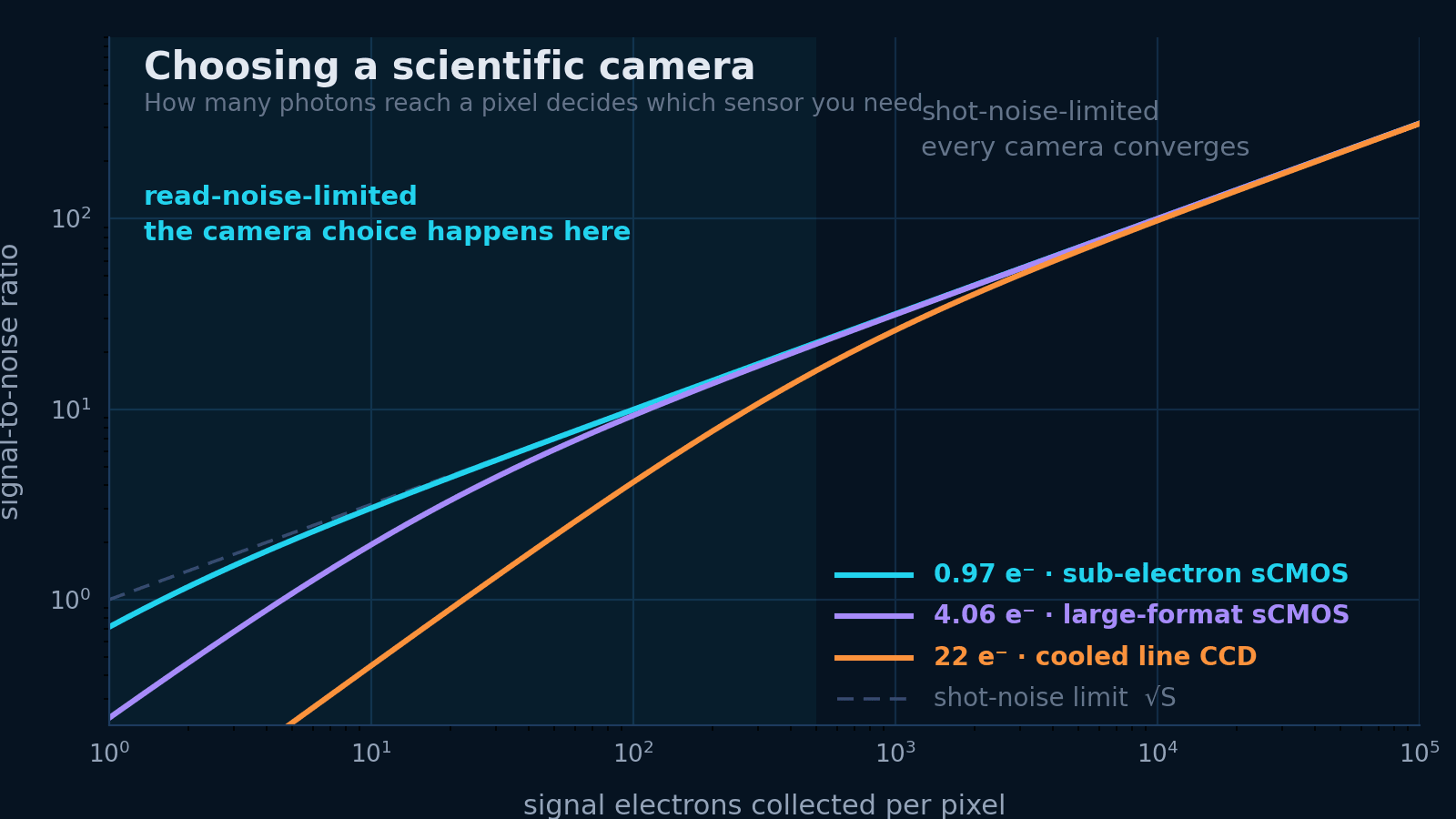
  • Choosing a scientific camera

    Sensor technology, shutter behaviour and whether the data can leave the camera fast enough for a real-time loop.

  • Field of view and sampling

    How many pixels you need across a cotyledon to classify it reliably, which sets the camera before it sets anything else.

Safety and enclosure

Not an accessory list — the part of the machine that makes it legal to operate. Budget for it from the start, because retrofitting containment onto a working prototype is how these projects stall.

  • Protective housing and enclosures

    Skirts to the soil, interlocked access panels, and a working zone that is physically inaccessible while the laser can fire.

  • Laser goggles

    Wavelength-specific and OD-rated for the actual power, for commissioning and service. Not a substitute for containment during operation.

  • Laser viewing card

    For aligning an invisible 1470 or 1940 nm beam during build and service, when the usual visual cues are absent.

  • Laser power supply

    Interlock-aware supplies with a defined behaviour on loss of enable, so a fault state is a dark state.

Three hazards specific to this application and absent from a laboratory analysis: fire in dry crop residue and stubble, which is a real operational limit on when the machine can run; specular reflection off wet leaves, stones, irrigation hardware and the machine itself, which means the hazard zone is not just the cone under the head; and animals and bystanders in an open field, who have neither training nor eyewear. All three belong in the hazard analysis before the first field trial.

Mechanics and integration

A boom on a vehicle is a worse optical bench than anything in a laboratory: it vibrates, it flexes, it gets hot, cold, wet and dusty, and it has to hold a millimetre-scale aim while doing it.

  • Optical cage system

    Rigid pre-aligned mounting for the delivery optics, with fewer degrees of freedom to shake loose.

  • Mirror mounts

    For a folded free-space path. Choose for vibration resistance and thermal stability over fine adjustment resolution.

  • Manual and motorised stages

    Height and standoff adjustment to keep the working plane at the focus as ground conditions change.

  • Heatsinks

    At 30–50 % wall-plug efficiency, a 200 W optical output is several hundred watts of heat to move on a vehicle with no mains supply.

The operating limit that is not on any datasheet.

A machine that deposits enough energy to denature plant tissue deposits enough energy to ignite dry crop residue. In stubble, in straw, in a dry season, that is not a theoretical risk — it is an operational constraint that decides which hours of which days the machine can run at all. Systems in the field carry residue sensing, moisture-dependent power limits, fire suppression, and in some conditions a simple prohibition on operating.

Budget for it in the specification and in the duty-cycle assumptions behind your business case. A field capacity of half a hectare per hour is worth much less if the machine is only permitted to work in the morning.

Common questions

The questions that decide the design.

What wavelength is best for laser weeding?

It depends on which absorber you want to target and how you need to deliver the beam. CO₂ at 10.6 µm has the strongest water absorption and the most field evidence, and it is what commercial machines use — but it cannot travel down a fibre, so the source has to be near the head. 450 nm blue couples into chlorophyll about as efficiently and is fibre-deliverable and cheap per watt, at the cost of being a visible retinal hazard. 1940 nm thulium is the interesting middle path: near-CO₂ coupling into water, fibre delivery, and a corneal-absorption safety band with an exposure limit roughly forty times higher than the visible. The one wavelength to avoid is around 1064–1080 nm, where neither water nor chlorophyll absorbs much and a green leaf reflects nearly half the beam.

How much energy does it take to kill a weed?

Roughly a few joules at the cotyledon stage, tens of joules by the four-leaf stage, and hundreds of joules once a plant is established — absorbed at the growing point, not delivered at the aperture. The steepness of that curve is the central economic fact of laser weeding: treat weeds early and the energy is trivial, treat them late and no plausible amount of laser power makes the throughput work. Published figures vary widely by species, moisture and conditions, so treat any number including ours as a starting point for your own trials.

Does laser weeding work on grasses?

Much less well than on broadleaf weeds, and this is the most important agronomic limitation of the technique. A dicot carries its apical meristem at the shoot tip where a beam can reach it. A monocot keeps its growing point at or below the soil surface, wrapped in leaf sheaths. You can burn the visible foliage off a grass weed completely and watch it regrow from an untouched meristem. Any supplier claim about grass control deserves specific trial data on the species and growth stage you actually have.

How many watts do I need?

Less than most people expect, and it is usually the wrong question. At the cotyledon stage a well-coupled 50 W source delivers the required dose in tens of milliseconds — but detecting the plant, classifying it and slewing a galvo onto it takes just as long. Past a modest power level the machine is targeting-limited, and extra watts buy nothing. The productive questions are how many parallel channels you can afford, how fast your vision pipeline is, and how early in the season you can get onto the field.

Can the laser be delivered through a fibre?

At 450 nm, 1470 nm and 1940 nm, yes — typically 200 to 600 µm core at 0.22 NA with SMA905 or QBH termination. At 10.6 µm, not through conventional fibre; CO₂ systems fold the beam through mirrors to a galvo head with ZnSe optics. This is a bigger architectural difference than it sounds. Fibre delivery lets you put the laser, its power supply and its cooling in the vehicle body and run only a lightweight scan head on the boom, which changes the mass, the alignment stability and the serviceability of the whole machine.

What are the safety requirements for a field laser weeder?

It is a Class 4 system operating outdoors around untrained people and animals, so the controls have to be engineering controls rather than procedural ones. In practice that means the beam is fully terminated by the machine: skirts sealing to the soil, interlocked panels, tilt and lift cut-outs that kill the emission if the enclosure lifts off the ground, and a working zone that is inaccessible while the laser can fire. Add fire risk in dry residue and specular reflection off wet leaves and stones, both of which are specific to this application. A formal classification and hazard analysis to IEC 60825-1 by a qualified laser safety officer is mandatory before any field trial, and choosing a corneal-absorption wavelength shortens the distance your controls must cover without removing the need for them.

Is laser weeding energy-efficient compared with spraying or tillage?

The optical energy is almost negligible — treating a dense stand of cotyledon-stage weeds costs a fraction of a kilowatt-hour per hectare in photons. The real energy cost is everything around the beam: wall-plug efficiency of 10 % for CO₂ or 30–50 % for diodes, the cooling that removes the rest, the compute running the vision pipeline, and above all the vehicle moving slowly across the field for a long time. Laser weeding competes on chemical-free control and on selectivity, not on energy.

What spot size should I use?

Large enough that your targeting error does not cause misses, and no larger. Irradiance falls as the square of the spot diameter, so doubling the spot quarters the intensity and quadruples the dwell time for the same effect. A useful starting rule is a spot at least twice your total targeting error — vision, calibration, scanner and vehicle motion combined — which for a typical implement puts you in the 2–5 mm range. Tighter spots are only worth chasing once the targeting chain can actually justify them.

Primary sources

Tell us the crop and the timing. We will size the laser.

Crop, weed species, growth stage at treatment, density, working width and platform power are enough for us to work back to a wavelength, a power per channel, a channel count and a delivery architecture — plus an honest answer on whether the field capacity you need is reachable at all.

  • Wavelength chosen for what the tissue absorbs
  • Throughput modelled before anything is ordered
  • Safety engineering scoped from the start