Back to Home
Laser Goggles

Laser components & accessories

Laser Goggles

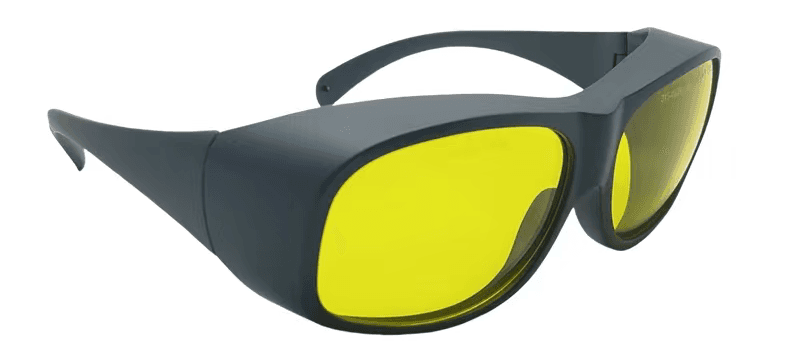
Laser Goggles is a configurable laser safety component in the Laser components and accessories family. The final part number should be released only after the optical, mechanical, electrical and environmental fields below are matched to the intended instrument.

Laser Goggles

Laser Goggles
1 . Protect wavelength: 180-540nm ; Typical wavelength: 266nm, 355nm, 405nm, 450nm, 532nm, etc. Application: excimer, ultraviolet, green laser protection.
LS-G: VLT=40%, OD5+ for 180-540nm, LB-Rating (EN 207): DIRM LB5 for 315-540nmLS-G-2: VLT=25%, OD7+ for 180-534nm (High protection), LB-Rating (EN 207): DIRM LB6 for 315-534nm
LS-G-3: T<1%, OD4+ Economical!
2. Protect wavelength: 200-460nm ; Typical wavelength: 450nm, etc. Application: UV, violet, blue laser protection.
LS-V: VLT=79%, OD5+ for 200-460nm, LB-Rating (EN 207): DIR LB5 for 315-460nm
3. Protect wavelength: 180-534nm & 740-1100nm ; Typical wavelength: 532 & 808 & 1064nm, etc . Application: ND:YAG and frequency doubling ND:YAG laser protection.
LS-GI: VLT=22%, OD5+ for 180-532nm, OD5+ for 900-1080nm. LB-Rating (EN 207): DIR LB5 + M LB5 for 316-532nm, DIR LB5 for 900-1080nm.LS-GI-2: VLT=20%, OD6+ for 180-534nm, OD5+ for 800-1100nm, OD6+ for 900-1095nm. LB-Rating (EN 207): DIRM LB6 for 315-534nm, DIR LB5 for 800-1100nm, DIRM LB6 for 900-1095nm
LS-GI-3: VLT=13%, OD7+ for 180-534nm, OD5+ for 740-1100nm, OD7+ for 900-1095nm. LB-Rating (EN 207): DIRM LB6 for 315-534nm, DIRM LB5 for 740-1100nm, D LB6 + IRM LB7 for 900-1095nm
4. Protect wavelength: 620-700nm ; Typical wavelength: 635nm, 650nm, 694nm, etc. Application: ruby, red laser protection.
LS-R: VLT=50%, OD4+ for 620-700nm. LB-Rating (EN 207): DIR LB4 for 620-700nmLS-R-2: VLT=25%, OD6+ for 620-700nm. (High protection) LB-Rating (EN 207): DIR LB5 for 620-700nm
5 . Protect wavelength: 560-600nm ; Typical wavelength: 561nm, 577nm, 585nm, 595nm, etc. Application: Pulsed-dye laser, yellow laser protection.
LS-DH: VLT=18%, OD4+ for 585-595nm, LB-Rating (EN 207): DIR LB4 for 585-595nmLS-DH-2: VLT=7%, OD6+ for 560-600nm, LB-Rating (EN 207): DIR LB5 for 560-600nm
6. Protect wavelength: 200-450nm & 630-660nm & 800-1100nm ; Typical wavelength: 635nm, 808nm, 980nm, etc. Application: red laser, 808 & 980 nm diode laser protection.
LS-RI: VLT=30%, OD3+ for 630-660nm, OD5+ for 800-830nm. LB-Rating (EN 207): DIR LB3 for 630-660nm, DIR LB5 for 800-830nm.LS-RI-2: VLT=35%, OD2+ for 630-660nm, OD5+ for 800-1100nm. LB-Rating (EN 207): DIR LB2 for 630-660nm, DIR LB5 for 800-1100nm.
LS-RI-3: VLT=25%, OD3+ for 630-660nm, OD3+ for 800-830nm, OD5+ for 900-1100nm. LB-Rating (EN 207): DIR LB3 for 630-660nm, DIR LB3 for 800-830nm, DIR LB5 for 900-1100nm.LS-RI-4: VLT=18%, OD4+ for 200-450nm, OD4+ for 630-660nm, OD6+ for 800-1100nm. LB-Rating (EN 207): D LB5 + IR LB6 for 316-440nm, DIR LB4 for 440-450nm, DIR LB4 for 630-660nm, DIR LB6 for 800-1080nm
7. Protect wavelength: 740-850nm ; Typical wavelength: 755nm, 808nm, etc. Application: alexandrite, 808 nm diode lasers protection.
LS-AT: VLT=35%, OD5+ for 740-850nm, OD6+ for 780-830nm. LB-Rating (EN 207): DIR LB5 for 740-850nm, DIR LB6 for 780-830nm.
8. Protect wavelength: 720-1100nm ; Typical wavelength: 755nm, 808nm, 1064nm, etc. Application: alexandrite, 808 & 980 nm diode lasers, ND:YAG laser protection.
LS-AD: VLT=33%, OD5+ for 740-780nm, OD6+ for 780-820nm. OD7+ for 820-1100nm. LB-Rating (EN 207): DIR LB5 for 740-780nm, D LB5+ IR LB6 for 780-820nm, D LB5+ IR LB7 for 820-1080nm.LS-AD-2: VLT=25%, OD5+ for 720-1100nm, (High protection) OD7+ for 750-1100nm. LB-Rating (EN 207): DIRM LB5 for 720-1100nm, D LB6+ IRM LB7 for750-1100nm.
LS-AD-3: VLT=31%, OD8+ for 900-1100nm, (High protection) LB-Rating (EN 207): D LB6+ IR LB8 for 900-1100nm.LS-AD-3 DIN4: VLT=6%, OD8+ DIN4 for 900-1100nm, (High protection) LB-Rating (EN 207): D LB6+ IR LB8 for 900-1100nm.
9. Protect wavelength: 800-1700nm ; Typical wavelength: 755nm, 808nm, 980nm, 1064nm, 1470nm, etc. Application: alexandrite, 808 & 980 nm diode lasers, ND:YAG laser protection.
LS-DT: VLT=18%, OD4+ for 800-1700nm OD6+ for 900-1550nm LB-Rating (EN 207): DIRM LB4 for 800-1400nm, DIRM LB6 for 900-1400nm, DI LB3 for 1400-1700nm.
10 . Protect wavelength: 660nm & 800-1100nm ; Typical wavelength: 808nm, 980nm, 1064nm, etc. Application: diode lasers, dental lasers, ND:YAG laser protection.
LS-IR-HP: VLT=43%, OD1+ for 660nm, OD5+ for 800-1095nm. LB-Rating (EN 207): DIR LB1 for 660nm, DI LB5+ R LB5 for 800-1095nm.LS-IR-HP-2: VLT=41%, OD6+ for 800-900nm, OD7+ for 900-1100nm. LB-Rating (EN 207): D LB5+ IR LB6 for 800-900nm, D LB5+ IR LB7 for 900-1080nm.
LS-IR-HP-3: VLT=65%, OD4+ for 800-1100nm, OD5+ for 830-980nm, OD7+ for 1000-1095nm. LB-Rating (EN 207): DIR LB4 for 800-1100nm, DIR LB5 for 830-980nm, D LB5+ IR LB7 for 1000-1095nm.LS-IR-HP-2 DIN4: VLT=8%, OD6+ for 800-900nm, OD7+ DIN4 for 900-1100nm. LB-Rating (EN 207): D LB5+ IR LB6 for 800-900nm, D LB5+ IR LB7 for 900-1080nm
11 . Protect wavelength: 1900-3000nm ; Typical wavelength: 2100nm, etc. Application: Holmium laser, thulium laser protection.
LS-HO: VLT=55%, OD4+ for 1900-3000nm, OD5+ for 2000-2300nm. LB-Rating (EN 207): DI LB3 for 1900-3000nm.
12. Protect wavelength: 2700-3000nm ; Typical wavelength: 2940nm, etc. Application: Er laser protection.
LS-ER: VLT=87%, OD6+ for 2700-3000nm. LB-Rating (EN 207): DI LB3 for 2940nm.
13. Protect wavelength: 9000-11000nm ; Typical wavelength: 10600nm (10.6um), etc. Application: CO ₂ laser protection.
LS-C: VLT=83%, OD6+ for 9000-11000nm. LB-Rating (EN 207): DI LB3 for 10600nm.
14. Protect wavelength: 200-1800nm ; Specially designed for IPL machine.
LS-UI: VLT=~10% Executive standard: CE EN169LS-UI-2: VLT=~2% Executive standard: CE EN169
15. Protect wavelength: 740-1150nm & 1010-1550nm & 1550-2300nm & 2850-11000nm ; Specially designed for absorbent glass sheet.
LS-GIR: VLT=50%, OD7+ for 740-900nm, OD8+ for 900-1150nm. LB-Rating (EN 207): D LB6+ IR LB7 for 740-900nm, D LB6+ IR LB8 for 900-1150nm.LS-GIR-2: VLT=75%, OD4+ for 870-950nm, OD5+ for 950-1000nm, OD7+ for 1010-1550nm, OD5+ for 1550-2300nm, OD4+ for 2850-11000nm. LB-Rating (EN 207): DIR LB4 for 870-950nm, DIR LB5 for 950-1000nm, D LB6+ IR LB7 for 1010-1400nm, DI LB4 for 1400-2300nm& 2850-11000nm.
Note : VLT: Visible light transmittance (Ambient light), OD: Optical density (Protection value of lase r), T: Transmittance in the protective
wavelength range. Executive standard: CE EN207

Application context

Why this design is used

Application fit depends on the ordered configuration; catalog values are separated from fields that still require confirmation.

Enclosed laser workstations

Laser Goggles: A housing limits accessible emission only when joints, apertures, service panels and interlocks are assessed as one protective system.

Alignment and maintenance

Laser Goggles: Eyewear and procedural controls must address the reduced but still accessible wavelength and power conditions used during alignment.

Engineering reference

Specify Laser Goggles from the interfaces inward

Laser Goggles is a configurable laser safety component in the Laser components and accessories family. The final part number should be released only after the optical, mechanical, electrical and environmental fields below are matched to the intended instrument.

Laser safety hardware is selected from the documented hazard analysis. Wavelength coverage, optical density, accessible emission, interlocks, viewing requirements and the applicable safety standard must be evaluated for the complete system rather than inferred from color or enclosure appearance.

Selection guidance describes the engineering fields that must be checked. It does not assign an option-dependent value that is absent from the catalog record.

Configuration fields to confirm

Laser hazard
Provide every wavelength, output or pulse energy, pulse duration, repetition rate and beam diameter.
Required attenuation
Determine optical density and protection level from the documented exposure calculation.
Protected access
Identify direct, reflected and service-access beam paths and required viewing windows.
Interlock behavior
Define switch logic, monitored panels, reset behavior and safe state after power loss.
Fit and field of view
For eyewear, confirm fit, visibility and compatibility with prescription glasses; for housings, confirm access and ventilation.
Compliance record
Verify marking, test standard, wavelength range and traceable documentation for the exact configuration.

Qualification sequence

  1. 1Define the measurement objective and the performance limit that Laser Goggles must satisfy.
  2. 2Freeze wavelength, mechanical, fiber and electrical interfaces before selecting option codes.
  3. 3Check loss, noise, heat, motion or vibration contributions in the complete system budget.
  4. 4Confirm the final drawing, pinout, environmental suffix and acceptance test with the quotation.

Technical FAQ

Configuration questions for Laser Goggles

What must be specified before ordering Laser Goggles?

Confirm laser hazard, required attenuation, protected access, interlock behavior, fit and field of view, and compliance record. These fields are coupled, so the final part number should be checked against the complete instrument rather than selected from the model name alone.

How should Laser Goggles be integrated into the system?

Laser safety hardware is selected from the documented hazard analysis. Wavelength coverage, optical density, accessible emission, interlocks, viewing requirements and the applicable safety standard must be evaluated for the complete system rather than inferred from color or enclosure appearance. Freeze the optical, mechanical and electrical interfaces before releasing the surrounding assembly.

Which documentation should be approved for Laser Goggles?

Approve the configuration-specific specification, mechanical drawing, connector or pinout definition, environmental suffix and acceptance-test limits supplied with the quotation. Any field absent from the local record remains a confirmation item, not an assumed capability.