Back to Home

Spectroscopy instruments

Spectrographs &Monochromators

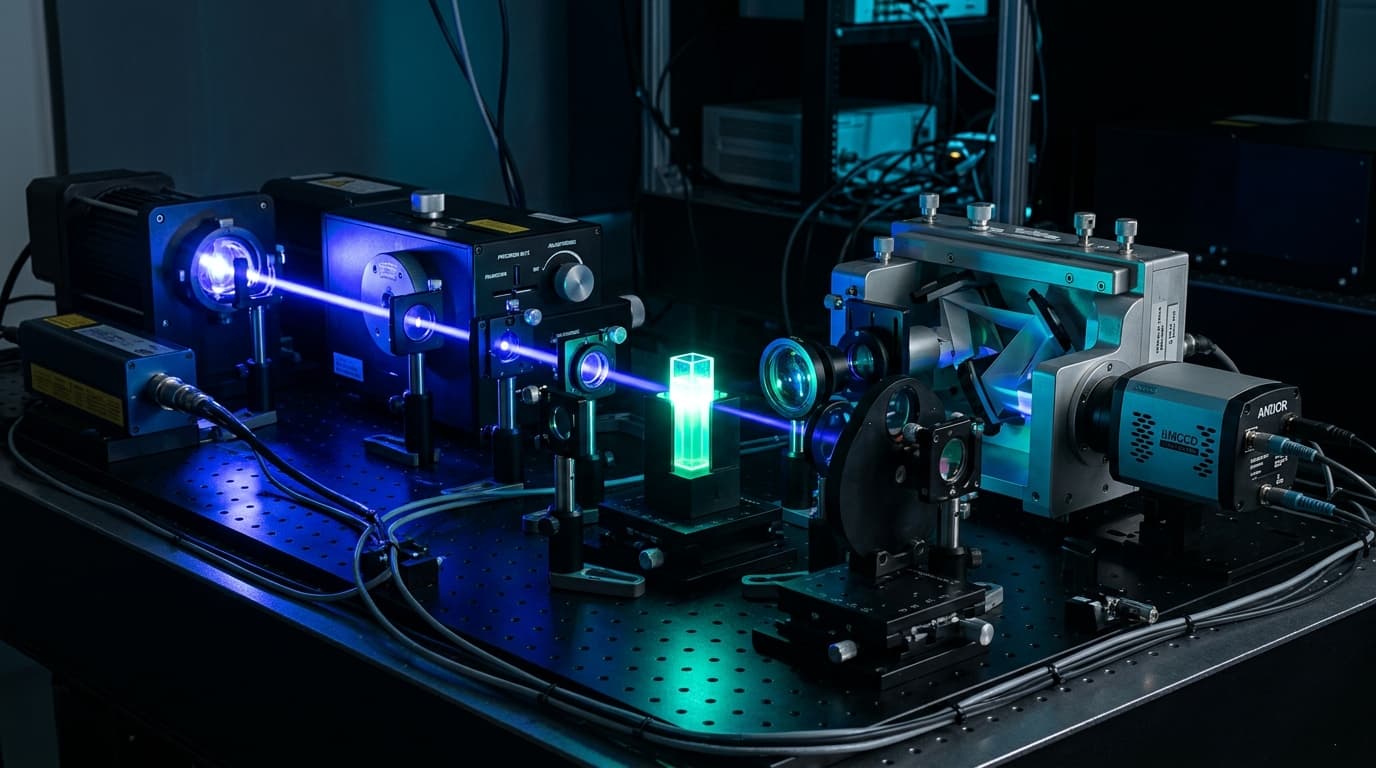
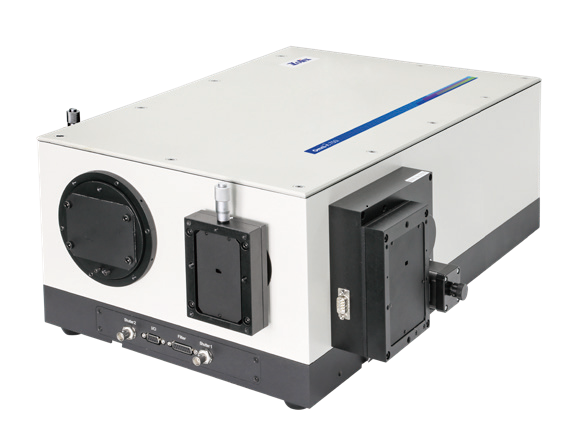
Czerny-Turner instruments from 200 to 750 mm, aberration-corrected imaging spectrographs, and the double and triple stages for work close to the laser line.

EntranceExit SlitCollimatorFocus MirrorGrating
Sweep grating angle:532 nm (Green)

Drag the grating. The exit wavelength follows.

Step 1 — Choose

Which spectrometer do you actually need?

Three questions. The answer names the model, shows the manufacturer figures behind it, and hands the choice straight to the port builder and the grating planner.

1. What are you measuring?
2. What matters more?
3. How close is the signal to an intense line?

Recommended

Omni-λ300i

Focal length
320 mm
Aperture
f/4.2
Dispersion
2.29 nm/mm
Resolution (PMT)
0.08 nm
Resolution (CCD)
0.173 nm
Stray light
1×10⁻⁵
  • Raman needs enough dispersion to separate bands a few cm⁻¹ apart without starving the detector.
  • 2.29 nm/mm dispersion gives 0.08 nm with a PMT and 0.173 nm on a CCD.
  • At f/4.2 it collects 1× the light of the 320 mm reference.

Also consider Omni-λ500i: Roughly 1.5× the dispersion when bands are still merging.

Step 2 — Compare

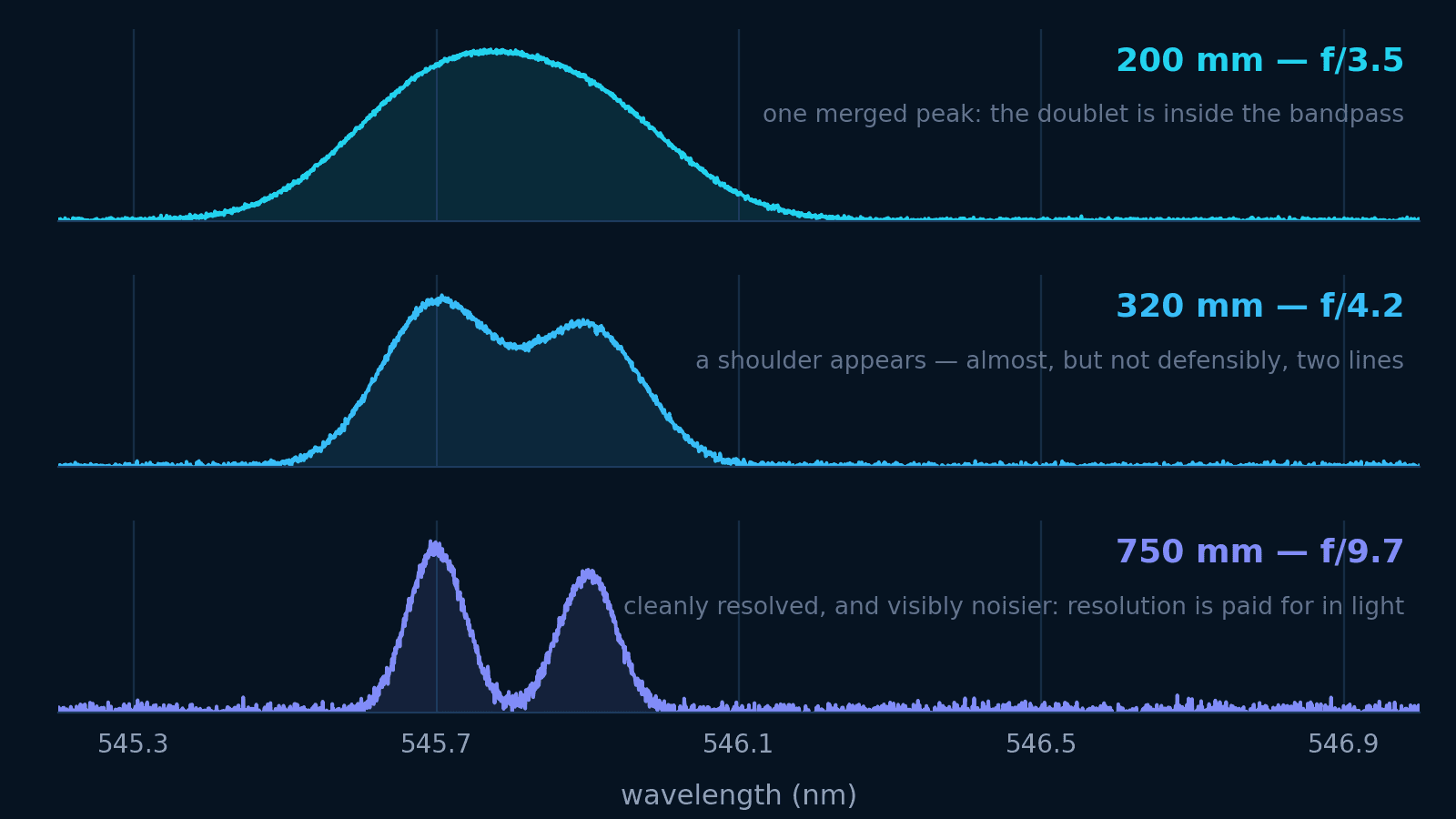
Resolution or light. You cannot have both.

Every model here is the same optical design at a different focal length. Longer spreads the spectrum further, and costs you photons for it.

Finer detail — lower nm is better

The complete range

Every spectrometer and accessory

The full spectrometer, monochromator and accessory line, with specifications taken from the manufacturer datasheets rather than summarised.

Spectrometers and monochromators

Omni-λ Series — Omni-λ Monochromators and Spectrographs

Imaging corrected spectrometers

Omni-λ Series

Omni-λ Monochromators and Spectrographs

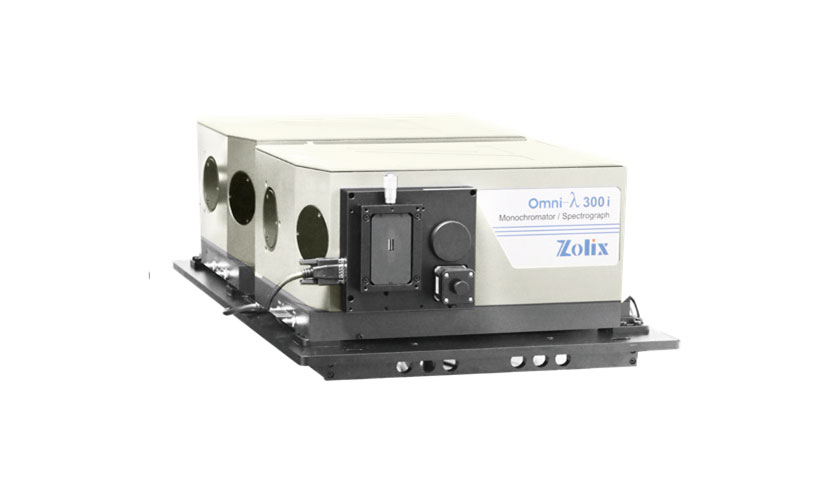
The Czerny-Turner monochromator and spectrograph line the rest of the spectroscopy range is built around, in 200, 320, 500 and 750 mm focal lengths. Every model ships pre-aligned and pre-calibrated, and the 320 mm and longer models take an interchangeable triple grating turret so UV, visible and NIR gratings can be swapped under software control.

Key specifications (17)▾
Focal length
200 / 320 / 500 / 750 mm
Aperture ratio
f/3.5, f/4.2, f/6.5, f/9.7
Resolution (PMT)
0.15 / 0.08 / 0.05 / 0.03 nm
Resolution (CCD, 26 µm)
0.27 / 0.173 / 0.11 / 0.077 nm
Dispersion
3.58 / 2.29 / 1.49 / 1.02 nm/mm
Wavelength accuracy
±0.2 nm (all models)
Wavelength repeatability
±0.1 nm (200i), ±0.025 nm (320/500/750)
Step size
0.01 nm (200i), 0.005 nm (320/500/750)
Stray light
5×10⁻⁵ (200i), 1×10⁻⁵ (320/500/750)
Focal plane size
30 (w) × 14 (h) mm
Optical axis height
146 mm
Slit
Width 0.01–3 mm, motorised or manual; height 2, 4 or 14 mm selectable
Grating size
50 × 50 mm (200i), 68 × 68 mm (320/500/750)
Grating mount
Dual turret (200i), interchangeable triple turret (320/500/750)
Interface
USB 2.0 (200i); USB 2.0 and RS232 (320/500/750)
Dimensions
300×216×213 / 420×295×232 / 550×288×220 / 800×338×218 mm
Weight
14 / 16 / 22 / 32.5 kg
Ordering options (4)▾
  • Omni-λ200i — 200 mm, f/3.5, dual grating turret
  • Omni-λ300i — 320 mm, f/4.2, triple grating turret
  • Omni-λ500i — 500 mm, f/6.5, triple grating turret
  • Omni-λ750i — 750 mm, f/9.7, triple grating turret
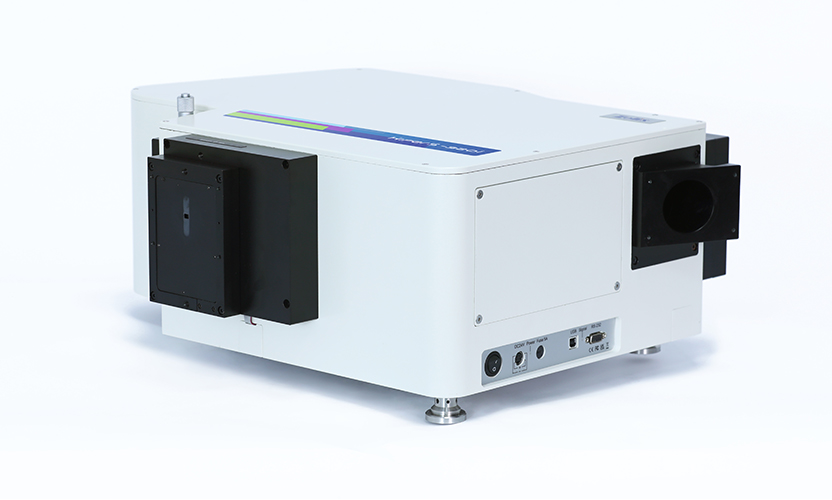
HiperS-320i — HiperS-320i Full Focal Plane Aberration-Free Imaging Spectrometer

Aberration-free imaging corrected spectrometers

HiperS-320i

HiperS-320i Full Focal Plane Aberration-Free Imaging Spectrometer

A 320 mm aberration-corrected imaging spectrograph. An on-axis rotation turret and an automatic focus mirror remove astigmatism across the whole focal plane, so intensity values stay reliable over the full width of the detector rather than only near the centre.

Key specifications (17)▾
Focal length
320 mm
Aperture ratio
f/4.4
Scan range
0–1430 nm
Resolution (PMT)
0.06 nm
Resolution (CCD, 15 µm)
0.12 nm
Dispersion
2.29 nm/mm
Wavelength accuracy
±0.2 nm
Wavelength repeatability
±0.025 nm
Step size
0.005 nm
Stray light
5×10⁻⁵
Focal plane size
29 (w) × 14 (h) mm
Optical axis height
156.3–171.3 mm
Grating size
68 × 68 mm
Grating mount
On-axis triple turret
Slit
0.01–3 mm continuous manual adjustment, motorised optional; height 2, 4 or 14 mm switchable
Dimensions and weight
591 × 460 × 260 mm, 30 kg
Interface
USB 2.0 or RS-232
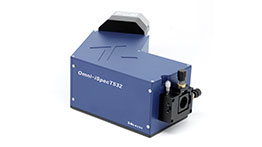
Omni-iSpecT — Omni-iSpecT High Performance Raman Spectrometer

Ultra-high throughput transmission spectrometers

Omni-iSpecT

Omni-iSpecT High Performance Raman Spectrometer

A transmissive f/2.3 Raman spectrograph built around a volume phase holographic grating and a lens-based optical train rather than mirrors. The high throughput and low focal-plane distortion suit weak Raman signals and fast mapping.

Key specifications (11)▾
Raman shift / wavelength range
0–4100 cm⁻¹ / 532–680 nm (532A1); −200–2400 cm⁻¹ / 770–960 nm (785A1)
Aperture ratio
f/2.3
Focal length (input / output)
85 / 85 mm
Grating
1800 l/mm VPH (532A1); 1200 l/mm VPH (785A1)
CCD detector
Back-illuminated deep depletion, 2000 × 256 pixels, 15 µm pixels, 30 × 3.8 mm image area
Adjustable entrance slit
10 µm – 6 mm
Resolution (typical)
5 cm⁻¹ @ 585 nm (532A1); 3 cm⁻¹ @ 912 nm (785A1), 50 µm slit
Fibre coupling
XY adjustable fibre adaptor; SMA / ferrule 10 mm (532A1), SMA / MPO / ferrule 10 mm (785A1)
Built-in long pass filter
Optional Ø50 mm; 186 cm⁻¹ transition (532A1), 309 cm⁻¹ transition (785A1)
Dimensions (without CCD)
248 × 200 × 118 mm (532A1); 277 × 215 × 118 mm (785A1)
Weight
5 kg (532A1); 5.8 kg (785A1)
Ordering options (2)▾
  • Omni-iSpecT532A1 — 532 nm excitation, 1800 l/mm VPH, 0–4100 cm⁻¹
  • Omni-iSpecT785A1 — 785 nm excitation, 1200 l/mm VPH, −200–2400 cm⁻¹
Omni-λ300Di / Omni-λ500Di — Double Monochromators and Spectrographs

Double and triple spectrometers

Omni-λ300Di / Omni-λ500Di

Double Monochromators and Spectrographs

Two finely aligned monochromators in series, switchable between additive and subtractive dispersion. Additive mode doubles the effective focal length and resolution; subtractive mode holds the focal length and cuts stray light by two orders of magnitude.

Key specifications (14)▾
Focal length (additive / subtractive)
640 / 320 mm (300Di); 1000 / 500 mm (500Di)
Aperture ratio
f/4.2 (300Di); f/6.5 (500Di)
Resolution (additive / subtractive)
0.04 / 0.08 nm (300Di); 0.025 / 0.05 nm (500Di)
Dispersion (additive / subtractive)
1.15 / 2.29 nm/mm (300Di); 0.75 / 1.49 nm/mm (500Di)
Wavelength accuracy
±0.2 nm
Wavelength repeatability
±0.025 nm
Step size
0.005 nm
Stray light (additive / subtractive)
1×10⁻⁷ / 1×10⁻⁹
Optical axis height
146 mm
Grating size
68 × 68 mm
Turret
Triple grating turret
Slit
Width 0.01–3 mm motorised or manual, height 2, 4 or 14 mm selectable; 24 mm motorised middle slit
Dimensions
825 × 500 × 281 mm (300Di); 825 × 600 × 281 mm (500Di)
Interface
USB 2.0
Ordering options (2)▾
  • Omni-λ300Di — 320 mm stages, f/4.2, 640 mm additive focal length
  • Omni-λ500Di — 500 mm stages, f/6.5, 1000 mm additive focal length
Omni-λ5008Ti — Triple Monochromator

Double and triple spectrometers

Omni-λ5008Ti

Triple Monochromator

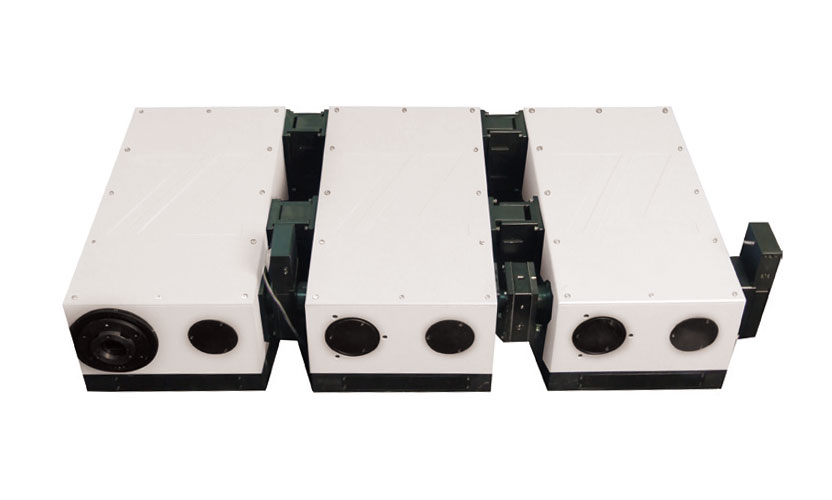
Three finely adjusted imaging monochromators in one instrument. The first two run in subtractive dispersion to suppress stray light and the last two in additive dispersion to build resolution, and the system can be operated as a single, double or triple monochromator.

Key specifications (13)▾
Aperture ratio
f/6.5
Resolution
<1 cm⁻¹ @ 585.25 nm
Low wavenumber limit
<15 cm⁻¹
Dispersion
0.91 nm/mm
Wavelength accuracy
±0.14 nm
Wavelength repeatability
±0.02 nm
Step size
0.0035 nm
Stray light
1×10⁻⁹
Optical axis height
190.5 mm
Grating size
68 × 68 mm
Turret
Triple grating turret
Slit
Width 0.01–3 mm motorised or manual, height 2, 4 or 14 mm selectable; 24 mm motorised middle slit
Interface
USB 2.0

Accessories and system instruments

The parts that turn a monochromator into a working measurement: order-sorting filters, fibre coupling, sample chambers, and the chopper, lock-in, counter and acquisition electronics that read the detector out.

Diffraction gratings — Gratings for Omni-λ Turrets

Accessories

Diffraction gratings

Gratings for Omni-λ Turrets

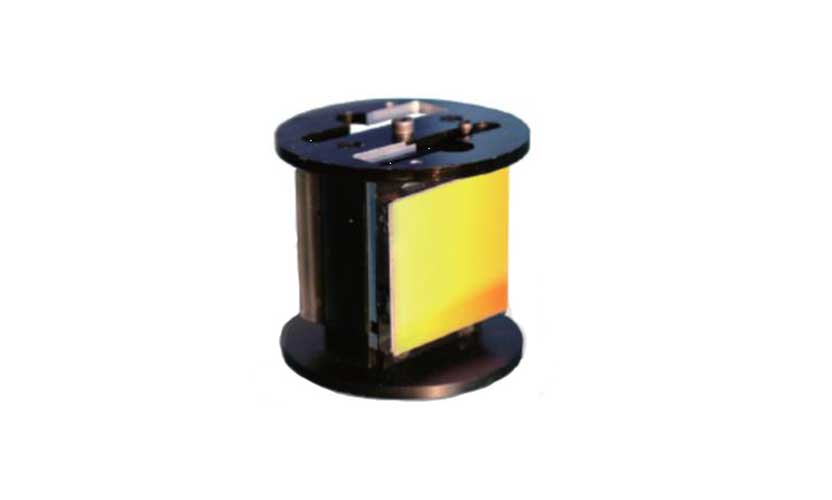
The holographic and ruled grating range for the Omni-λ turrets, from 3600 g/mm for deep-UV work down to 50 g/mm reaching 22 µm in the mid-infrared. All catalogued gratings are 68 × 68 mm.

Key specifications (5)▾
Groove densities
3600, 2400, 2000, 1800, 1200, 900, 830, 600, 300, 150, 75, 50 g/mm
Types
Holographic and ruled
Size
68 × 68 mm
Coverage
180 nm (3600 g/mm holographic) to 22 µm (50 g/mm ruled)
Catalogued models
43
SD25 Series — SD25 Series Motorised Filter Wheels

Accessories

SD25 Series

SD25 Series Motorised Filter Wheels

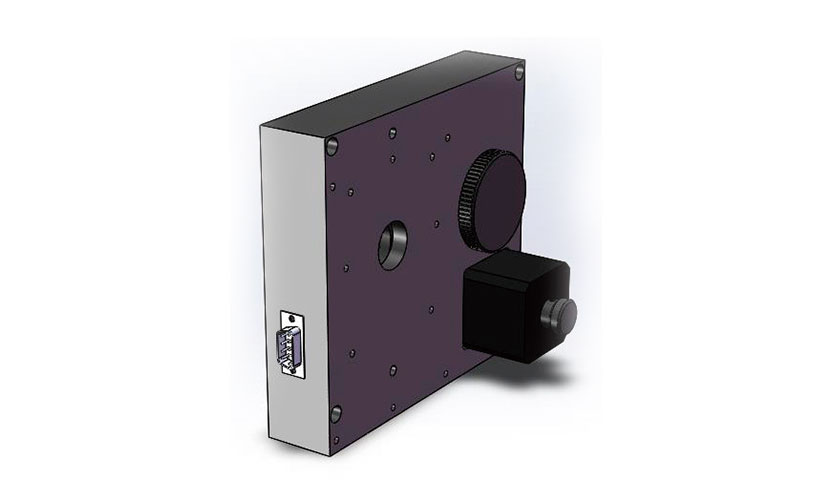
A six-position stepping-motor filter wheel driven straight from the monochromator or spectrograph controller. It holds six 25 mm filters behind a 22 mm clear aperture and is used to block grating higher orders as the instrument scans.

Key specifications (5)▾
Positions
Six, stepping motor controlled
Filter size
25 mm diameter, 22 mm clear aperture
Control
Driven by the Omni-λ monochromator/spectrograph controller and software
Compatibility
SD25 for Omni-λ300i/500i/750i; SD25-R for Omni-λ200i and the SAC-Fluo chamber
Outline
164 × 149 mm
Ordering options (7)▾
  • SD25 / SD25-R — Supplied without filters — fit any 25 mm filters
  • SD25-IR1 / -IR1-R — 200–1500 nm order-sorting set
  • SD25-IR2 / -IR2-R — 200–2000 nm order-sorting set
  • SD25-IR3 / -IR3-R — 400–3000 nm order-sorting set
  • SD25-IR5 / -IR5-R — 650–5000 nm order-sorting set
  • SD25-IR8 / -IR8-R — 800–8000 nm order-sorting set
  • SD25-IR12 / -IR12-R — 1300–12000 nm order-sorting set
FLG Series — FLG Series Fibres and Fibre Bundles

Accessories

FLG Series

FLG Series Fibres and Fibre Bundles

Quartz fibres and 19-fibre bundles that connect an Omni-λ monochromator or sample chamber to the rest of an optical setup through a BFC series fibre coupler. Single fibres come in UV (200–1100 nm) and IR (350–2000 nm) grades.

Key specifications (7)▾
Single fibre range
200–1100 nm (UV grades); 350–2000 nm (IR grades)
Core diameters
50, 100, 200, 400, 600 µm
Material
Quartz
Numerical aperture
0.22
Divergence (full angle)
25°
Termination
SMA905 standard; FC and others optional
Bundles
19 fibres of 200 µm; 200–1100, 400–1800 or 400–2400 nm depending on model
Ordering options (5)▾
  • FLG-UV50/100/200/400/600-x — 200–1100 nm quartz single fibres, x = length
  • FLG-IR50/100/200/400/600-x — 350–2000 nm quartz single fibres, x = length
  • FLG-401-x to FLG-409-x — 19-fibre bundles, 200 µm cores, Ø10/13 mm or SMA905 A-end
  • 74-UV — Fibre collimator, UV fused silica, 5 mm lens, SMA905
  • TLS-SMA905-GJ — Fibre focus accessory, UV fused silica, 2 mm focus spot
SAC Series — SAC Series Sample Chambers

Accessories

SAC Series

SAC Series Sample Chambers

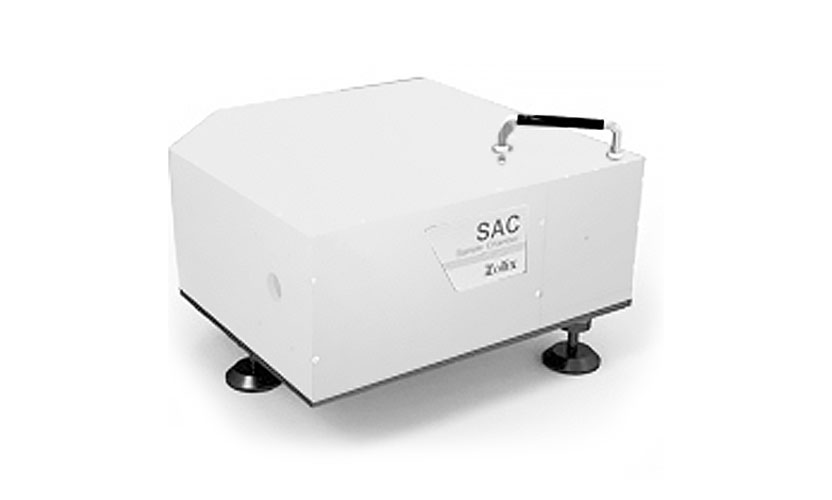
Sample chambers that bolt directly to an Omni-λ spectrometer for fluorescence, photoluminescence, transmission, reflection and absorption measurements. The SAC-Fluo uses an f/1 collection design and takes a cryostat as an option.

Key specifications (5)▾
SAC-Fluo collection optics
f/1 design, external laser excitation path, cryostat upgrade optional
Filter mounting
25 / 25.4 mm filters in the collection path
Standard sample holders
Cuvette, SAC-SH15 cuvette holder, SAC-SH11 film holder, SAC-SH12A powder holder
SAC-PL optical path
Reflective, two laser traps; optical axis height 134–170 mm adjustable
Compatibility
SAC-Fluo and SAC-PL require an Omni-λ spectrometer with manual slit
Ordering options (5)▾
  • SAC-Fluo — Fluorescence sample chamber, f/1 collection, large working space
  • SAC-PL05 — Compact PL chamber, aluminium-coated mirror for UV-VIS-NIR
  • SAC-PL06 — Compact PL chamber, gold-coated mirror for infrared
  • SAC-RF — Transmission and reflection sample chamber
  • SAC-FT — Transmission and absorption sample chamber
DCS540 — DCS540 Optical Chopper System

Accessories

DCS540

DCS540 Optical Chopper System

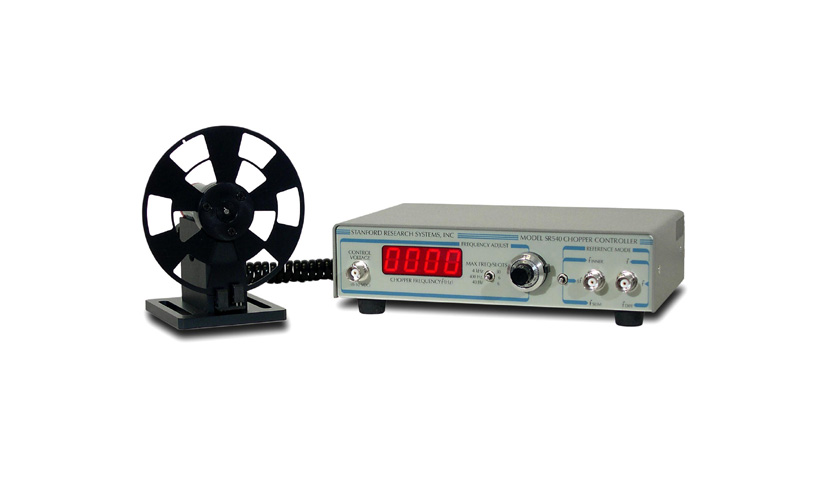
A chopper controller and blade set for lock-in detection. Six blades cover 1 Hz to 5 kHz, and a two-frequency blade provides separate input and output chopping for pump-probe style experiments.

Key specifications (9)▾
Frequency resolution
0.01 Hz
Frequency stability
250 ppm/°C typical
Frequency drift
<1%
Operating temperature
10–40 °C
Display
2.4 inch 320 × 240 LCD, 6-digit frequency readout
Input / output
BNC, standard TTL/CMOS; input 0–5 V, high >3.6 V, low <0.4 V, min load 500 Ω
Interface
RS232 to USB; all functions controllable over USB
Power
220 VAC ±10%, 50 Hz ±0.2 Hz, <30 W
Dimensions
206 (w) × 150 (d) × 70 (h) mm
Ordering options (6)▾
  • DCS540-01 — 2-slot blade, 1–99 Hz
  • DCS540-02 — 10-slot blade, 20 Hz – 1 kHz (standard)
  • DCS540-03 — 15-slot blade, 30 Hz – 1.5 kHz (standard)
  • DCS540-04 — 30-slot blade, 60 Hz – 3 kHz (standard)
  • DCS540-05 — 60-slot blade, 120 Hz – 5 kHz
  • DCS540-06 — Two-frequency blade, in 5 slot / out 7 slot: 10–500 Hz in, 14–700 Hz out
DCS500PA — DCS500PA High Performance Lock-in Amplifier

Accessories

DCS500PA

DCS500PA High Performance Lock-in Amplifier

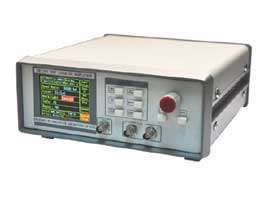
A digital lock-in amplifier covering 50 mHz to 120 kHz with low-noise voltage and current inputs, up to 100 dB dynamic reserve and time constants from 10 µs to 30 s.

Key specifications (17)▾
Frequency range
50 mHz to 120 kHz
Full-scale sensitivity
1 nV to 1 V in a 1-2-5 sequence
Voltage input mode
Single-ended or differential
Voltage input impedance
10 MΩ // 25 pF, AC or DC coupled
Current input
10⁶ or 10⁸ V/A, 1 kΩ to virtual ground
Noise
10 nV/√Hz at 1 kHz; 0.13 pA/√Hz at 1 kHz; 0.013 pA/√Hz at 100 Hz
Dynamic reserve
>100 dB
CMRR
>100 dB to 10 kHz, decreasing by 6 dB/octave
Gain accuracy
0.2% typical, 1% max
Phase resolution
0.01° increments; absolute <1°, relative <0.01°
Time constants
10 µs to 3 ks (<200 Hz); 10 µs to 30 s (>200 Hz), 6/12/18/24 dB/oct
Harmonic rejection
−90 dB
Internal oscillator
50 mHz–120 kHz, 25 ppm + 30 µHz accuracy, 1 mHz resolution
Display
3.5 inch 320 × 240 TFT, four channels showing X, Y, R and θ
Interfaces
RS232 and RS232-to-USB; fully remote controllable
Power
220/240 VAC, 50/60 Hz, 30 W
Dimensions and weight
259 (w) × 320 (d) × 115 mm with feet, 3.2 kg
DCS300PA — DCS300PA Data Acquisition System

Accessories

DCS300PA

DCS300PA Data Acquisition System

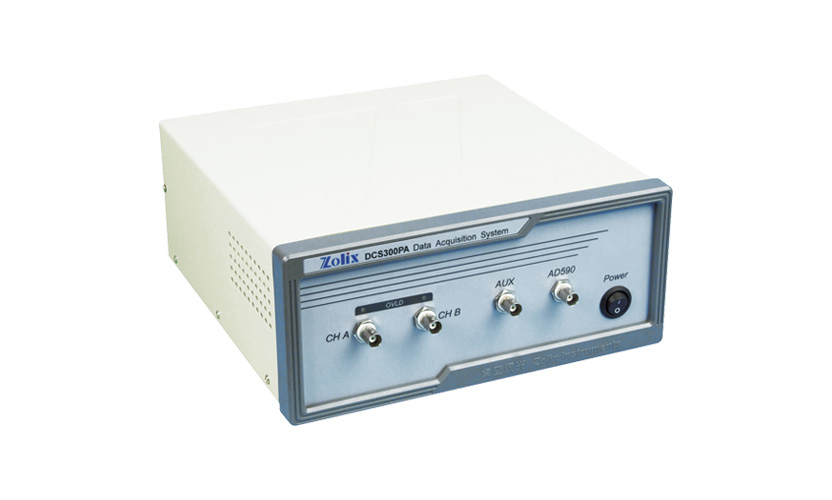
A dual-channel weak-signal pre-amplifier and acquisition unit, and the successor to the DCS103. The added multi-position high-gain pre-amplifier is what makes it suitable for low-level detector signals.

Key specifications (14)▾
Analog input channels
2, 16-bit A/D
Voltage input range
±1 mV to ±10 V
Voltage gain
10⁰–10⁴
Current gain
10³–10⁷
AUX measurement range
DC 0–10 V
Analog output
2 channels, 12-bit D/A, DC 0–10 V
Temperature measurement
1 channel, AD590 probe, −30 to 100 °C
Integration time
10 µs to 10 s
Data points
≤2000, stored in RAM
Triggering
Software and external trigger; TTL rising edge input
I/O
5 input, 2 TTL output
Interface
USB 2.0
Power
AC 100–240 V, 50/60 Hz (DC 24 V, 0.3 A)
Dimensions and weight
260 × 260 × 120 mm, 3.3 kg
DCS210PC — DCS210PC Photon Counter

Accessories

DCS210PC

DCS210PC Photon Counter

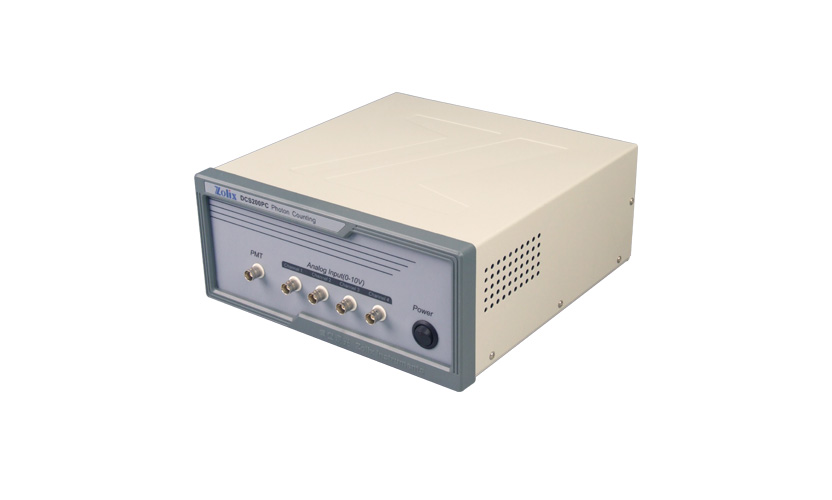
A single-photon counter with a chopper control function and a lifetime measurement mode, plus analog input and output channels so it can act as the acquisition hub of an Omni-λ system.

Key specifications (10)▾
Photon counting
1 channel, 100 Mcps count rate
Analog inputs
3 channels, 0–10 V, 16-bit A/D
Analog output
1 channel, 0–10 V, 12-bit D/A
Triggering
External TTL-compatible trigger input, plus software trigger
Chopping mode
Chopper control to improve signal-to-noise ratio
Lifetime measurement
Range 10 µs to 10 s; instrument response width 1 µs
Interface
USB
Dimensions
240 × 240 × 120 mm
Power
AC 110 V / 220 V
Weight
3.4 kg
Scanning software — CCD and Scanning Software

Accessories

Scanning software

CCD and Scanning Software

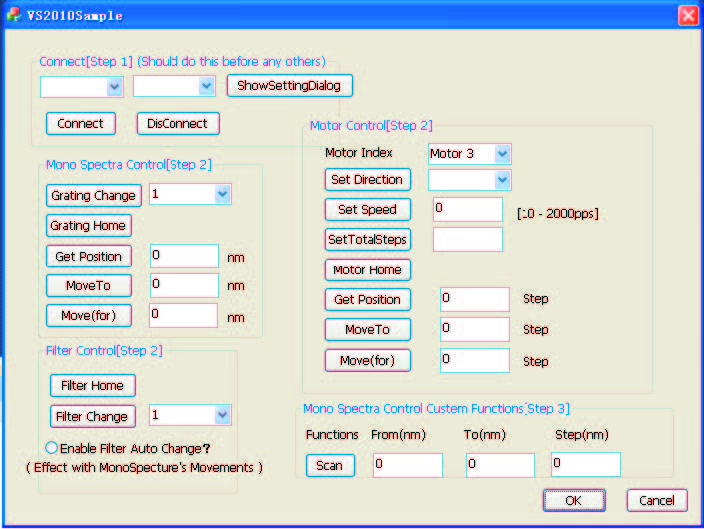
Instrument control and acquisition software for the Omni-λ range, covering both scanning monochromator operation and CCD spectrograph readout.

Key specifications (2)▾
Scope
Instrument control and spectral data acquisition
Instruments
Omni-λ monochromators and spectrographs, and the matching CCD detectors

How it works

One design, two instruments

Light enters through a slit, a curved mirror collimates it, and a diffraction grating separates it by angle. A second mirror focuses the result. What sits at the exit decides what you own.

As a monochromator

A narrow exit slit passes one wavelength band at a time. Rotating the grating tunes it — a scanning, tunable source.

As a spectrograph

A camera flange replaces the exit slit and the whole dispersed spectrum lands on a CCD or sCMOS array at once.

The grating sets the range

Focal length fixes how far the spectrum spreads; the grating decides where it sits and how efficiently. Turrets hold two or three so you can switch UV to NIR without opening the instrument.

Not sure which configuration you need?

Send us the measurement — sample, wavelength range, detector, and the resolution you need — and we will come back with a configuration and a quote.

Talk to a specialist