Configure for your measurement
Raman spectrographs & monochromator selection
A Raman spectrograph must separate weak inelastic scattering from the excitation line while resolving the bands you need. Start with your laser wavelength and required Raman-shift interval, then choose the rejection optics, grating and detector together.
Typical optical path
- Excitation laser
- Sample and collection optics
- Edge or notch filter
- Spectrograph entrance slit
- Grating
- Array detector
Specify Raman shift as well as laser wavelength
The lowest Raman shift sets how close the measurement approaches the excitation line. The highest shift determines the other end of the recorded spectrum. These limits translate into different detector wavelengths for different excitation lasers. Include both limits so grating coverage, detector response and rejection-filter requirements can be checked together.
Choose resolution and coverage as one decision
Higher dispersion spreads nearby spectral features farther apart, while reducing the wavelength interval on a fixed-width sensor. Slit width, optical aberrations and detector pixel size also contribute to the instrument response. Give the narrowest band separation you need and say whether the full spectrum must fit in one exposure or can be recorded in several grating positions.
Check laser rejection before choosing extra stages
A filtered single-stage spectrograph is suitable for many Raman measurements. Measurements very close to the laser line can require additional rejection or multiple stages. Extra optical stages also affect throughput. Share your existing filters and collection geometry so the proposed system addresses the actual background rather than adding components by default.
Instrument & component options
Use these as starting points. Published instrument specifications depend on the stated test conditions; the grating, slits, detector and coupling determine your final configuration.
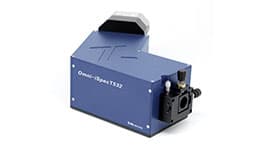
Omni-iSpecT
Review the dedicated Raman spectrograph configurations published for 532 nm and 785 nm excitation.
View specifications →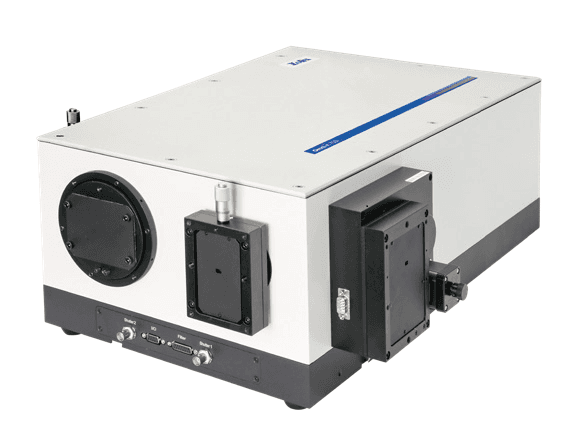
Omni-λ Series
Compare configurable focal lengths and gratings when your spectral range or detector requires a different arrangement.
View specifications →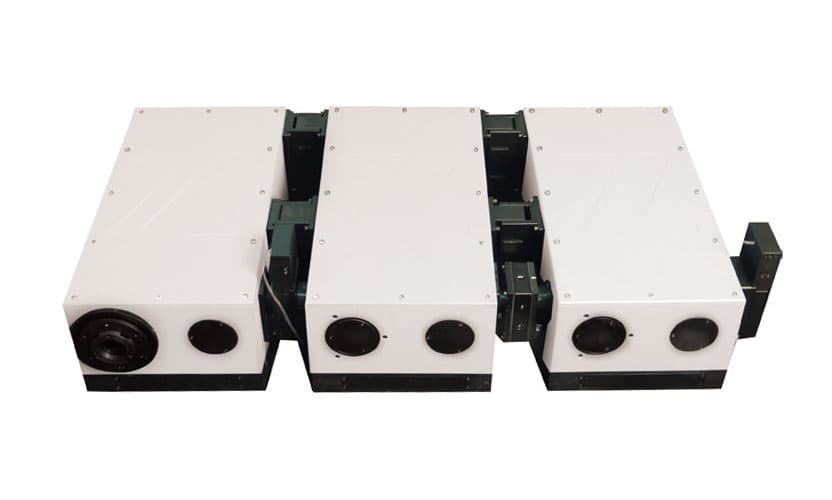
Omni-λ5008Ti
Discuss a multi-stage instrument for measurements requiring additional laser-line rejection.
View specifications →Questions about this configuration
Is every monochromator suitable for Raman spectroscopy?
Suitability depends on dispersion, throughput, laser rejection and the detector. A wavelength range alone does not establish Raman performance. Specify your excitation wavelength, Raman-shift interval and required resolution.
Do I always need a triple monochromator?
No. Many Raman measurements use rejection filters and a single spectrograph. The minimum Raman shift, background and available signal determine whether additional stages are appropriate.