Configure for your measurement
Monochromators for fluorescence & photoluminescence
An excitation monochromator selects the light reaching your sample. An emission monochromator or spectrograph separates the light your sample emits. Choose the two sides around your wavelength range, signal level and measurement method.
Typical optical path
- Lamp or laser
- Excitation selection
- Sample
- Excitation rejection
- Emission monochromator or spectrograph
- Detector
Choose excitation selection or emission analysis
A broadband lamp and an excitation monochromator let you tune illumination through an absorption or excitation band. For an emission scan, a second monochromator selects wavelengths before a single-point detector. An array detector on a spectrograph records a wavelength interval in one exposure. Tell us whether you need excitation scans, emission spectra or both.
Balance bandpass with the available signal
Narrower slits reduce the wavelength band passed by the instrument and also reduce the light reaching the detector. Start with the narrowest spectral feature you need to distinguish. Select the focal length and grating around that feature, then check the coupling optics and detector sensitivity. A broad fluorescence band and a narrow semiconductor emission line can call for different configurations.
Control excitation leakage and detector background
Specify the separation between excitation and emission, together with any filters already in your setup. Order-sorting and excitation-rejection filters address different sources of unwanted light. Weak emission may also require cooled detection, modulation or background subtraction; these choices depend on exposure time and sample behaviour.
Instrument & component options
Use these as starting points. Published instrument specifications depend on the stated test conditions; the grating, slits, detector and coupling determine your final configuration.
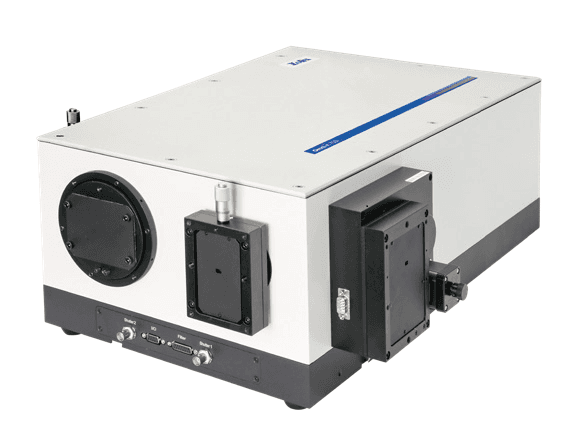
Omni-λ Series
Compare 200, 320, 500 and 750 mm focal lengths for excitation selection and emission analysis.
View specifications →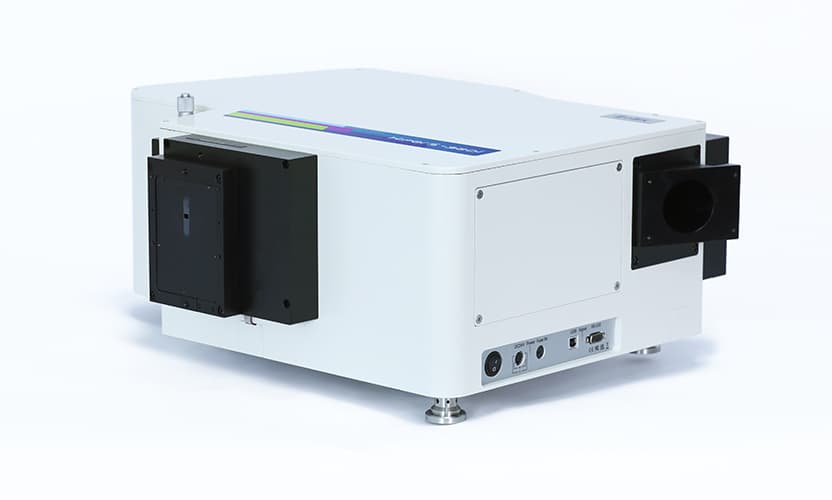
HiperS-320i
Consider imaging correction when recording multiple fibres or spatial positions on a 2D detector.
View specifications →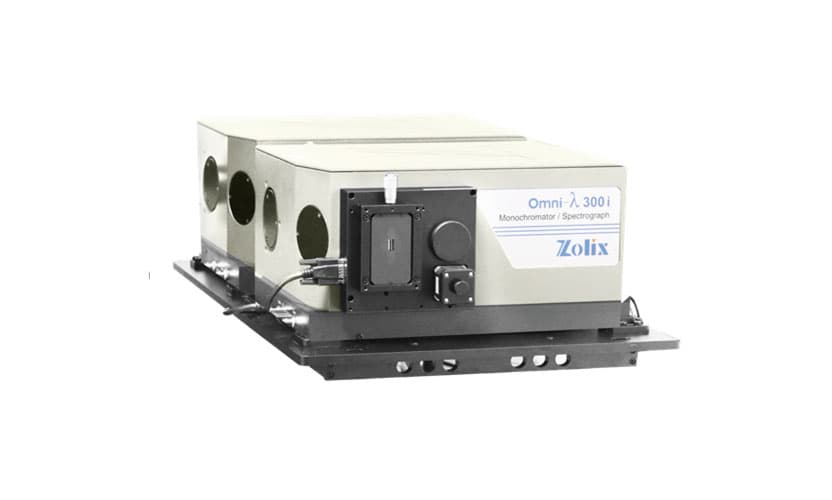
Omni-λ300Di / Omni-λ500Di
Discuss a double-stage configuration when spectral purity or stray-light rejection is a limiting requirement.
View specifications →Questions about this configuration
Do I need two monochromators for fluorescence?
Excitation and emission wavelength selection are separate functions. A tunable broadband excitation source and a scanning emission detector can use two monochromators. A fixed laser and an array spectrograph can use a different arrangement. Start with the scans your experiment needs.
Can I use my existing detector?
Send its model, spectral sensitivity, active area or sensor dimensions and mounting interface. We can check the optical and mechanical requirements before proposing a configuration.