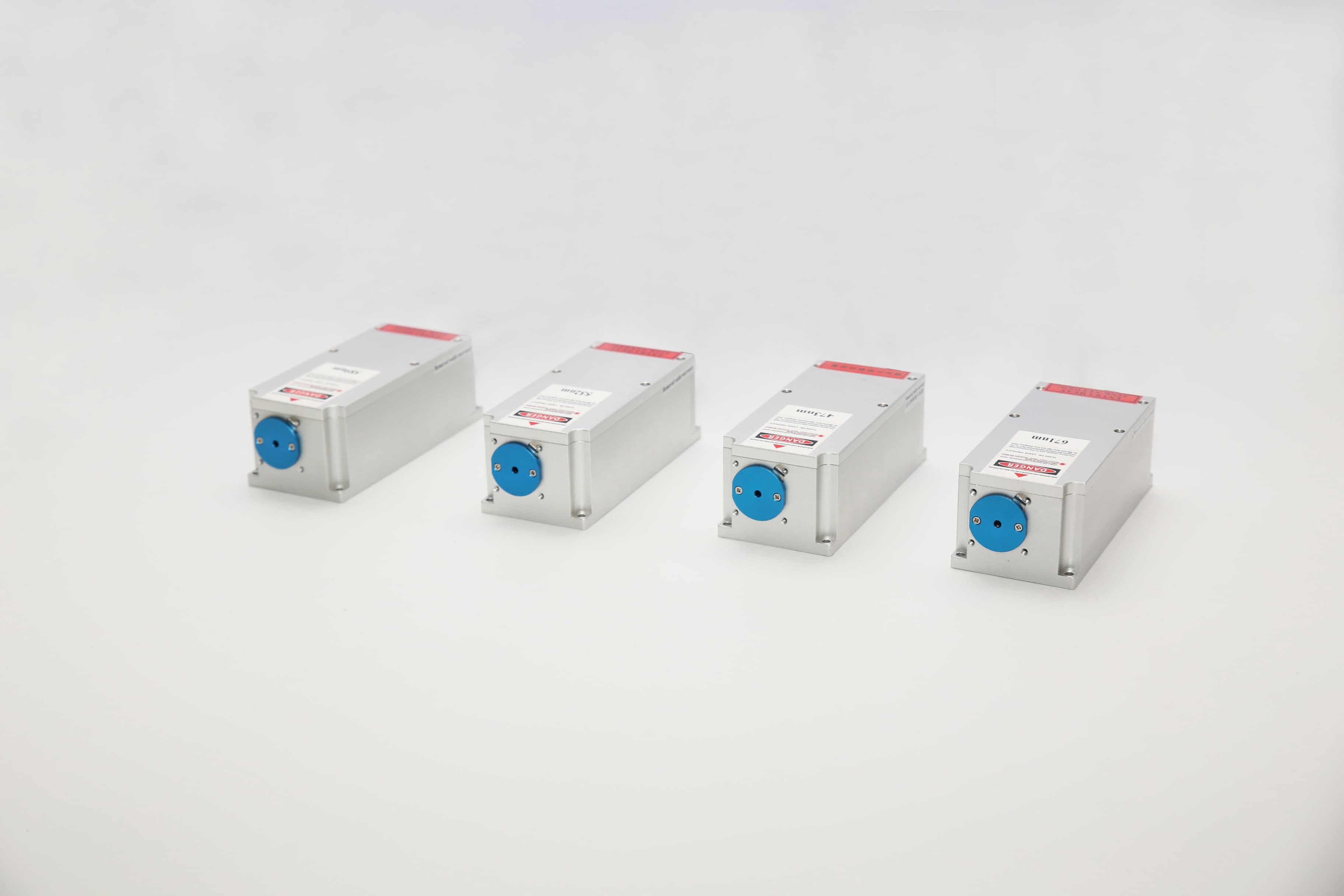
5 models · 2 series
1530nm DFB Laser, Infrared Laser, DPSS Laser |
4 models| Model | Wavelength | Output / average power | Power stability (rms, 4 hours ± 3°C) | Noise of amplitude (rms, 20Hz-20MHz) | Fiber | Transverse mode | M2 after fiber | Warm-up time (minutes) | Cooled method | Operating temperature (°C) | Power supply (100-240VAC) | Expected lifetime (hours) | |
|---|---|---|---|---|---|---|---|---|---|---|---|---|---|
| MLL-III-1530-SM | 1530 nm | 1~15 mW | <2%, <1%, <0.5% | <1%, <0.5% | 1m | TEM00 | ~1.1 | <5 | Conduction | 10-35 | PSU-III-FDA/PSU-III-LED/PSU-A-D/PSU-III-OEM | >10000 | Datasheet |
| MDL-III-1530-SM | 1530 nm | 1~15 mW | – | – | – | – | – | – | – | – | – | – | |
| MDL-III-1530DFB-SM | 1530 nm | 1~15 mW | – | – | – | – | – | – | – | – | – | – | |
| FC-OEM-1530 | 1530 nm | 1~15 mW | – | – | – | – | – | – | – | – | – | – |
Single Longitudinal Mode SLM Laser, Green and Infrared Single Frequency Laser AT 532 NM and 1064 NM.
1 model| Model | Wavelength | Output / average power | Spectral linewidth | Optical noise | M² | Power stability (rms, 4 hours , ±3℃) | Transverse mode | Longitudinal mode | Frequency shift (MHz) (over ±2℃and 8 hours) | Fiber connector | Fiber jacket | Polarization ratio (dB) | Warm-up time (minutes) | Cooled method | Power supply (VAC) | Expected lifetime (hours) | |
|---|---|---|---|---|---|---|---|---|---|---|---|---|---|---|---|---|---|
| FL-1530-SLM | 1530 nm | 1~1000 mW | <5 kHz | <0.05% RIN(DC-3 MHz) | <1.1 | <2%, <1%, <0.5% | TEM00 | SLM | <±200 | FC/APC, Collimator optional | PVC, Metal optional | >15, after PM fiber | <30 | Air cooled or Water cooled | 110/220VAC | >10000 | Datasheet |
Not sure which model fits?
Send the physics — wavelength, mode, power or energy, linewidth or pulse width, delivery, control and safety — and we qualify the source.