Cryogenic Piezo Stages
Zolix piezoelectric motion stages are custom-engineered to deliver sub-nanometer positioning resolution at extreme temperatures (down to 30 mK with the .ULT option), high magnetic fields (up to 35 Tesla), and ultra-high vacuums (down to 2e-11 mbar).
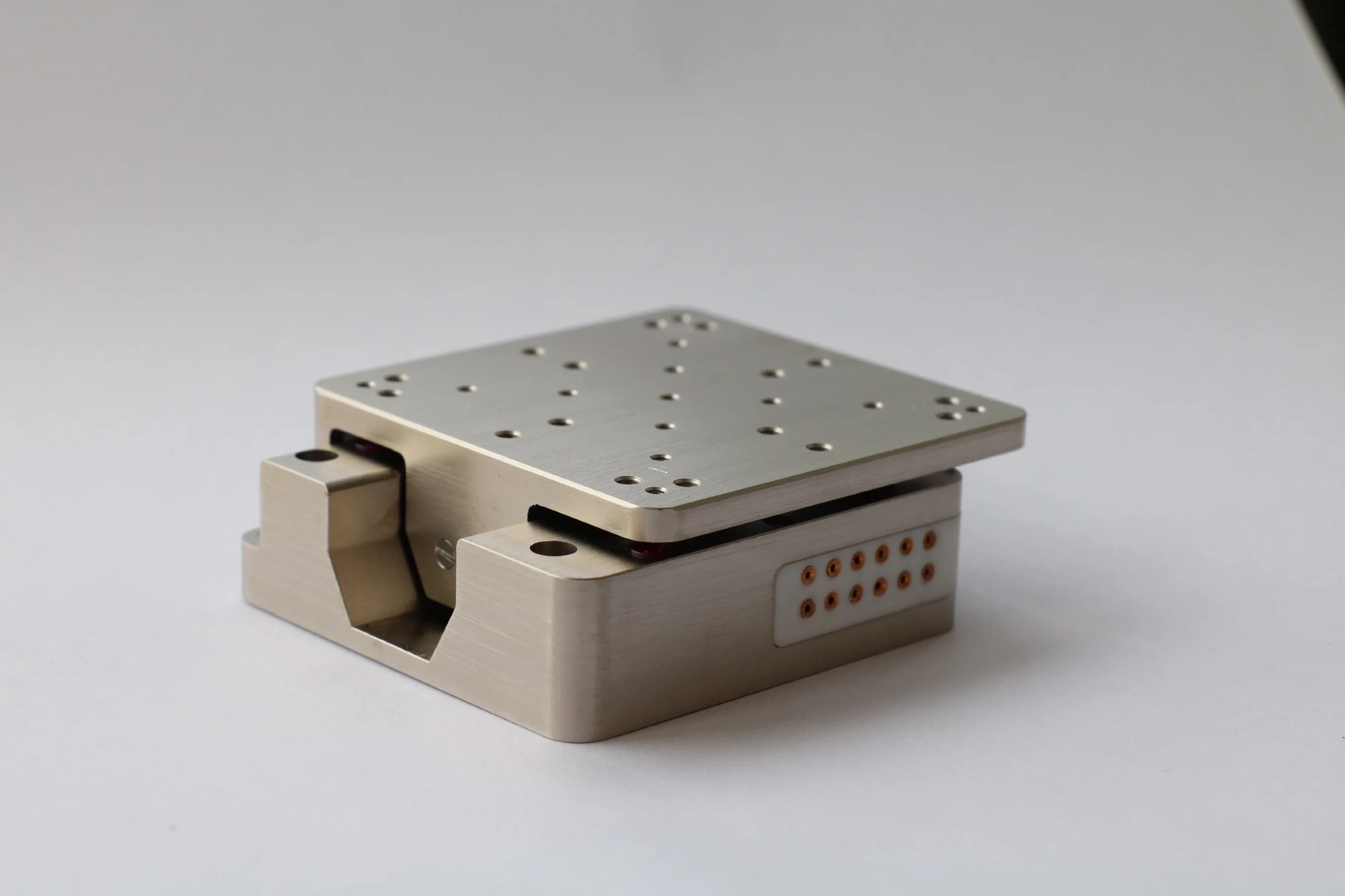
Choose by motion and environment
Compare cryogenic nanopositioners, rotators and scanners
Start with the motion required at the sample: coarse approach, rotation or fine scanning. Open the model pages below to compare specifications, then choose the temperature, vacuum and feedback configuration.
Swipe across the table to compare models and selection checks.
| Required motion | Models to compare | Selection checks |
|---|---|---|
| Coarse approach inside a cryostat | Choose footprint, coarse travel and payload, then confirm encoder and temperature options. Plan the axis stack, thermal anchoring and cable routing together. | |
| Cryogenic rotation and tilt | Decide between continuous rotation and tilt about a defined pivot. Check payload, optical access, angular feedback and available space inside the cryostat. | |
| Open-loop scanning at low temperature | Use the scan range at the operating temperature and drive voltage. Room-temperature stroke alone does not specify the scan area available after cooldown. | |
| Closed-loop cryogenic nanopositioning | Select capacitive feedback and the matching Ultra controller. Specify UHV and ultra-low-temperature options explicitly and confirm the complete operating envelope. |
Specifying a vacuum-compatible nanopositioner
State the working pressure, bakeout temperature, operating temperature and magnetic field separately. HV, UHV, non-magnetic and cryogenic options describe different requirements; one option does not automatically satisfy the others.
For a UHV-compatible nanopositioning stage, confirm the selected materials, encoder, wiring and feedthroughs as an assembly. Include duty cycle and heat dissipation in the specification, especially when convection is unavailable.
Compare room-temperature and vacuum piezo stagesGet help specifying the complete axis
Send the axes, travel, payload, available space, position-feedback requirement and operating environment. Add the base temperature, available cooling power and magnetic field. Precisometer can help identify a stage, controller and mounting configuration for quotation.
Temperature Range
1.4 K to 400 K
Down to 30 mK with .ULT option
Magnetic Fields
Up to 35 Tesla
Fully non-magnetic construction
Vacuum Rating
2 × 10⁻¹¹ mbar
HV, UHV & ULT options available
Position Sensor
0.5 nm Resolution
Resistive or capacitive encoders
Interactive Configurator
Cryogenic Piezo Stages Configurator
Select standard cryogenic linear stages, rotators, goniometers, scanners, controllers, or accessories. Configure closed-loop displacement sensors, vacuum ratings, and temperature limits to suit your cryostat setup.
Linear16-x Compact Linear Stage (X)
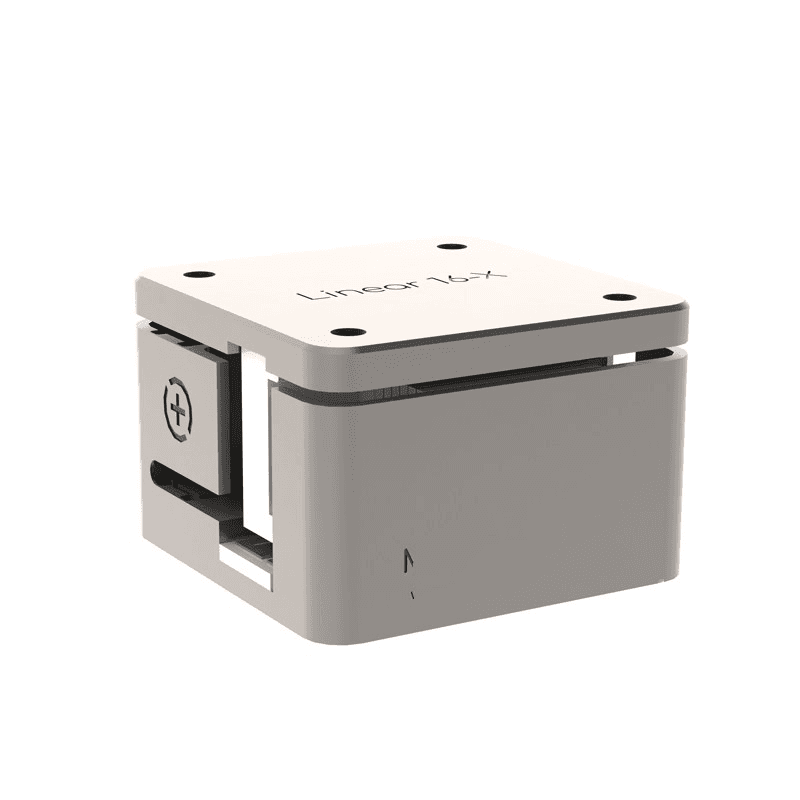
Identified Model Reference
Linear16-x
Specifications
- Dimensions: 16 x 16 x 10.5 mm
- Travel: 3 mm coarse
- Payload: 50 g
- Material: Pure Titanium body
- Encoder: Resistive closed-loop (150 nm resolution)
Why choose this
Smallest 16 mm titanium body — pick it when space inside the cryostat is the constraint and payloads are light.
We will match this configuration with Zolix extreme-environment cryogenic positioners and provide the relevant STEP files and technical solution.
Before you specify
Specifying a positioner for a dilution refrigerator
Four constraints decide which of the series below you need, and none of them is the part number. Below base temperature the limits are thermal and mechanical, not electrical — so it is worth settling these before choosing a model.
How much heat a moving stage puts into the mixing chamber
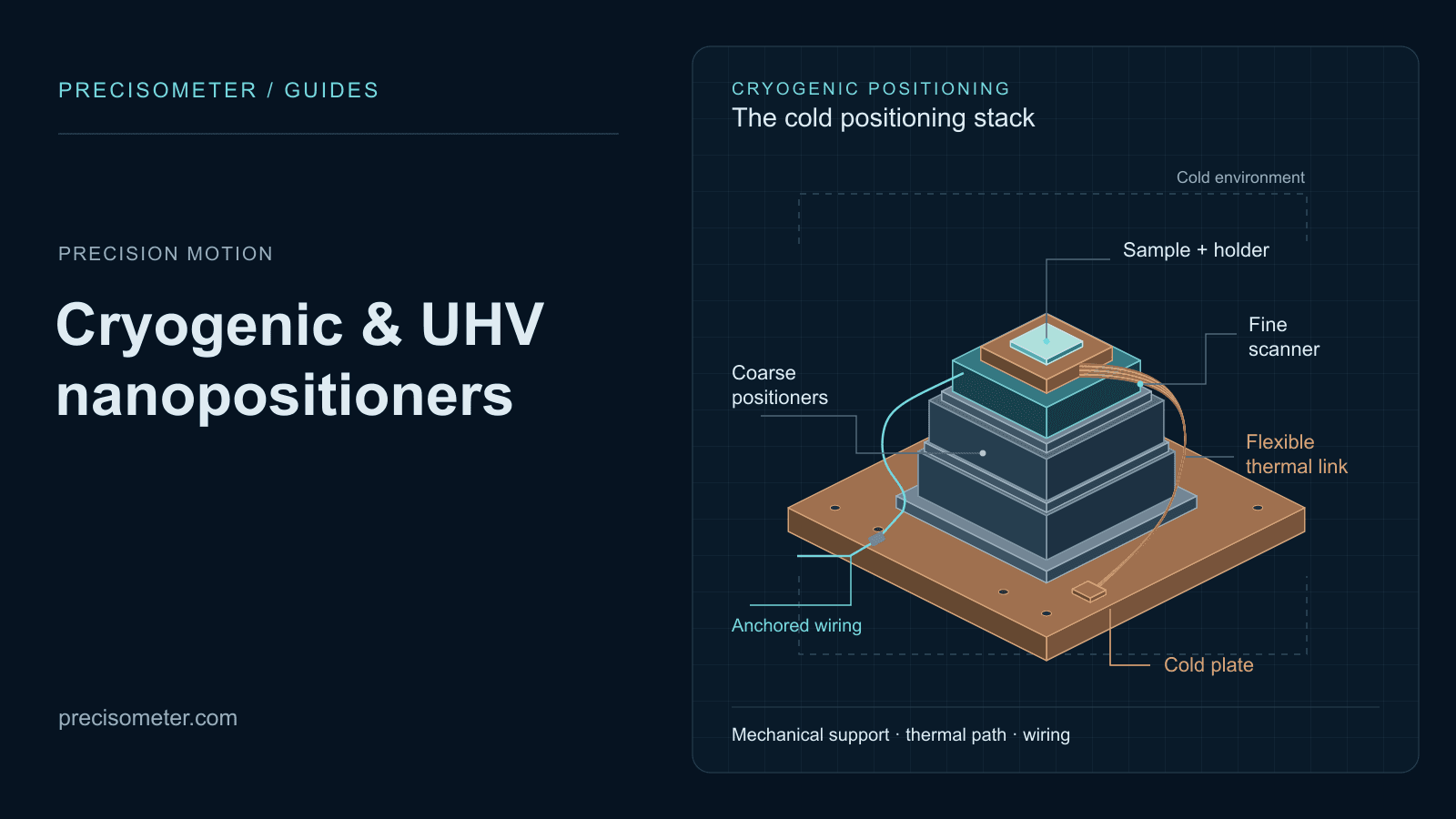
A stick-slip inertial drive dissipates energy per step, so what matters at the mixing chamber is duty cycle rather than step size — cooling power below 100 mK is measured in microwatts. These positioners hold position with no holding current once motion stops, which means the steady-state load on the cold plate is the wiring loom, not the motor. Position coarsely, then stop. Anchor the loom at each temperature stage, and use a flexible copper braid (FTC) to tie the moving body to the cold plate without restraining travel.
Why scan range shrinks below 4 K
Piezoelectric coefficients fall as temperature drops, so a flexure scanner specified at room temperature will not deliver that range at base. Part of the loss is recovered in the drive electronics through voltage headroom — the scanner series is rated to 75 V at 300 K and 180 V at 4 K — but the working range at base temperature is still the number to design against. Check the low-temperature figure on the model page for the exact part. Coarse stick-slip stages behave differently: their 3–20 mm travel is mechanical rather than piezo expansion, so it survives cooldown intact. That asymmetry is why a coarse-plus-fine stack is the standard arrangement rather than a single actuator.
Mounting and thermalising to the cold finger
Stacking different series together needs matched interfaces — the AP.LT cross-mount adapter plates are pure titanium so the stack does not build a differential-contraction stress path as it cools. An L-shaped bracket converts an XY stack into XZ or side-mounts a positioner onto a cold finger; a pin-aligned plate makes remounting repeatable between cooldowns, which matters when a thermal cycle costs a day. Fasteners are BeCu at M1.6 and M2, rated for both 30 mK and 35 T.
Running inside a high-field magnet bore
Operation to 35 T requires that nothing in the assembly is ferromagnetic — titanium bodies, BeCu fasteners and non-magnetic connectors throughout, which is why the toolkit is specified as a set rather than left to standard workshop hardware. A single steel screw substituted during installation is enough to compromise the assembly.
Open-loop or closed-loop at base temperature
Coarse positioners carry resistive encoders at around 150 nm resolution, which is enough to return to a feature but not to hold one. If the measurement sits at a fixed position for hours, thermal drift and piezoelectric creep dominate the error budget, and that is the case the capacitive Ultra series addresses — 0.5 nm closed-loop resolution with the controller compensating creep, drift and self-heating in the loop. If instead the sample is re-found optically at the start of each run, open-loop is the better trade: fewer wires into the cryostat, and less heat with them.
Coarse steppers, rotators, goniometers and scanners
Our stages utilize a stick-slip inertial drive mechanism for coarse positioning over millimeters, coupled with direct analog expansion for sub-nanometer fine tuning.
“Linear” Series (Linear16 · 25 · 35)
Engineered for X & Z axis positioning. These linear stages feature a highly compact footprint, making them ideal for space-constrained sample chambers inside cryostats. Stackable to form multi-axis XYZ assemblies.
| Model | Dimensions | Travel | Max. Load | Sensor |
|---|---|---|---|---|
| Linear16-x / z | 16 × 16 × 10.5 mm / 16 mm | 3 mm | 50 g / 250 g | Resistive (150 nm res) |
| Linear25-x / z | 25 × 25 × 9.5 mm / 19.6 mm | 6 mm | 500 g / 300 g | Resistive (150 nm res) |
| Linear35-x / z-Optic | 35 × 35 × 10.5 mm / 30 mm | 20 mm / 8 mm | 2500 g / 500 g | Resistive or Optical |
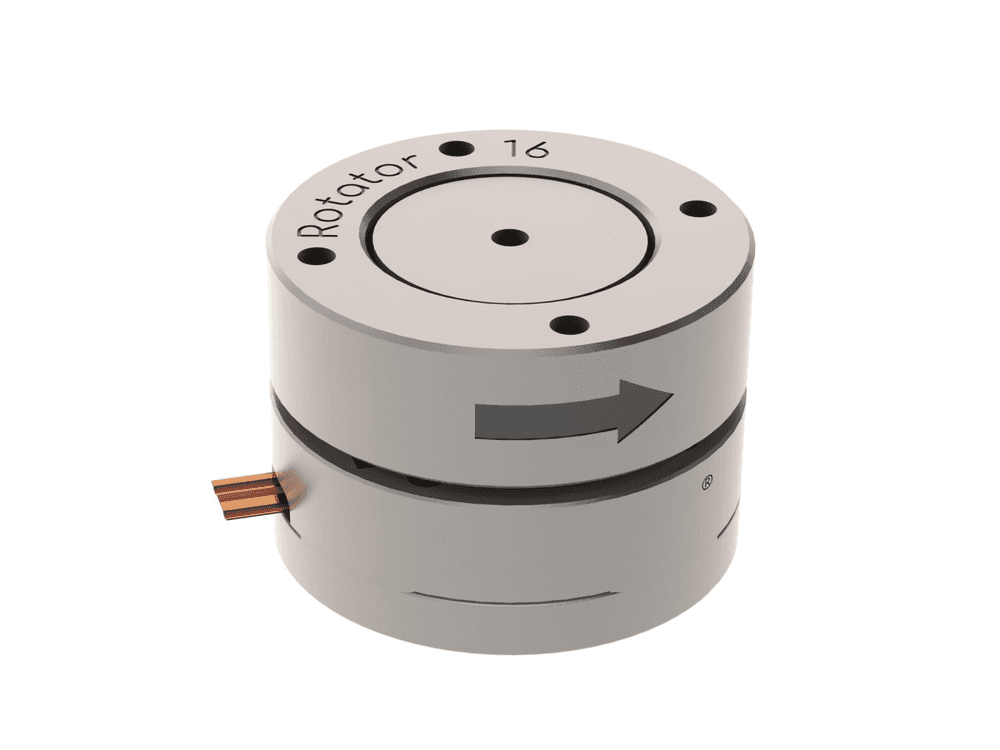
“Rotator” Series (Rotator16 · 25 · 35)
Designed for 360° endless coarse rotation. Ideal for sample orientation changes, polarization-dependent spectroscopy, and angle-resolved measurements inside dilution refrigerators. Available with center aperture options (Rotator25-Optic, Rotator35-Optic) for optical transmission through the rotation axis.
| Model | Dimensions | Max. Load | Aperture | Fine Tune @2K |
|---|---|---|---|---|
| Rotator16 | Ø16 × 15.6 mm | 100 g | — | 5 µ° |
| Rotator25 / 25-Optic | 25 × 25 × 14.5 mm | 250 g | Ø6 mm (Optic) | 4 µ° |
| Rotator35-Optic | 35 × 35 × 16.5 mm | 500 g | Ø6 mm | 3 µ° |
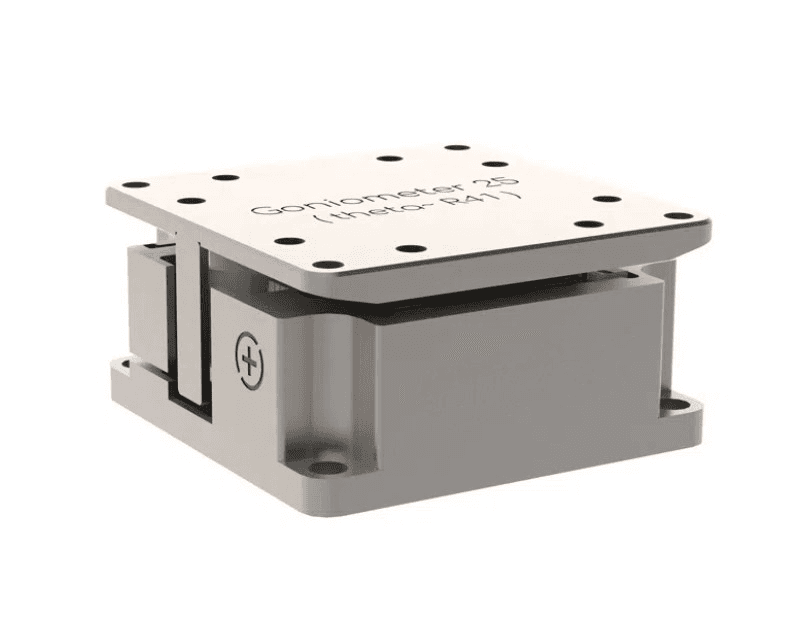
“Goniometer” Series (Goniometer25 · 35)
High-precision tilt positioning units with closed-loop resistive encoders. Each goniometer has a fixed rotation centre above the top plate — stacking a theta and a phi unit together produces dual-axis tip/tilt around a common virtual pivot. Available in matched theta and phi configurations across two footprint sizes.
| Model | Tilt Range | Pivot Above Plate | Max. Load | Sensor Res. |
|---|---|---|---|---|
| Goniometer25-theta | 6.6° | 41 mm | 200 g | 0.2 m° |
| Goniometer25-phi | 6° | 53.5 mm | 200 g | 0.2 m° |
| Goniometer35-theta | 12° | 50 mm | 500 g | 0.5 m° |
| Goniometer35-phi | 10° | 66 mm | 500 g | 0.5 m° |
Pair Goniometer25-theta + Goniometer25-phi (or 35 equivalents) for orthogonal dual-axis tilt with shared rotation centre.
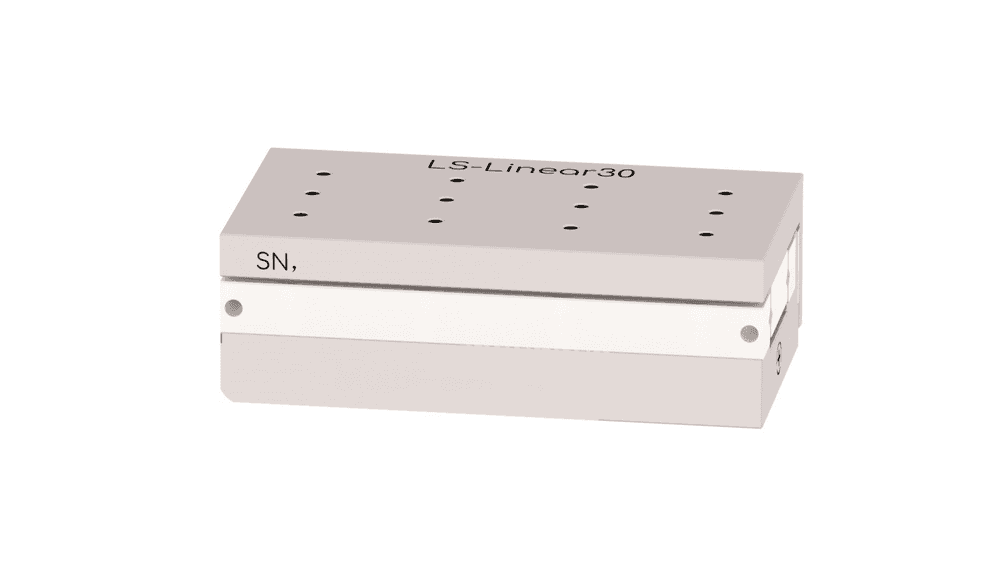
“LS-Linear” Series (LS-Linear 30 to 200)
Designed for applications requiring significant mechanical displacement under cryogenic conditions. Five model variants cover travel ranges from 30 mm up to 200 mm. Closed-loop resistive encoder over full travel, ~150 nm sensor resolution and 1–2 µm repeatability across the series. Suited to sample load-locks, filter exchangers, and long-stroke scanner positioning.
| Model | Footprint | Travel | Max. Load | Weight |
|---|---|---|---|---|
| LS-Linear30 | 60 × 32 × 19.5 mm | 30 mm | 750 g | 120 g |
| LS-Linear50 | 90 × 32 × 19.5 mm | 50 mm | 750 g | 150 g |
| LS-Linear75 | 135 × 32 × 19.5 mm | 75 mm | 1000 g | 200 g |
| LS-Linear100 | 180 × 32 × 19.5 mm | 100 mm | 1000 g | 300 g |
| LS-Linear200 | 320 × 32 × 19.5 mm | 200 mm | 1500 g | 600 g |
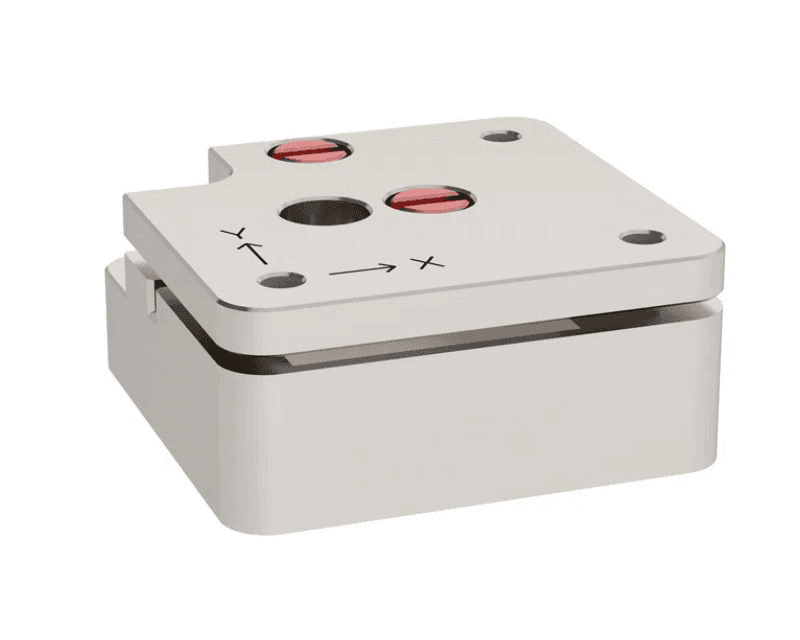
“Scanner” Series (Scanner16 · 25 · 35 xy & z)
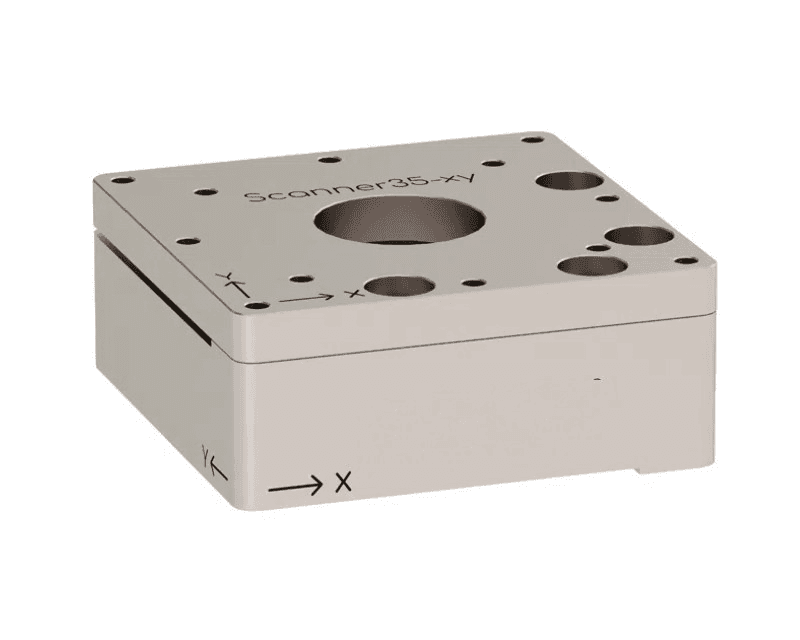
Piezoelectric stack-driven, friction-free scanners. Utilizing flexure hinges, these scanners provide extremely smooth, linear, and reproducible nanometer-scale movement. The absence of mechanical friction makes them ideal for high-resolution scanning probe microscopies (STM/AFM) at low temperatures.
| Model | Axes | Scan Range (300K) | Scan Range (4K) | Drive Voltage |
|---|---|---|---|---|
| Scanner16-xy / z | XY or Z | 30 × 30 μm / 30 μm | Not published | Max. 75 V @300 K / 180 V @4 K |
| Scanner25-xy / z | XY or Z | 55 × 55 μm / 55 μm | Not published (Ultra: 30 μm) | Max. 75 V @300 K / 180 V @4 K |
| Scanner35-xy / z | XY or Z | 100 × 100 μm / 100 μm | Not published (Ultra: 60 × 60 μm / 60 μm) | Max. 75 V @300 K / 180 V @4 K |
“ScannerXX.Ultra” Closed-Loop Scanner Series
Unprecedented precision at ultra-low temperatures. By integrating a sub-nanoscale resolution capacitive displacement sensor, the Ultra series actively compensates for thermal drift, piezoelectric creep, and self-heating inside dilution refrigerators.
Capacitive Sensor
Direct feedback loop, closed-loop resolution of 0.5 nm
High Load Capacity
Up to 500 g load handling in Z-axis configurations
- Scanner25-x / z.Ultra (HV / UHV / ULT / UHV.ULT)
- Scanner35-xy / z.Ultra (HV / UHV / ULT / UHV.ULT)
Piezo Drive Electronics
Drive electronics, APIs and control interfaces
High-performance drive electronics with USB, TCP/IP and SPI interfaces. Full LabVIEW and Python API support.
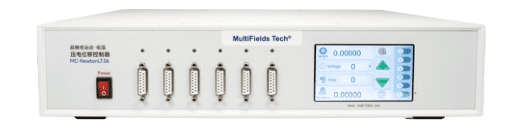
MC-NewtonLT Series
Positioner Controller
Specifically designed to control coarse inertial stages (Linear, Rotator, Goniometer). Supports multiple channels with convenient switching between coarse stepping and fine analog scanning modes.
- • **Models:** MC-NewtonLT.01 (1 ch) and MC-NewtonLT.06 (6 ch)
- • **API Support:** LabVIEW, C++, Python
- • **Communication:** USB, TCP/IP
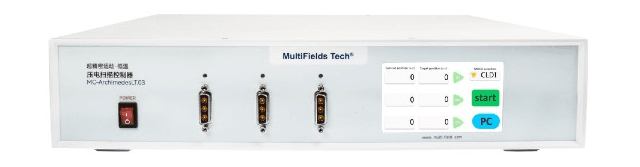
MC-ArchimedesLT Series
Scanner Controller
Engineered for ultra-low noise control of piezoelectric scanning stages. Minimizes mechanical vibration through optimized analog amplifiers. Ideal for cryogenic SPM applications.
- • **Models:** MC-ArchimedesLT.03 (3 ch scanner driver)
- • **Interface:** SPI communication for slave-master sync
- • **Noise level:** Sub-millivolt output noise
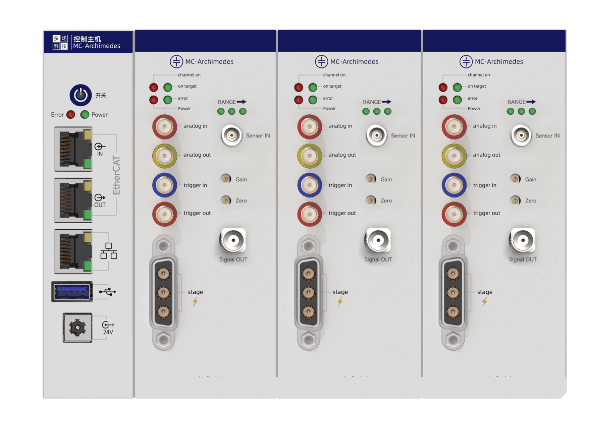
MC-ArchimedesLT.03.Ultra
Closed-Loop & High Speed
Multi-channel closed-loop scanner controller designed for our Ultra capacitive sensor stages. Features synchronous closed-loop calculation at high speeds to suppress creep and drift.
- • **Sampling Rate:** 50 kSa/s data acquisition & feedback
- • **Sensor Input:** Dual capacitive sensor input channels
- • **Real-Time Communication:** EtherCAT, EtherNET, USB 3.0
Ecosystem & Integration
Mounting, thermalisation and cabling inside the cryostat
Zolix provides all brackets, thermal links, non-magnetic hardware, and configurations required to install piezo stages directly onto cryostat cold fingers.
Stacking positioners into an XYZ tower
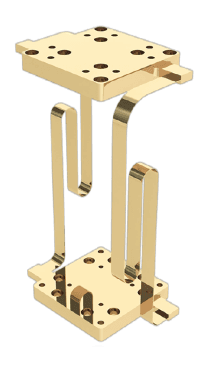
Pure-Ti adapter plates for stacking different series positioners together (e.g. Linear16 on Linear25, Scanner16 on Rotator25). Non-magnetic screws included.
- AP.LT.L16z — Linear16-z mount
- AP.LT.L16x — Linear16-x mount
- AP.LT.R16 — Rotator16 mount
- AP.LT.L25 — Scanner16 mount
Converting an XY stack to XZ
L-shaped Ti bracket for cross-mounting any positioner in vertical / horizontal orientation. Converts an XY stack into XZ, or side-mounts stages onto cryostat cold fingers.
Mounting to a standard optical table
Direct optical-table mounting plate — connects MultiFields positioners to standard M6 / ¼"-20 optical table grids. Anodized aluminum for room-temperature setups, Ti version for cryogenic mounting.
Repeatable remounting between cooldowns
Alternative direct optical-table mount with integrated alignment pins for repeatable positioner placement. Pre-routed connector pin-out for fast cable swap between experiments.
Heat sinking a stage that has to move
High-purity copper thermal braids keep the sample cold while the positioner moves in vacuum. Conducts heat away from the scanner stack without restricting translation or introducing mechanical strain.
Fasteners and connectors rated to 30 mK and 35 T
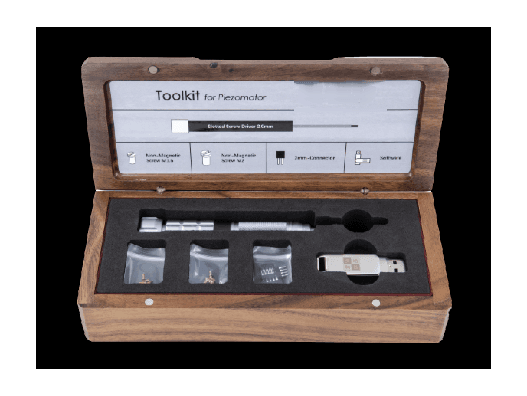
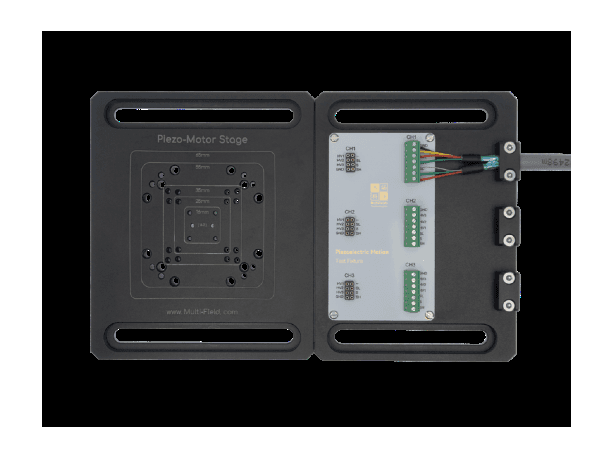
Complete cryo-compatible installation kit: BeCu screws (M1.6 / M2, 30 mK & 35 T compatible), PA-standard connectors (2/3/4-pin), Peek UHV connector set, multi-function screwdriver, tweezers, USB driver + manual.
Worked cryostat integrations
Zolix stages are natively designed for integration inside dilution cryostats, superconducting magnets, and vacuum chambers. Below are examples of operational mounting setups.
Multiaxis Cryogenic Tower
Concentric stacking of Linear and Goniometer stages creates a sub-nm XYZ-tilt platform on dilution refrigerators.
Superconducting Magnet Setup
Non-magnetic pure Titanium stages installed inside a 35 Tesla high magnetic field bore, working at He3 base temperatures.
STM/AFM Scanning Heads
Scanner Ultra series stages mounted directly beneath standard optical objectives, achieving closed-loop AFM scanning down to 30 mK.
tailored configurations
Designing a mounting layout for your cryostat
Our engineers and physicists work directly with your lab to design custom adapter brackets, select appropriate cabling, and advise on heat sinking techniques for dilution cryostats. No-obligation technical consultations, in person in the Netherlands and Belgium.
Where these are used
Applications in cryogenic, vacuum and high-field systems
Below about 10 K, conventional motors seize, lubricants freeze and heat load becomes the limiting factor. These stages are built for experiments where the environment is as demanding as the precision.
Quantum materials spectroscopy
Position samples inside dilution refrigerators for magneto-optical, Raman and photoluminescence measurement at millikelvin base temperatures.
Single-photon emitters & quantum dots
Locate and address individual emitters confocally at 4 K and below, then hold them under the objective for the length of a coherence measurement.
Low-temperature STM & AFM
Stick-slip coarse approach brings the tip into tunnelling range over millimetres; closed-loop fine scan then delivers sub-nanometre raster at base temperature.
High magnetic field experiments
Fully non-magnetic titanium construction operates inside superconducting magnet bores up to 35 T without force, heating or field distortion.
2D materials & heterostructures
Rotators and goniometers give angle-resolved access to van der Waals stacks, twist-angle devices and anisotropic transport measurements.
Cryo-optical microscopy & UHV
Vacuum ratings to 2 × 10⁻¹¹ mbar and thermal links that conduct heat away from a moving stack suit correlative cryo-imaging and surface science.
Before you specify
Guides for cryogenic and UHV motion
Translate temperature, pressure, travel and feedback requirements into a defensible shortlist.
 Precision motion
Selecting nanopositioners for cryogenic and UHV systems
Translate temperature, pressure, travel, payload, feedback, and motion requirements into a defensible cryogenic-stage shortlist.
Open guide Precision motion
How to integrate piezo nanopositioners into a cryostat
The practical companion to the selection guide: a requirements worksheet, coarse and fine stage pairing, mechanical stack order, thermal anchoring, the wiring chain to the controller, vacuum and field checks, a commissioning sequence, and three worked configurations.
Open guide NanopositioningPiezo drive architectures: stack, flexure, stick-slip, walking, ultrasonic
Piezo ceramic strains by one part in a thousand, so a 20 mm stack gives 20 µm. Every stage architecture is a different way around that limit — and each one wins a different experiment.
Open guide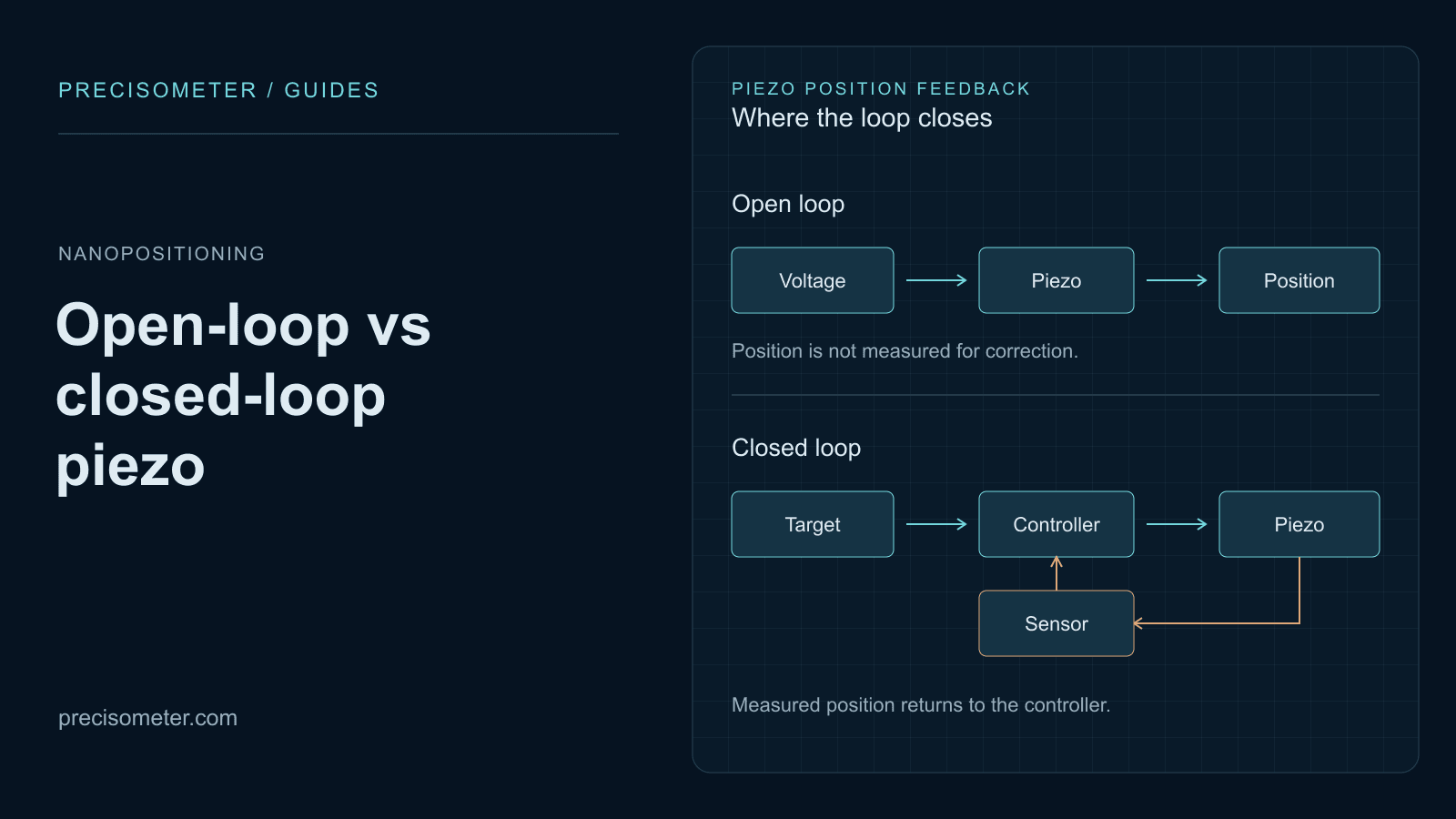 Nanopositioning
Open-loop vs closed-loop piezo
Why an open-loop piezo is wrong by 15 % of its travel, how creep grows with the logarithm of hold time, what strain-gauge and capacitive feedback actually fix — and the bandwidth and sensor noise a servo costs you in return.
Open guide