Ambient PiezoStages @ 300K
Zolix MultiFields® piezoelectric stages for room temperature, from single-axis stick-slip motor stages to 6-DOF parallel-kinematic platforms and capacitive-sensor scanners with sub-nanometer resolution.
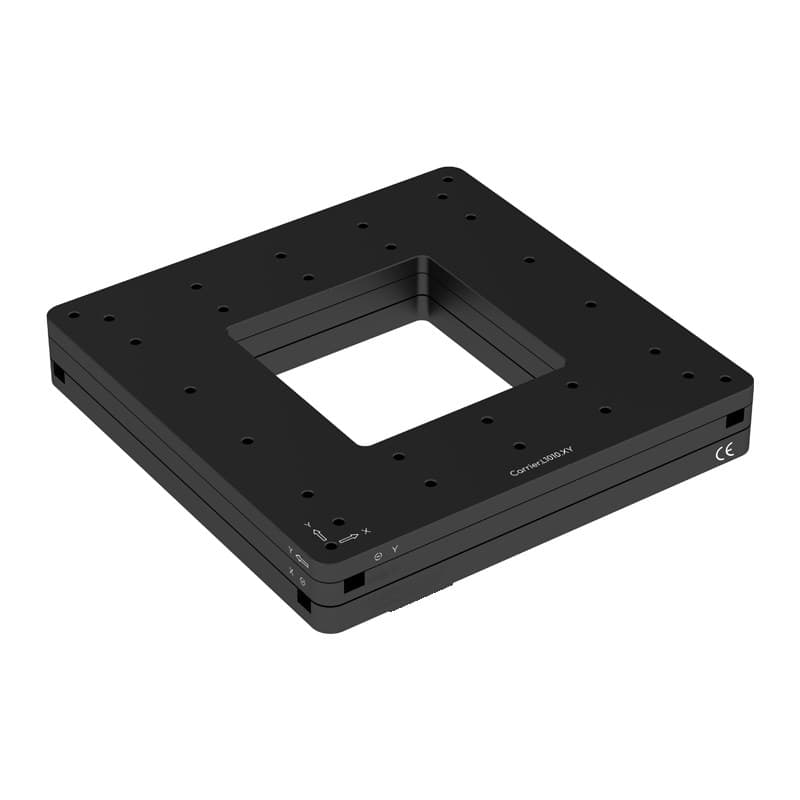
Choose by motion and environment
Compare piezo positioning stages and microscope scanners
Start with the required travel and motion: a piezo motor stage covers coarse positioning, while a flexure scanner handles fine motion. Open the model pages below to compare specifications and configuration options.
Swipe across the table to compare models and selection checks.
| Required motion | Models to compare | Selection checks |
|---|---|---|
| Coarse sample or optic positioning | Choose travel and load capacity for the mounted assembly. Specify encoder grade and the required air, HV, UHV or non-magnetic configuration. | |
| Microscope objective focusing | Compare Z travel, objective thread, moving mass and loaded dynamics. Resonant frequency is not the same as usable closed-loop bandwidth. | |
| Fine XYZ sample scanning | Compare closed-loop scan range, feedback, payload and clear aperture. Include sample holders and cabling in the moving load. | |
| Compact or multi-axis alignment | Check the complete mounting envelope and required degrees of freedom. A compact linear axis and a six-axis platform solve different alignment tasks. |
Specifying a vacuum-compatible nanopositioner
State the working pressure, bakeout temperature, operating temperature and magnetic field separately. HV, UHV, non-magnetic and cryogenic options describe different requirements; one option does not automatically satisfy the others.
For a UHV-compatible nanopositioning stage, confirm the selected materials, encoder, wiring and feedthroughs as an assembly. Include duty cycle and heat dissipation in the specification, especially when convection is unavailable.
Explore cryogenic and UHV piezo positionersFor camera-based microscopy, coordinate stage settling and exposure timing. Compare scientific CMOS cameras for the same setup.
Get help specifying the complete axis
Send the axes, travel, payload, available space, position-feedback requirement and operating environment. For microscopy, include the objective or sample holder and the required settling time. Precisometer can help identify a stage, controller and mounting configuration for quotation.
Sensor Resolution
0.5 nm Optical
Advanced grade — 2 nm Standard
Scanner Resolution
< 1 nm Closed-Loop
Capacitive feedback
Travel Range
up to 200 mm
Long-stroke LS200.Indus
Working Environment
Air · HV · UHV · NM
.HV / .UHV / .NM versions available
Interactive Configurator
Ambient Piezo Stages Configurator
Select standard room-temperature stages, scanners, mirror actuators, or multi-axis platforms. Adjust feedback sensors, select vacuum rating options, or specify custom requirements to configure your system.
LS35x.Lab Linear Piezo Stage (X)
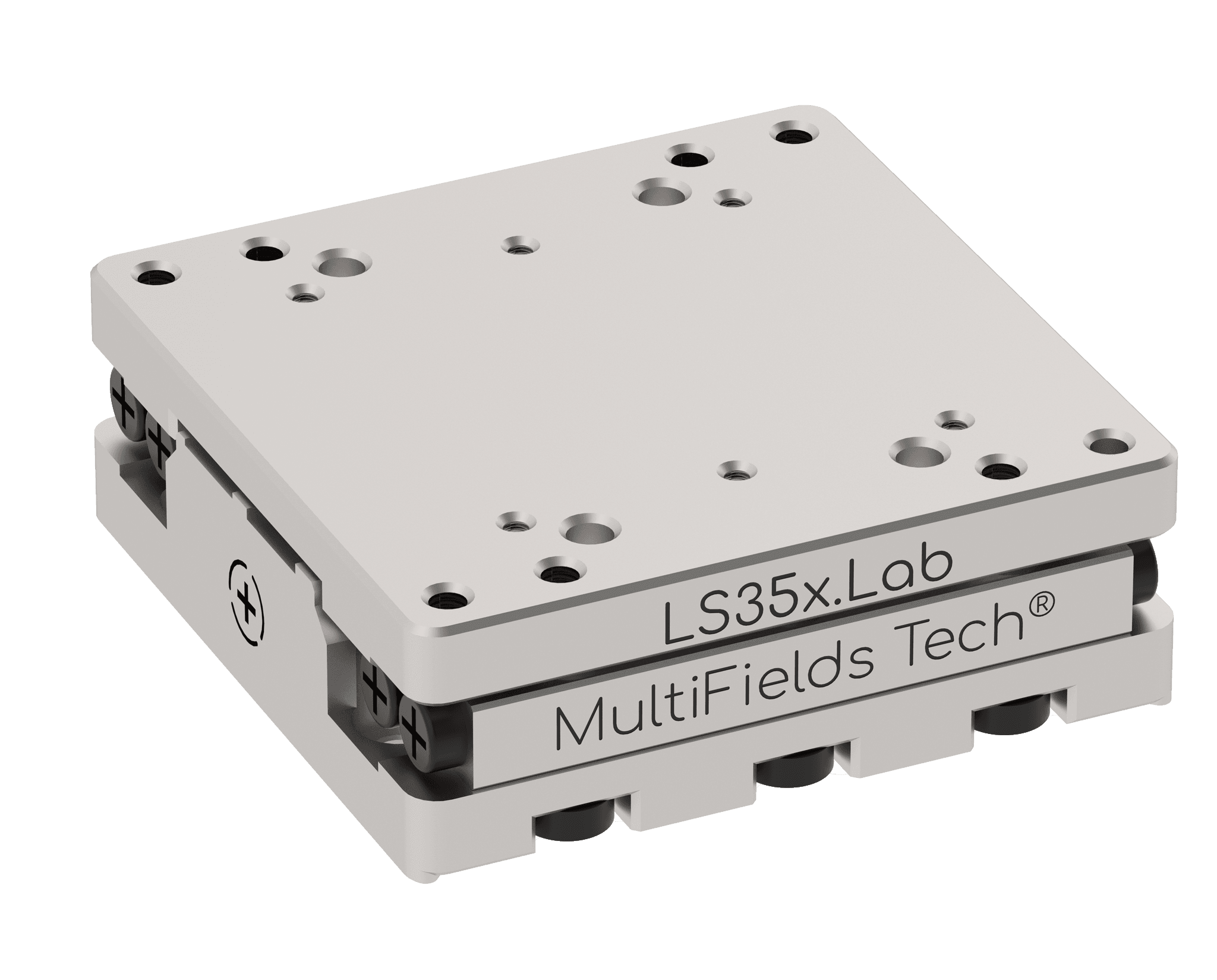
Identified Model Reference
LS35x.Lab
Specifications
- Footprint: 35 x 35 mm
- Travel: 20 mm
- Max payload: 500 g
- Sensor: 2 nm (Standard)
- Environment: Standard Room Air (300K)
Why choose this
Piezo-motor stage with 2 nm optical-encoder feedback — the choice for nanometre-repeatable positioning with real travel in a lab footprint.
We will match this configuration with Zolix room temperature piezo systems and provide the relevant STEP files and technical solution.
Before you specify
Choosing a room-temperature piezo positioner
At 300 K the constraints are travel, dynamics and feedback rather than thermal budget. Four questions settle the model before the part number does.
Piezo motor or piezo stack — millimetres or micrometres
These are two different machines. A stick-slip piezo motor stage (Lab, Indus, mini) walks over 6 to 200 mm of travel and holds position with no power once stopped. A piezo stack acting through flexure hinges (the S, Carrier and Mirrors families) covers tens to hundreds of micrometres with no sliding contact anywhere, which buys smooth continuous motion and millisecond response. If you need both — coarse approach and fine scan — they stack, and that is the normal arrangement rather than an either/or choice.
Speed drops to about a tenth of its rated value in vacuum
This is the specification most often missed. A Lab-series motor stage rated at roughly 20 mm/s in air is derated to about 10 % of that once it is running in vacuum, because a stick-slip drive depends on friction at the contact and on conducting the resulting heat away. Size the axis on the vacuum figure if the stage will live in a chamber, and budget the duty cycle accordingly — otherwise a scan that took a minute on the bench takes ten.
Three feedback technologies, one per job
The catalogue is not using one sensor everywhere. Motor stages carry an optical encoder — 2 nm on the standard grade, 0.5 nm on the .adv advanced grade, 50 nm on rotary. Flexure scanners use a capacitive sensor (the .C suffix) reading directly against the moving surface. Fast steering mirrors use strain gauges, which give the bandwidth that beam stabilisation needs rather than the ultimate linearity. Pick the axis by the sensor it carries, not only by its travel.
Closed-loop travel is shorter than open-loop travel
Closing the loop costs range, because the controller reserves headroom to correct within. An S100.XY.C covers 120 × 120 µm open-loop and 100 × 100 µm closed-loop; an S200 covers 240 × 240 µm against 200 × 200 µm. Specify against the closed-loop number whenever the application needs the sensor, and treat the open-loop figure as headroom rather than usable range.
Moving the objective or moving the sample
For focus stacks and z-series, an objective scanner drives the lens and leaves a liquid sample or a mounted cell undisturbed — usually the right call when the specimen is delicate or the medium can slosh. A Carrier stage moves the sample instead and takes the load, above 10 kg in the larger planar versions, which is what a heavy stage insert or a cryostat-adjacent fixture needs. Settling time rather than travel is normally the limiting specification in both cases.
Section 1
Stick-slip motor stages: millimetres of travel
Stick-slip inertial drive single-axis stages with optical encoder feedback. Stackable to build XY, XYZ, tip/tilt, and goniometer assemblies. Compatible with HV (10⁻⁷ mbar), UHV (2 × 10⁻¹¹ mbar), and non-magnetic environments.
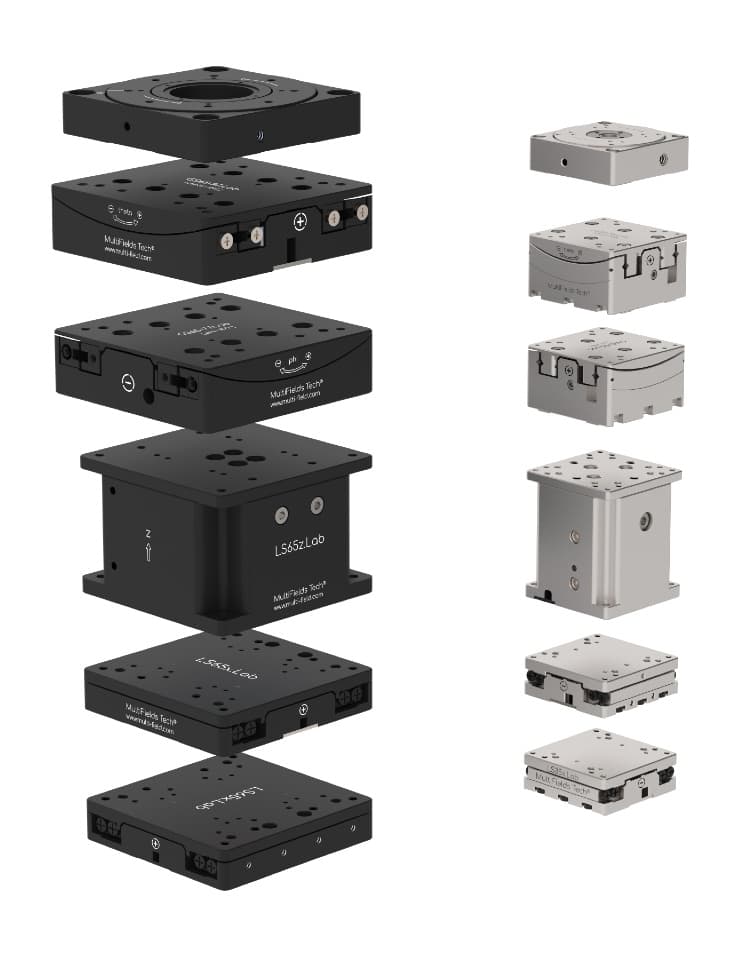
Balancing speed, load and footprint
35 mm and 65 mm size families with optical encoder closed-loop control. Highly stackable to build multi-axis combinations. Three quality grades — Standard (2 nm), Cost-Effective (50 nm), Advanced (0.5 nm) — and 80 mm / 105 mm large-load options.
Standard
2 nm sensor
.Lab
Cost-Effective
50 nm sensor
.Lab.E
Advanced
0.5 nm sensor
.Lab.adv
Linear Motion Stages (LS · RS · GS)
| Model | Motion | Footprint | Travel / Range | Max. Load |
|---|---|---|---|---|
| LS35x.Lab | X (linear) | 35 × 35 mm | 20 mm | 1 kg (100 g vertical) |
| LS35z.Lab | Z (elevation) | 35 × 35 mm | 10 mm | 500 g |
| RS35.Lab | Rz (rotary) | 35 × 35 mm | 360° endless | 300 g |
| GS35-35.Lab | Tx (gonio θ) | 35 × 35 mm | ±8°, R=35 mm | 1 kg |
| GS35-55.Lab | Ty (gonio φ) | 35 × 35 mm | ±8°, R=55 mm | 1 kg |
| LS65x.Lab | X (linear) | 65 × 65 mm | 30 mm | 2 kg (100 g vertical) |
| LS65z.Lab | Z (elevation) | 65 × 65 mm | 10 mm (20 mm option) | 500 g |
| RS65.Lab | Rz (rotary) | 65 × 65 mm | 360° endless | 2 kg |
| GS65-77.Lab | Tx (gonio θ) | 70 × 70 mm | ±10°, R=77 mm | 2 kg |
| GS65-97.Lab | Ty (gonio φ) | 70 × 70 mm | ±10°, R=97 mm | 2 kg |
| LS80z.Lab | Z (elevation) | 80 × 80 mm | 10 mm | 1 kg |
| LS105x.Lab | X (linear) | 105 × 105 mm | 40 mm | 5 kg |
All models available in .HV / .UHV / .NM vacuum + non-magnetic variants. Add .E (cost-effective) or .adv (advanced sensor) suffix.
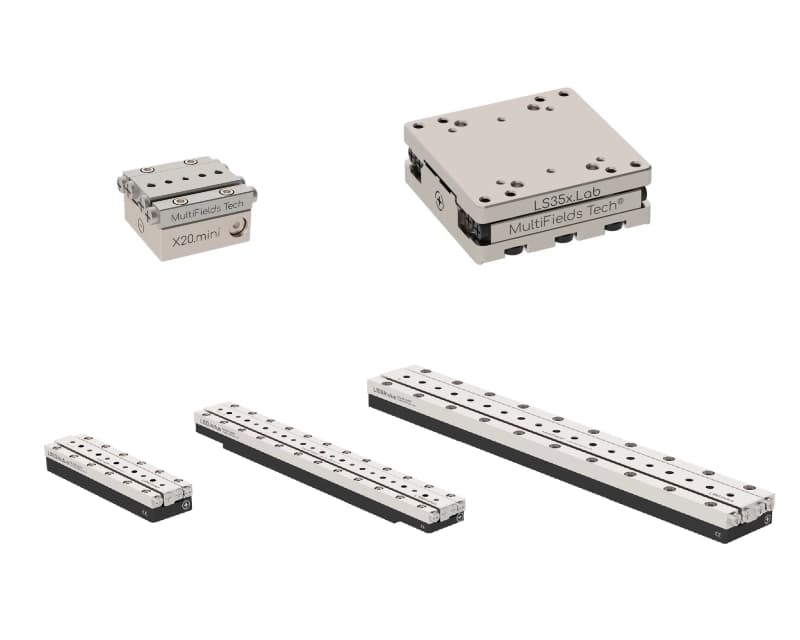
Long travel for industrial integration
Quiet motion with self-locking and nanometer resolution. Five travel-range options from 30 mm to 200 mm in a narrow 24 mm (or 36 mm) footprint — designed to drop into existing experimental setups. Optical encoder 2 nm resolution.
| Model | Travel | Footprint | Mass | Max. Load |
|---|---|---|---|---|
| L030.Indus | 30 mm | 60 × 24 × 14 mm | 110 g | 1 kg |
| L060.Indus | 60 mm | 105 × 24 × 14 mm | 174 g | 1 kg |
| L100.Indus | 100 mm | 180 × 24 × 14 mm | 388 g | 2 kg |
| L150.Indus | 150 mm | 250 × 36 × 16.5 mm | 840 g | 3 kg |
| LS200.Indus | 200 mm | 80 × 295 × 20 mm | 1050 g | 2 kg |
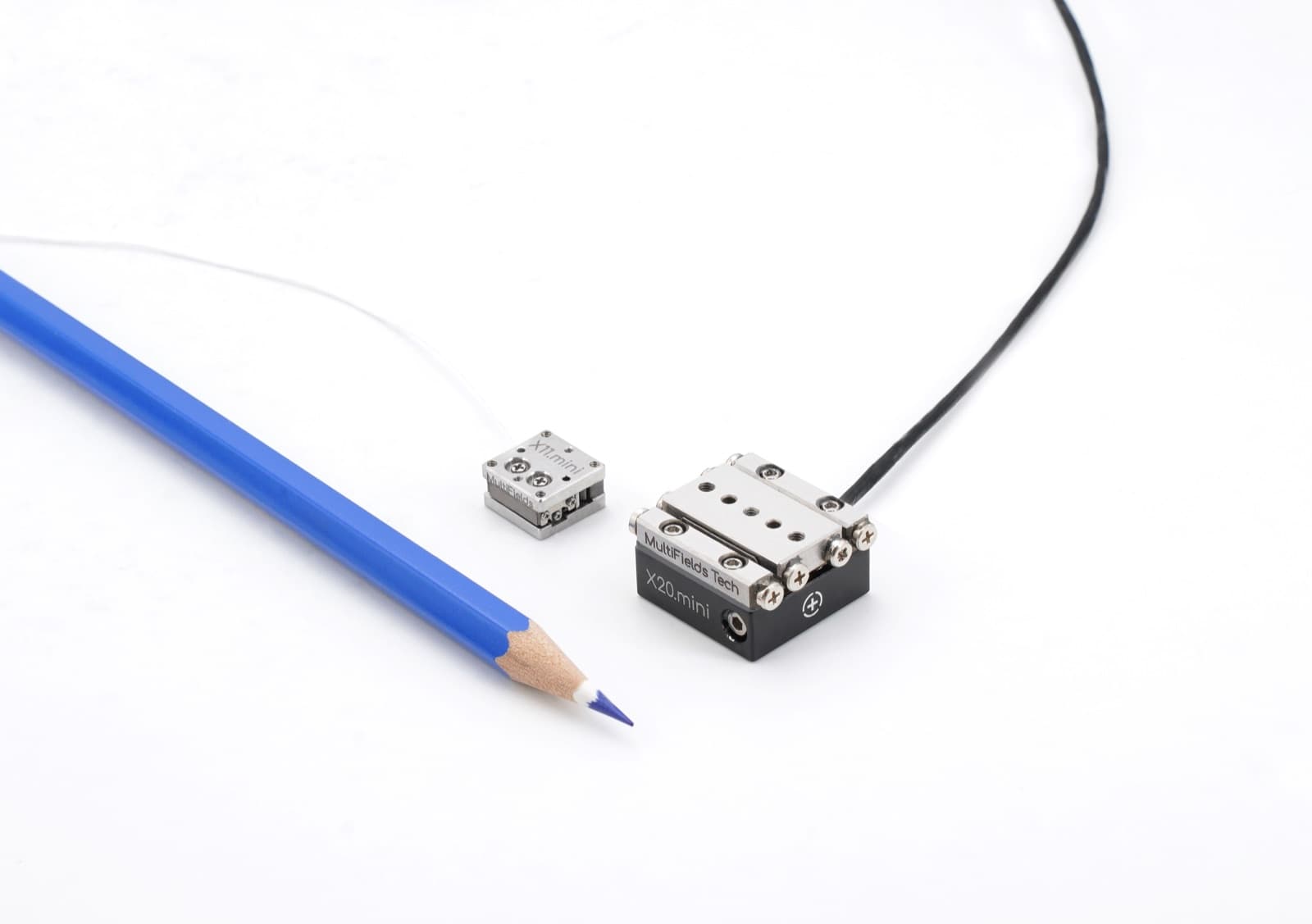
Fitting an axis into a confined assembly
Tiny structure, quiet motion, self-lock, nanometer resolution. Sub-15 mm footprint stages for space-constrained setups, in-vacuum experiments, and integrating into compact optical assemblies.
X11.mini
11 × 11 × 6.5 mm
- Travel
- 6 mm
- Resolution
- < 1 nm
- Max. Payload
- 50 g
- Mass
- 10 g
X20.mini
20 × 20 × 12 mm
- Travel
- 10 mm
- Resolution
- 2 nm
- Max. Payload
- 300 g (H) / 100 g (V)
- Mass
- 30 g
Section 2
Multi-axis platforms and planar sample carriers
Parallel-kinematic platforms with 3 or 6 simultaneous axes, and integrated XY microscopy carriers — single stiff platform, no stacking error, programmable virtual pivot.
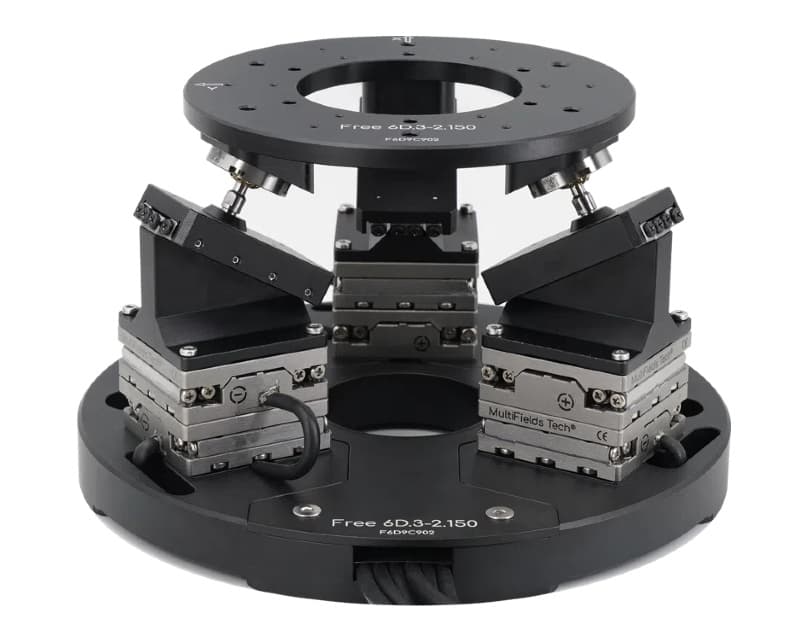
Six degrees of freedom about one point
Multi-DoF parallel-kinematic stages with long travel range. All struts move in concert — no stacked-axis angular error. Programmable virtual pivot, optical sensor feedback, paired with the dedicated MC-Free6D controller.
| Model | Axes | Linear Travel | Angular Travel | Max. Payload |
|---|---|---|---|---|
| Free3D.ZTxTy.150 | Z + Tx + Ty | ±5 mm | ±3° / ±3° | 3 kg |
| Free6D.3-2.150 | 6-DoF | ±10 / ±10 / ±5 mm | ±10° / ±10° / ±20° | 1 kg |
| Free6D.3-2.070 | 6-DoF compact | ±5 / ±5 / ±2.5 mm | ±16° / ±13° / ±26° | 100 g |
Free3D resolution: Z 25 nm, θ 7.5 µrad. Free6D resolution: XYZ 20 nm, θ 1 µrad. Capacitive sensor feedback on each strut.
Carrying a heavy sample across millimetres
Large-aperture XY planar stages for sample positioning under inverted or upright microscopes. Compatible with standard slide holders and stackable with piezo scanners for combined coarse + fine motion.
| Model | Travel Range | Aperture | Max. Payload | Resolution |
|---|---|---|---|---|
| Carrier.L7550.XY | 75 × 50 mm | 85 × 65 mm | 2 kg | 10 nm |
| Carrier.L1010.XY | 100 × 100 mm | 120 × 120 mm | 4 kg | 10 nm |
| Carrier.L1010s.XY | 100 × 100 mm | 20×20 mm (full) / 50×50 mm (≤ 70×70 mm) | 4 kg (2 kg vacuum) | 10 nm |
Section 3
Flexure scanners with capacitive feedback
Piezo-stack-driven flexure-guided nanopositioners with direct capacitive sensor metrology, sub-nanometer closed-loop resolution, kHz-range bandwidth. Compact and clear-aperture configurations.
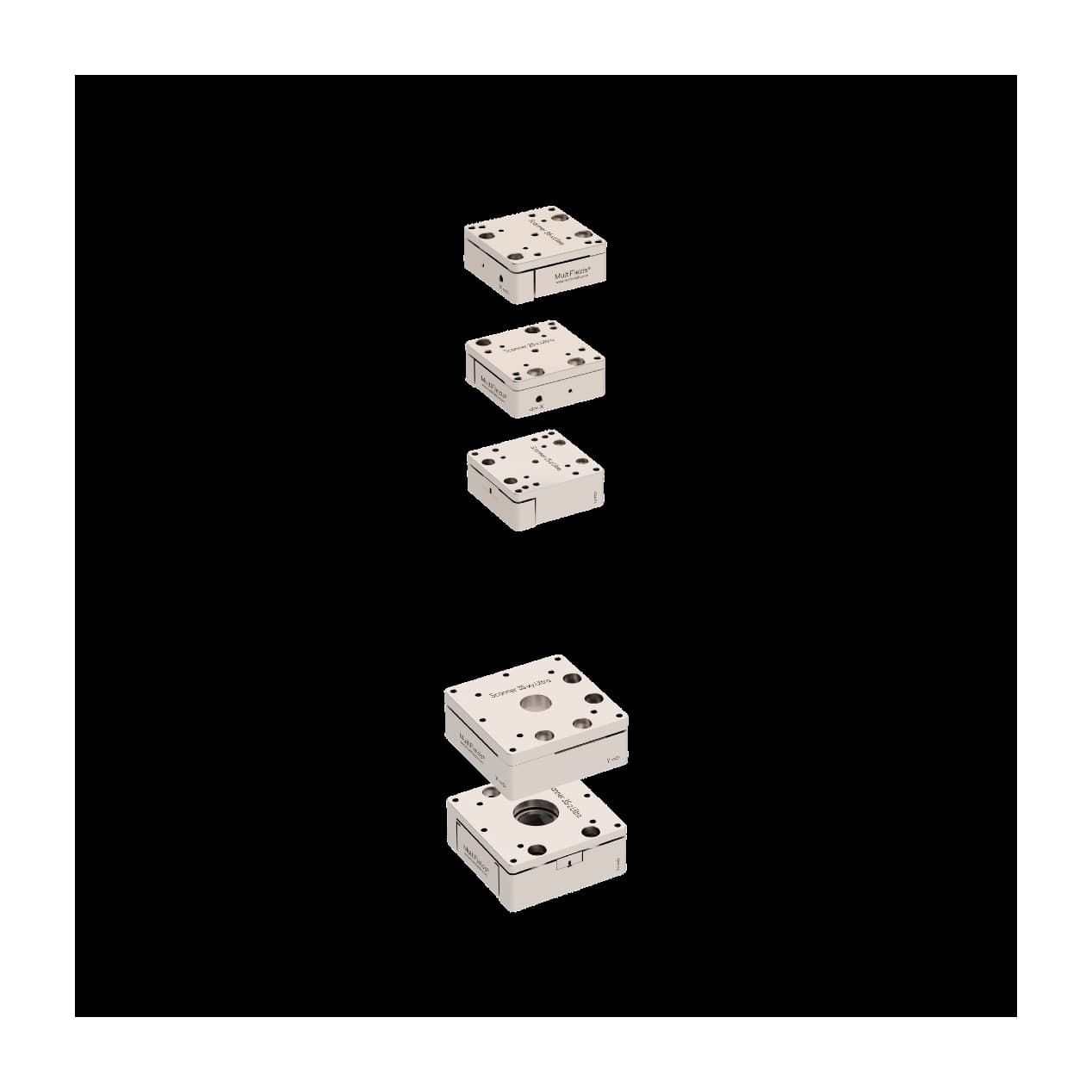
Sub-micrometre scanning in a small footprint
Three variants: S series (long travel, 100–500 µm), SD series (high dynamic, ms response, kHz bandwidth), SH series (high load, 10 kg). 1, 2, or 3 axes. Closed-loop resolution down to 0.5 nm.
S Series — Long Travel
| Model | Axes | Travel | Resolution |
|---|---|---|---|
| S100.X.C / S100.Z.C | 1 (X or Z) | 100 µm | 0.5 nm |
| S300.X.C / S300.Z.C | 1 (X or Z) | 300 µm | 0.9 nm |
| S500.X.C | 1 (X) | 500 µm | 1.5 nm |
| S100.XY.C | 2 (XY) | 100 × 100 µm | 1 nm |
| S200.XY.C | 2 (XY) | 200 × 200 µm | 1.5 nm |
| S300.XY.C / S500.XY.C | 2 (XY) | 300 / 500 µm | ~ 1.5 nm |
| S100.XYZ.C | 3 (XYZ) | 100 × 100 × 100 µm | 1 nm |
| S200.XYZ.C | 3 (XYZ) | 200 × 200 × 200 µm | 1.5 nm |
| S100.XYZ.C.P | 3 (XYZ parallel) | 100 × 100 × 100 µm | 1 nm |
SD · High Dynamic
- SD15.X.C — 15 µm, 3.3 kHz
- SD30.X.C — 30 µm, 2.2 kHz
- ms response time, 28 N/µm stiffness
SH · High Load
- SH30.XYZ.C — 30×30×15 µm, 10 kg
- 160 × 160 mm footprint, 500 Hz bandwidth
Driving the objective instead of the sample
Objective-mounted piezo scanners for microscope autofocus, photon laser scanning, and Z-stacking. M25×0.75 standard objective thread, optional autofocus integration. High-load variant for heavy oil-immersion objectives.
| Model | Travel | Resonant Freq (150 g) | Resolution (Close-loop) |
|---|---|---|---|
| Carrier.OB100.C | Z 100 µm | 250 Hz | 1 nm |
| Carrier.OB200.C | Z 200 µm | 220 Hz | 3 nm |
| Carrier.OB400.C | Z 400 µm | 165 Hz | 5 nm |
| Carrier.OBHL100.C | Z 100 µm (high load) | 560 Hz | 1 nm |
| Carrier.OB200.XY.C | XY 200 × 200 µm | 300 Hz | 2 nm |
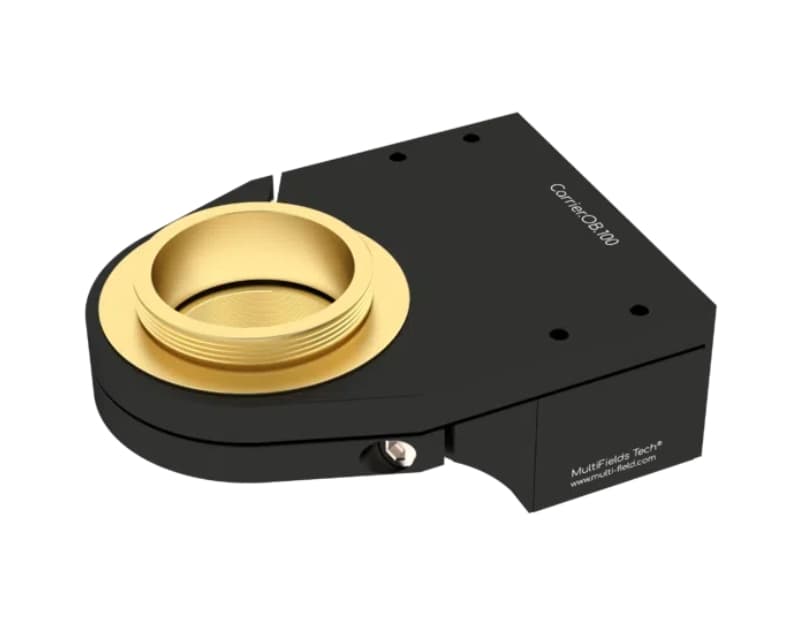
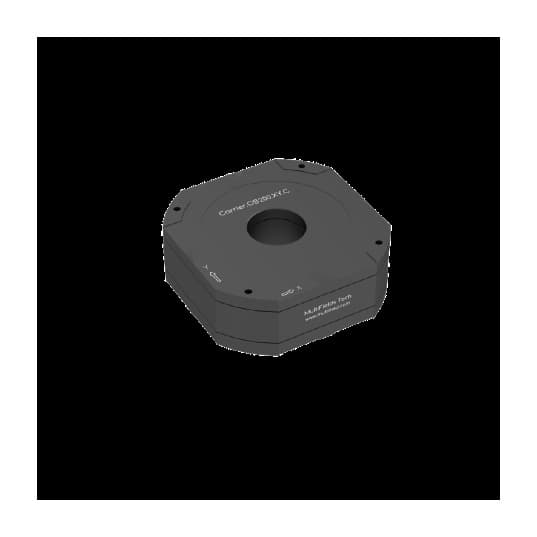
Objective Scanner Use Cases
- Z-stacking & autofocus on inverted microscopes
- Photon laser scanning (confocal / multi-photon)
- XY beam scanning behind objective
- High-throughput slide imaging
- Sub-nm focus stability for super-resolution
Scanning with a clear optical aperture
Versatile clear-aperture scanners with capacitive parallel metrology — 1 to 6 axes in a 150 × 150 mm body with 66–80 mm aperture. Three travel ranges (100 / 200 / 300 µm) covering Z, XY, XYZ, XYRz, ZTxTy, and full 6-DoF configurations.
| Configuration | 100 µm Travel | 200 µm Travel | 300 µm Travel |
|---|---|---|---|
| 1-axis Z | Carrier.S100.Z.C | Carrier.S200.Z.C | — |
| 2-axis XY | Carrier.S100.XY.C | Carrier.S200.XY.C | — |
| 3-axis XYZ | Carrier.S100.XYZ.C | Carrier.S200.XYZ.C | Carrier.S300.XYZ.C |
| 3-axis XY + Rz | Carrier.S100.XYRz.C (±1 mrad) | Carrier.S200.XYRz.C (±2 mrad) | — |
| 3-axis Z + Tx Ty | Carrier.S100.ZTxTy.C (±1 mrad) | Carrier.S200.ZTxTy.C (±2 mrad) | — |
| 6-axis XYZ + TxTyRz | Carrier.S100.XYZTxTyRz.C | Carrier.S200.XYZTxTyRz.C | — |
5 kg payload, ≤ 0.03 % linearity, 10 nm repeatability across the family. 66 × 66 mm to 80 × 80 mm clear aperture depending on motion direction.
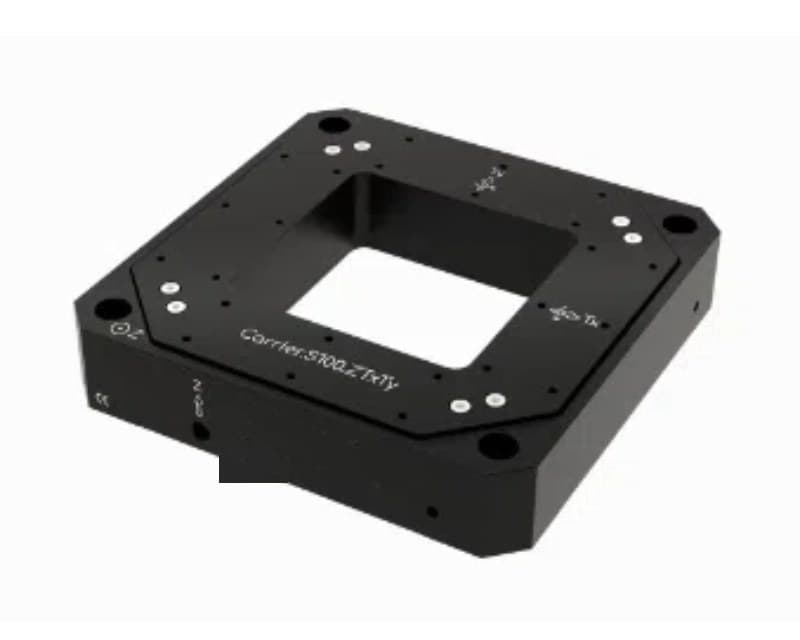
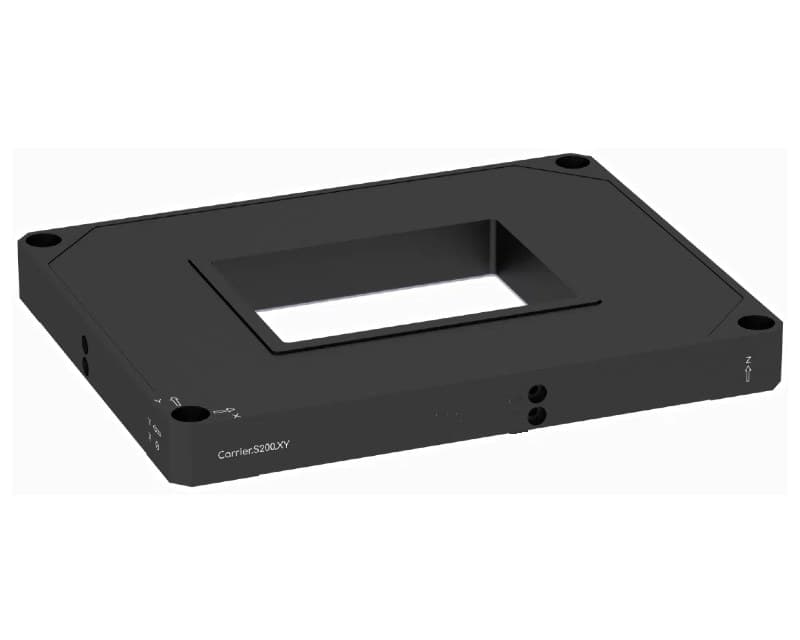
Low-profile stages with a large aperture
Large 77 × 65 mm clear aperture with low 19.5 mm profile — designed to stack on Carrier.L7550 microscopy stages. 200 × 200 µm or 200 × 200 × 200 µm travel, 500 g payload, 2 nm resolution.
Carrier.SL200.XY.C — 200 × 200 µm XY
Carrier.SL200.XYZ.C — 200 × 200 × 200 µm XYZ
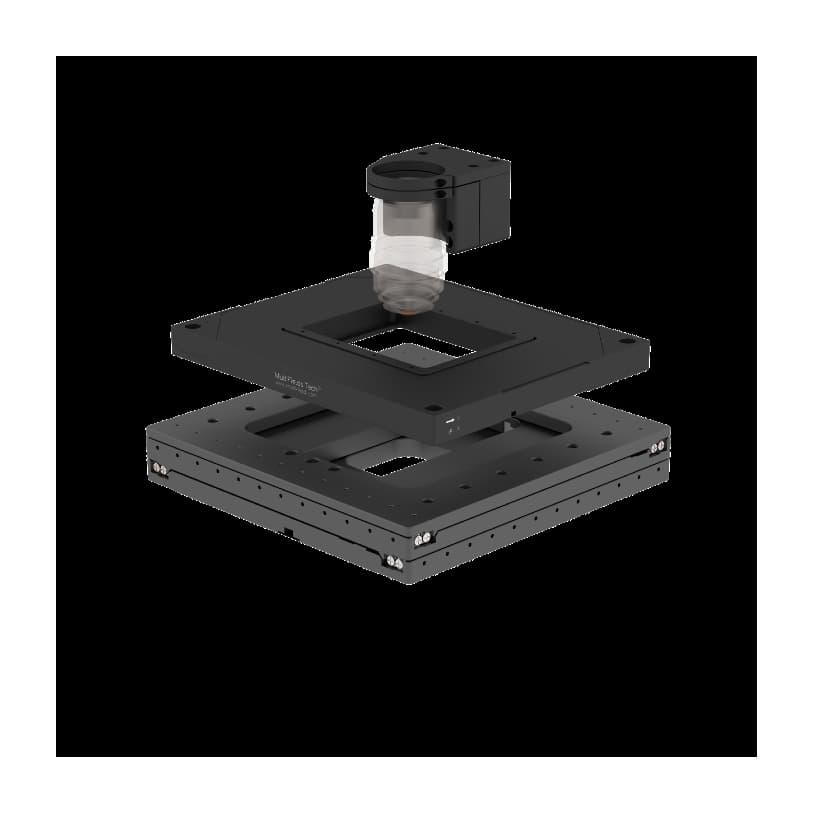
Combined Microscopy Stack
Sample · Focus · Scan
Typical microscopy stack combining coarse + fine motion in three stages:
- Carrier.L1010s.XY — coarse
- Carrier.SL200.XYZ.C — scan
- Carrier.OB400.C — focus
Section 4
Steering a beam and motorising a mount
Fast steering mirrors with strain-gauge sensor feedback, and piezo-driven motorized mirror mount actuators that retrofit onto standard 1″ / 2″ mirror mounts.
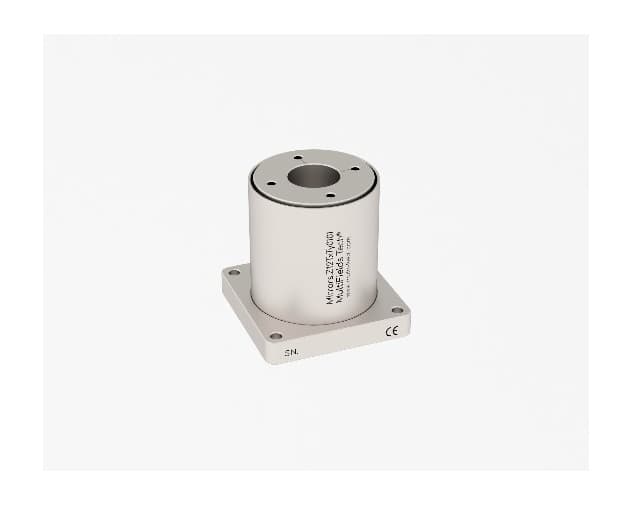
Stabilising and scanning a beam
Dynamic, robust, compact beam-steering platforms. SGS strain-gauge closed-loop control with ms response, sub-µrad resolution, kHz bandwidth. Z-only (piston), 2-axis tip/tilt, and tripod 3-axis configurations.
| Model | Motion | Travel (Close-loop) | Resonant Freq. |
|---|---|---|---|
| Mirrors.Z12 | Z (piston) | 12 µm | 4 kHz |
| Mirrors.TxTy.0303 | Tx + Ty (short) | ±1.5 mrad / ±1.5 mrad | 2 kHz |
| Mirrors.TxTy.1010 | Tx + Ty (mid) | ±5 mrad / ±5 mrad | 1 kHz |
| Mirrors.Z12TxTy0101 | Z + Tx + Ty (tripod) | 12 µm + ±1 mrad × 2 | 5.5 kHz |
All Mirrors series available in .NM (non-magnetic), .HV, and .UHV variants. Controllers: MC-Archimedes.N (closed-loop, multi-channel).
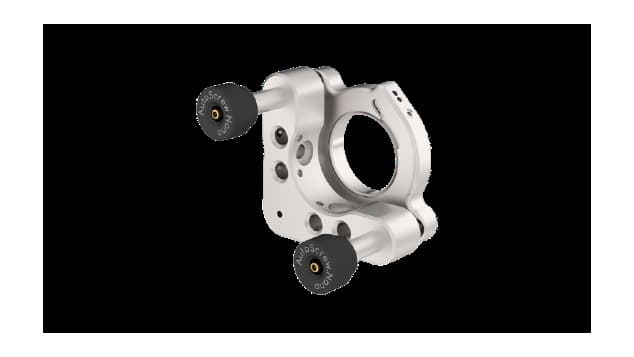
Motorising an existing kinematic mount
Piezo screw actuators that retrofit onto standard kinematic mirror mounts (1″ and 2″ optics). Two variants: AutoScrew.LR for long-stroke 10 mm coarse motion, AutoScrew.Nano for sub-nm dynamic tuning. Both self-locking.
AutoScrew.LR · Long Stroke
10 mm travel
- Min. Motion
- 20 nm
- Max. Output
- 20 N (up to 50 N)
- Holding Force
- 100 N
- Velocity
- 2 mm/min
.Set.01 — 1″ optic, ±4°
.Set.02 — 2″ optic, ±3°
AutoScrew.Nano · Dynamic
18 µm travel
- Resolution
- 1 nm
- Max. Output
- 300 N
- Driving V
- 0 – 120 V
- Mass
- 9.5 g
.Set.01 — 1″ optic, 0.5 mrad
.Set.02 — 2″ optic, 0.3 mrad
Drive electronics, APIs and control interfaces
Four dedicated controller families, one per stage class. All support LabVIEW, C++, Python via PC GUI / SDK.
Single-Channel Piezo Motor
For Lab, Indus, Mini, and Carrier piezo motor stages. Open-loop + closed-loop with optical encoder. Hardware trigger, analog input, USB / EtherNet / RS485.
- • 0 – 75 V output · 30 W max
- • 136 × 131 × 32 mm, IEC inlet
- • PC GUI + SDK · hardware trigger SMA/TTL
Modular rack — up to 10 channels
Modular Multi-Channel
Modular design — stack 1 to 10 channels in a single chassis. Same control features as MC-Newton.S plus EtherCAT (on request). For multi-axis Lab / Carrier / Indus assemblies.
- • 30 W per channel · 100 W total
- • USB · EtherNet · RS485 · EtherCAT
- • 136 × 131 × (32 × (x+1)) mm
6-channel hexapod controller
6-DOF Hexapod Controller
Dedicated 6-channel controller for FreeXD series parallel-kinematic stages. Parallel kinematic algorithm, 3D module simulation, trajectory distribution, user-defined virtual pivot.
- • 6 channels · 200 × 200 × 140 mm
- • DB15 × 6 · USB-C / EtherNet / EtherCAT
- • 20 kHz max frequency · 100 W output
N ≤ 8 channels modular FPGA
Piezo Scanner Controller
For S / SD / SH / Carrier.OB / Carrier.S / Carrier.SL / Mirrors scanner series. FPGA architecture, fully digital process, digital linearization. Capacitive or strain gauge sensor input.
- • N channels (N ≤ 8) · 20 / 50 kHz sample rate
- • −20 to 150 V output · 24 W per channel
- • Hardware trigger · USB / EtherNet
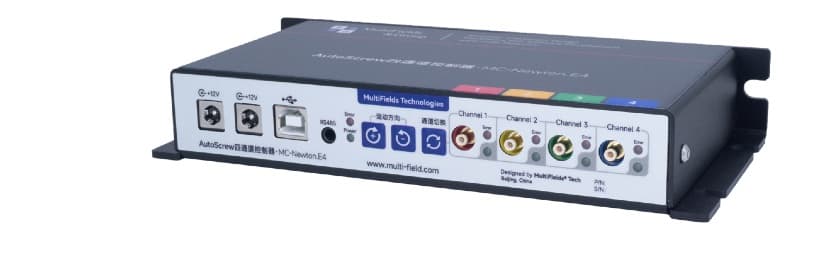
Piezo Screw Actuator Controller — 4 Channels
Cost-effective 4-channel open-loop stepping controller for AutoScrew.LR and AutoScrew.Nano mirror-mount actuators. USB interface, ASCII command set, manual front-panel control.
120 V
Driving
2 kHz
Frequency
4 ch
Channels
USB
Interface
Custom Configurations
Multi-axis assemblies, custom adapter plates
Our engineers spec multi-axis stacks, design adapter plates between Lab / Carrier / Scanner platforms, and integrate the full motion + control + cabling solution. In-person consultation in the Netherlands and Belgium.
Where these are used
Applications for room-temperature nanopositioners
Piezo stages earn their place wherever a measurement is limited by how precisely, repeatably and quietly the sample can be moved — not by the optics in front of it.
Super-resolution & single-molecule imaging
STORM, PALM and single-particle tracking need nanometre sample stability across acquisitions lasting minutes. Closed-loop capacitive feedback holds position while the camera integrates.
Confocal & multiphoton Z-sectioning
Objective scanners move the lens instead of the sample, so optical sections can be stepped in milliseconds without disturbing live specimens or immersion media.
AFM & scanning probe microscopy
Capacitive closed-loop XY scanners raster linearly and repeatably, removing the hysteresis and creep that distort open-loop probe images.
Photonic device & waveguide testing
Sub-nanometre steps let you walk a fibre or probe onto a waveguide mode and hold peak coupling while the device is characterised.
Semiconductor metrology & inspection
Short travel with fast settling suits step-and-measure inspection under high-NA objectives, where every millisecond of settling multiplies across the wafer.
Interferometry & beam steering
Piezo actuators and tip/tilt mirror platforms provide phase stepping, cavity length tuning and closed-loop beam stabilisation with no backlash.
Before you specify
Guides for nanopositioning
Feedback, travel and payload, plus the drift and vibration budget a nanopositioner has to survive.
 Nanopositioning
Choosing a piezo stage for microscopy: sample scanning or objective focusing?
Decide what to move — sample, objective or both — then turn field of view, stack depth, settling and synchronisation into stage specifications. Comparison tables, an acquisition-time calculator, three configurations and a purchasing checklist on documented objective scanners, clear-aperture XYZ stages and controllers.
Open guide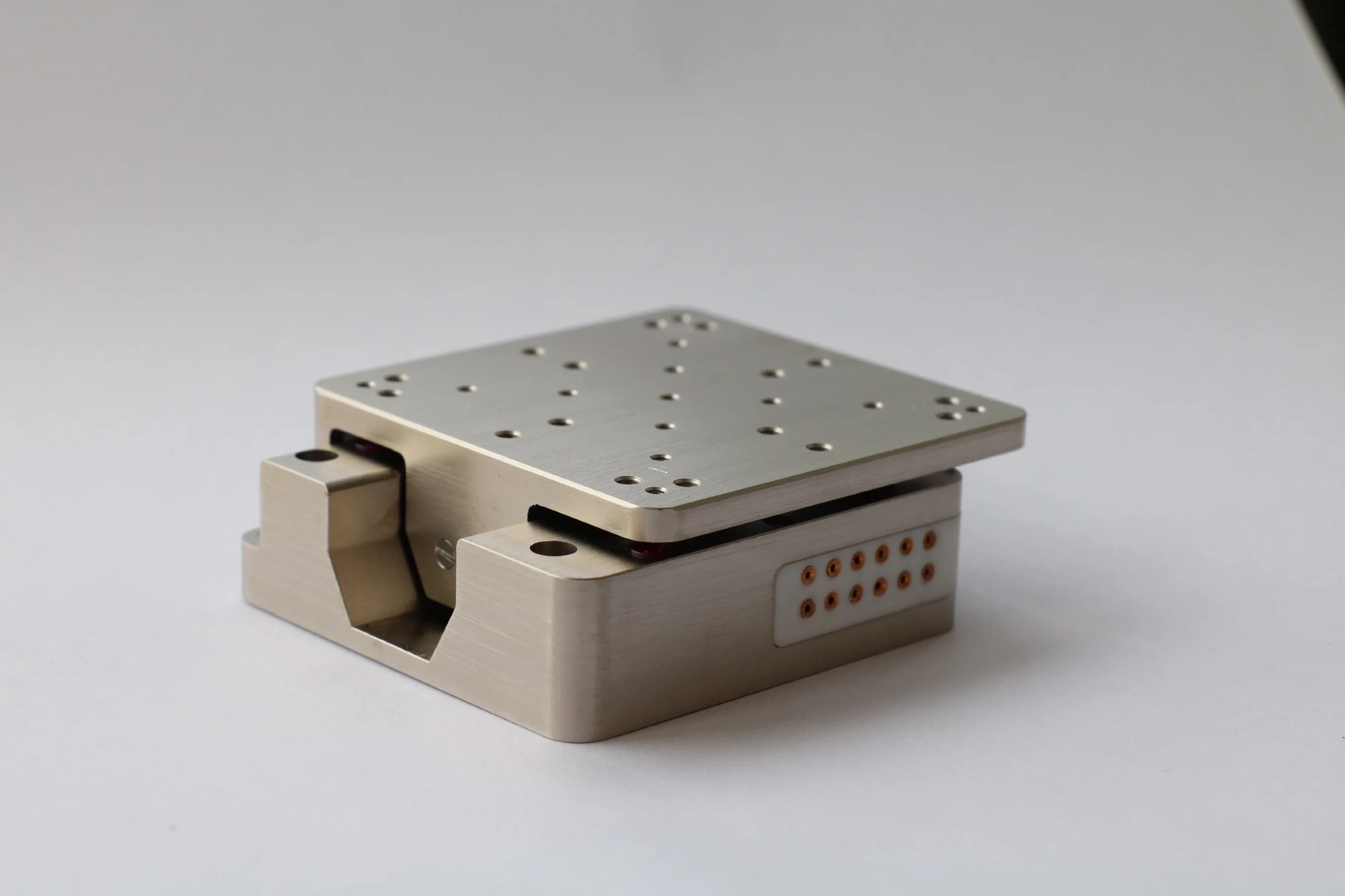 Nanopositioning
Piezo drive architectures: stack, flexure, stick-slip, walking, ultrasonic
Piezo ceramic strains by one part in a thousand, so a 20 mm stack gives 20 µm. Every stage architecture is a different way around that limit — and each one wins a different experiment.
Open guide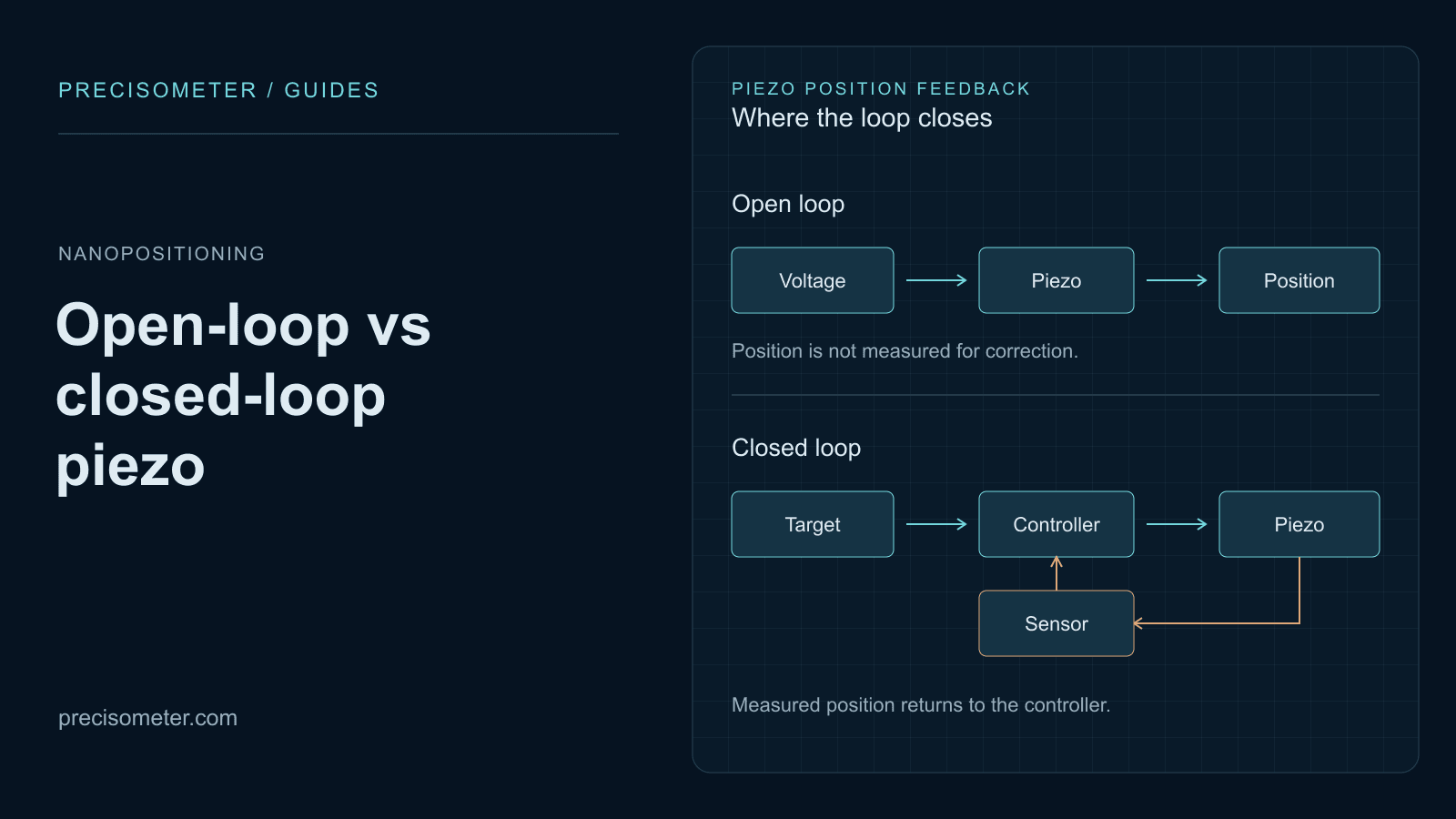 Nanopositioning
Open-loop vs closed-loop piezo
Why an open-loop piezo is wrong by 15 % of its travel, how creep grows with the logarithm of hold time, what strain-gauge and capacitive feedback actually fix — and the bandwidth and sensor noise a servo costs you in return.
Open guide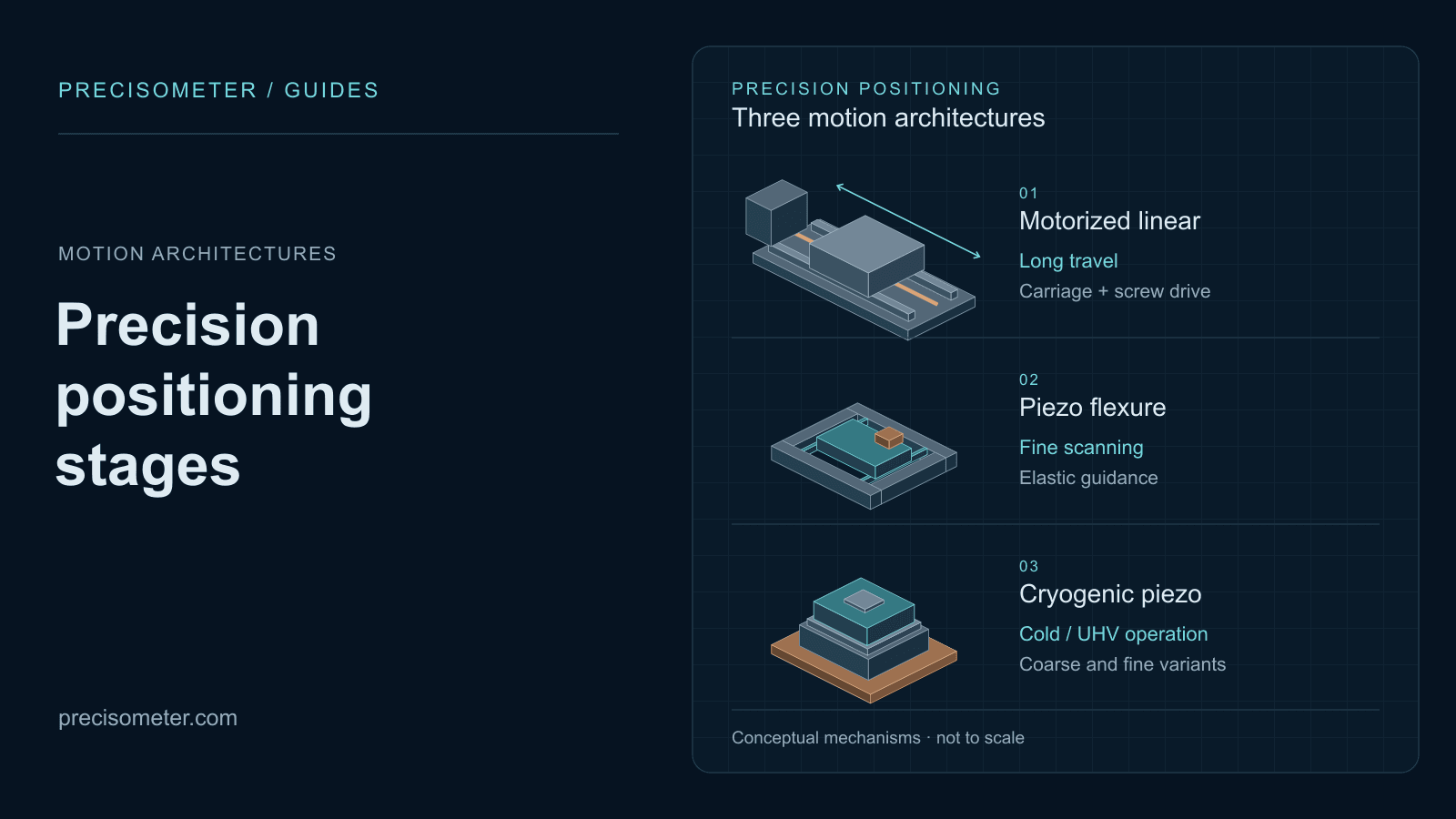 Precision motion
How to Choose a Precision Positioning Stage: Linear, Piezo, or Cryogenic Piezo?
Match travel, resolution, speed, load, vacuum, temperature, and magnetic field requirements to motorized linear, ambient piezo, or cryogenic piezo positioning architectures.
Open guide