Compare the details
Technical specifications
Compare the listed configurations and match the specifications to your setup.
Jump to a specification table (2)
12 specification rows.
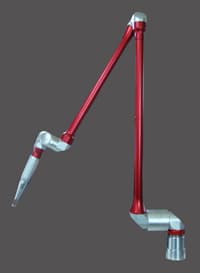
Counterbalanced beam-delivery arms
7 entriesScroll horizontally to compare all columns
| Model / configuration | Counterbalance | Laser compatibility |
|---|---|---|
| S-6 | Spring mechanism | YAG / CO₂ |
| S-7 | Spring mechanism | YAG / CO₂ |
| SM-1 / SM-2 | Spring mechanism | Confirm selected configuration |
| WL-7 | Weight | YAG |
| WS-7 | Weight | CO₂ |
| WC-7 | Weight | CO₂ |
| W-1 / W-2 / W-3 / W-4 | Weight | Confirm selected configuration |
Integration options
5 entries| Parameter | Options |
|---|---|
| Articulated joints | 6 or 7 |
| Focusing lens focal length | 50, 75, 100, 125, 150, 200 or 400 mm |
| Source interface | Laser mount plate and coupling hardware |
| Process interface | Handpiece adapter |
| Finish | Custom arm color available |
Build around your experiment
What to specify
Share these details with your enquiry so we can match the component to your optical setup.
- 01Laser wavelength, CW power or pulse energy, input beam diameter and polarization.
- 02Required reach, joint arrangement, counterbalance and mounting geometry.
- 03For 532 nm PIV, confirm wavelength-specific mirror coatings, aperture, transmission and pulse-energy compatibility; CO₂ or YAG labeling alone does not establish compatibility.
Technical FAQ
Configuration questions for Articulated Arm
What is the Articulated Arm made from?
Finish: Custom arm color available. Aluminium moves about 23 ppm per kelvin and stainless about 16. In a path where thermal drift is already budgeted, the material of the mount belongs in that budget rather than in the appearance of the part.
Technical documents
Keep the specifications at hand when planning your setup.
Download datasheet (PDF)Talk through your setup
Find the right configuration
Add this component to your enquiry and include your requirements. We will help specify the variant, interfaces and mounting.