Low-dissipation fine scan
No sensor excitation means no additional heat load where the cooling budget is tight.
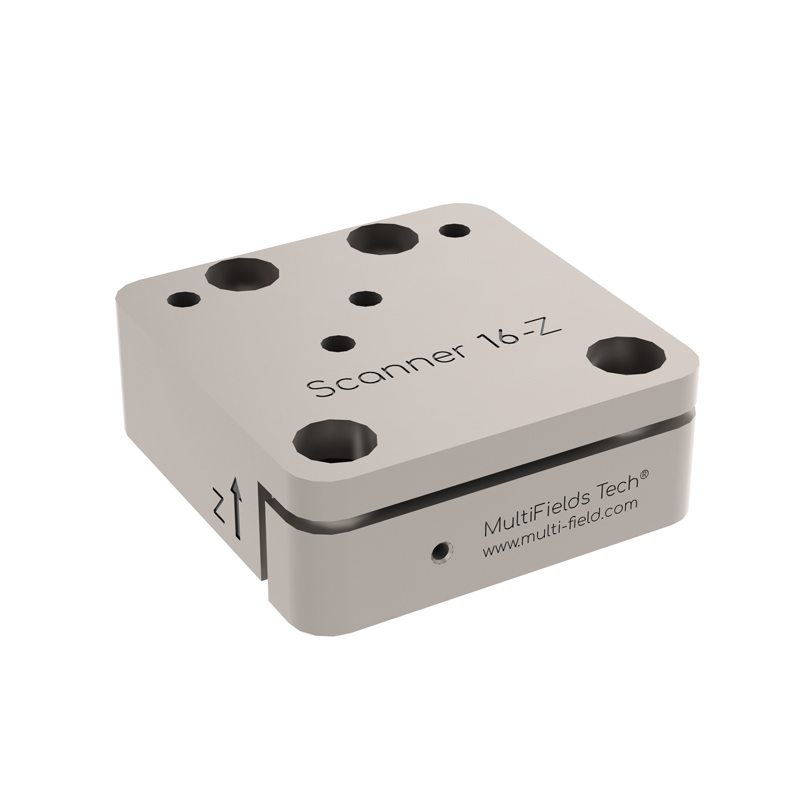
Opto-Mechanics · Cryogenic Piezo Stages - Open-loop scanners
Open-loop cryogenic Z optic scanner; 35 x 35 x 14.5 mm flexure body with optical through-aperture; 100 um range at 300 K (range reduces at cryogenic temperature); 500 g payload; 2 nm resolution, <10 nm repeatability; 75 V @300 K / 180 V @4 K drive range.
Datasheet (PDF) ↗CAD Model (STEP) ↗Catalog context
Scanner35-z-Optic is listed in the Cryogenic Piezo Stages - Open-loop scanners family. The local catalog record provides these first selection fields: Active axes: Z; Footprint × hight: 35 x 35 x 14.5 mm; Mass: 65 g.
| Active axes | Z |
|---|---|
| Footprint × hight | 35 x 35 x 14.5 mm |
| Mass | 65 g |
| Work Environment | Default: 1.4 K~ 400 K, 1e-7 mbar, 35 Tesla |
| Mainbody | Default: Pure Ti, ULT: BeCu |
| Wires | Phosphor Bronze Twisted Paired Wires, 20cm |
| Pin materials | Polyster(glass fiber filled), BeCu |
| Pins number | 2 pins |
| Travel range @300 K | 100 um |
| Drive Voltage | Max. 75 V @300 K, Max. 180 V @4 K |
| Max. Load | 500 g |
| Capacitance @300 K | 8 uF |
| Resolution | 2 nm |
| Repeatibility | <10 nm |
Application context
No sensor excitation means no additional heat load where the cooling budget is tight.
Provide sub-nanometre trim above a stick-slip positioner that has done the travelling.
Suits scans where the observable depends on relative displacement, not absolute coordinates.
System integration
Use these checks to connect Scanner35-z-Optic to the surrounding optical, mechanical and control system. Every value shown is taken from this model's own specification record.
Technical FAQ
Travel range @300 K: 100 um · Resolution: 2 nm. Separate travel from resolution and both from repeatability. Repeatability is what an automated sequence actually depends on, and it is the figure most often absent from a headline specification.
Max. Load: 500 g. Check the load rating in the orientation you will use it — a vertical or cantilevered load is a moment, not a mass — and match the base to an M6 pattern on a 25 mm grid or a 1/4"-20 pattern on a 1 inch grid.
Specifying this part
Piezoelectric coefficients drop as temperature falls, so a flexure scanner does not deliver its room-temperature range at base. The drive electronics recover part of it through voltage headroom — these scanners are rated to 75 V at 300 K and 180 V at 4 K. Specify against the low-temperature figure for your model, not the 300 K one.
A piezo stack acting through flexure hinges, with no sliding contact anywhere in the mechanism. Motion is smooth, continuous and reproducible with no stick-slip signature — which is what scanning probe microscopy at low temperature requires of a fine axis.
Stick-slip inertial drives dissipate energy per step and draw no holding current once stopped, so the steady-state load on the mixing chamber is the wiring loom rather than the motor. Anchor the loom at each temperature stage and thermalise the moving body with an FTC copper braid.
Titanium bodies (BeCu on the .ULT variants) and BeCu fasteners throughout, rated for operation to 35 T and down to 30 mK with the .ULT option, at 2 × 10⁻¹¹ mbar with .UHV. A single steel screw substituted at installation is enough to compromise a high-field assembly.
Full series comparison, controller pairing and mounting hardware on the cryogenic piezo stages overview, or work through the selection with the configurator.
Model selection
Compare Scanner35-z-Optic with the closest available models in the Cryogenic Piezo Stages - Open-loop scanners family.
| Selection parameter | Scanner35-z-Optic (current) | Scanner35-z | Scanner35-xy-Optic |
|---|---|---|---|
| Travel / adjustment | 100 um | 100 um | 100 x 100 um |
| Resolution / sensitivity | 2 nm | 2 nm | 2 nm |
Scanner16-xy
Open-loop cryogenic XY flexure scanner; 16 x 16 x 9 mm body; 30 x 30 um range at 300 K (range reduces at cryogenic temperature); 100 g payload; 0.5 nm resolution, <10 nm repeatability; 75 V @300 K / 180 V @4 K drive range.
Scanner16-z
Open-loop cryogenic Z flexure scanner; 16 x 16 x 6 mm body; 30 um range at 300 K (range reduces at cryogenic temperature); 100 g payload; 0.5 nm resolution, <10 nm repeatability; 75 V @300 K / 180 V @4 K drive range.
Scanner25-xy
Open-loop cryogenic XY flexure scanner; 25 x 25 x 13.5 mm body; 55 x 55 um range at 300 K (range reduces at cryogenic temperature); 200 g payload; 0.8 nm resolution, <10 nm repeatability; 75 V @300 K / 180 V @4 K drive range.
Scanner25-z
Open-loop cryogenic Z flexure scanner; 25 x 25 x 12 mm body; 55 um range at 300 K (range reduces at cryogenic temperature); 200 g payload; 0.8 nm resolution, <10 nm repeatability; 75 V @300 K / 180 V @4 K drive range.
Before you specify
Engineering context for choosing this class of component, with the tradeoffs worked through on real specifications.
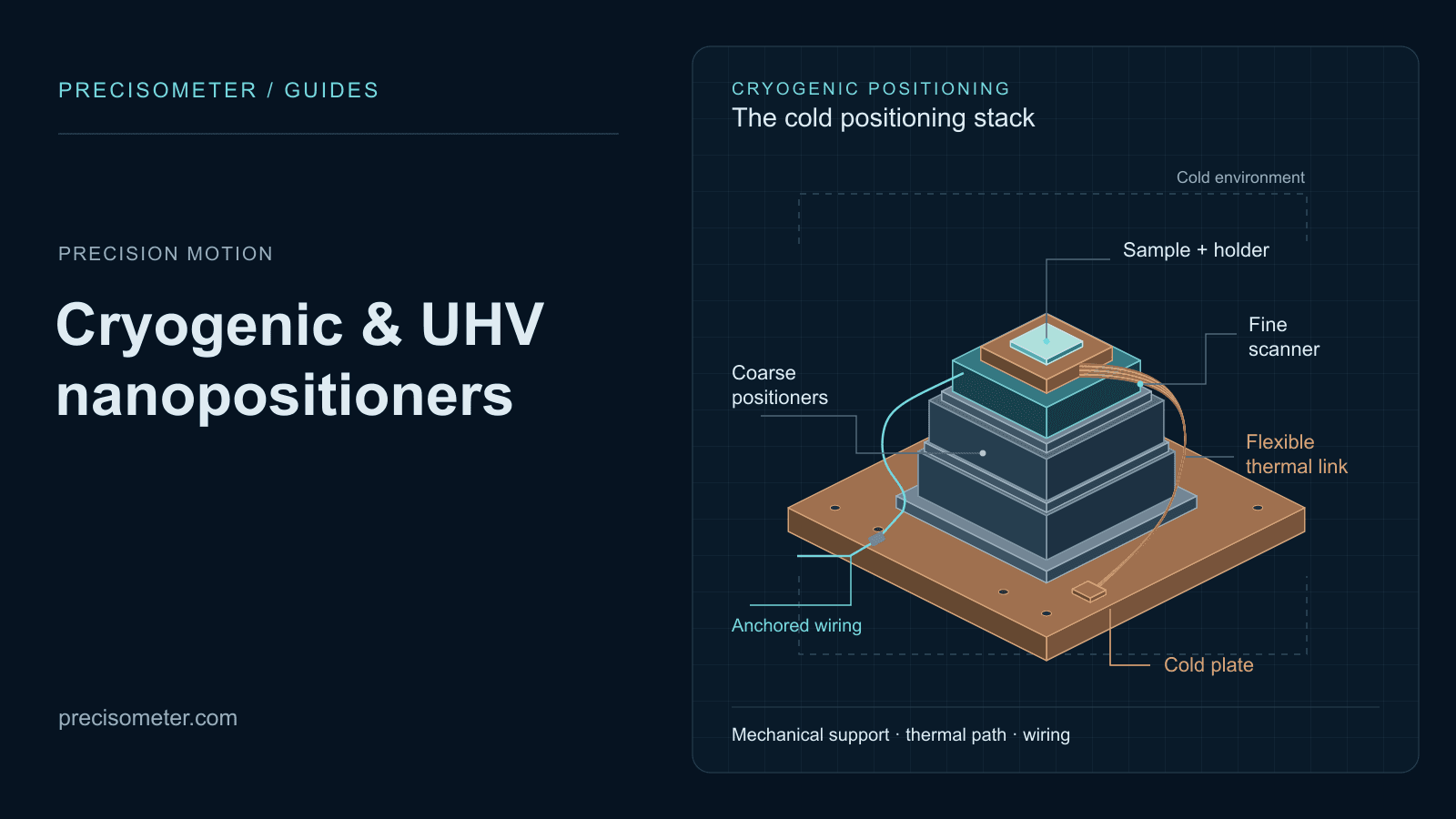 Precision motion
Translate temperature, pressure, travel, payload, feedback, and motion requirements into a defensible cryogenic-stage shortlist.
Open guide Precision motion
The practical companion to the selection guide: a requirements worksheet, coarse and fine stage pairing, mechanical stack order, thermal anchoring, the wiring chain to the controller, vacuum and field checks, a commissioning sequence, and three worked configurations.
Open guide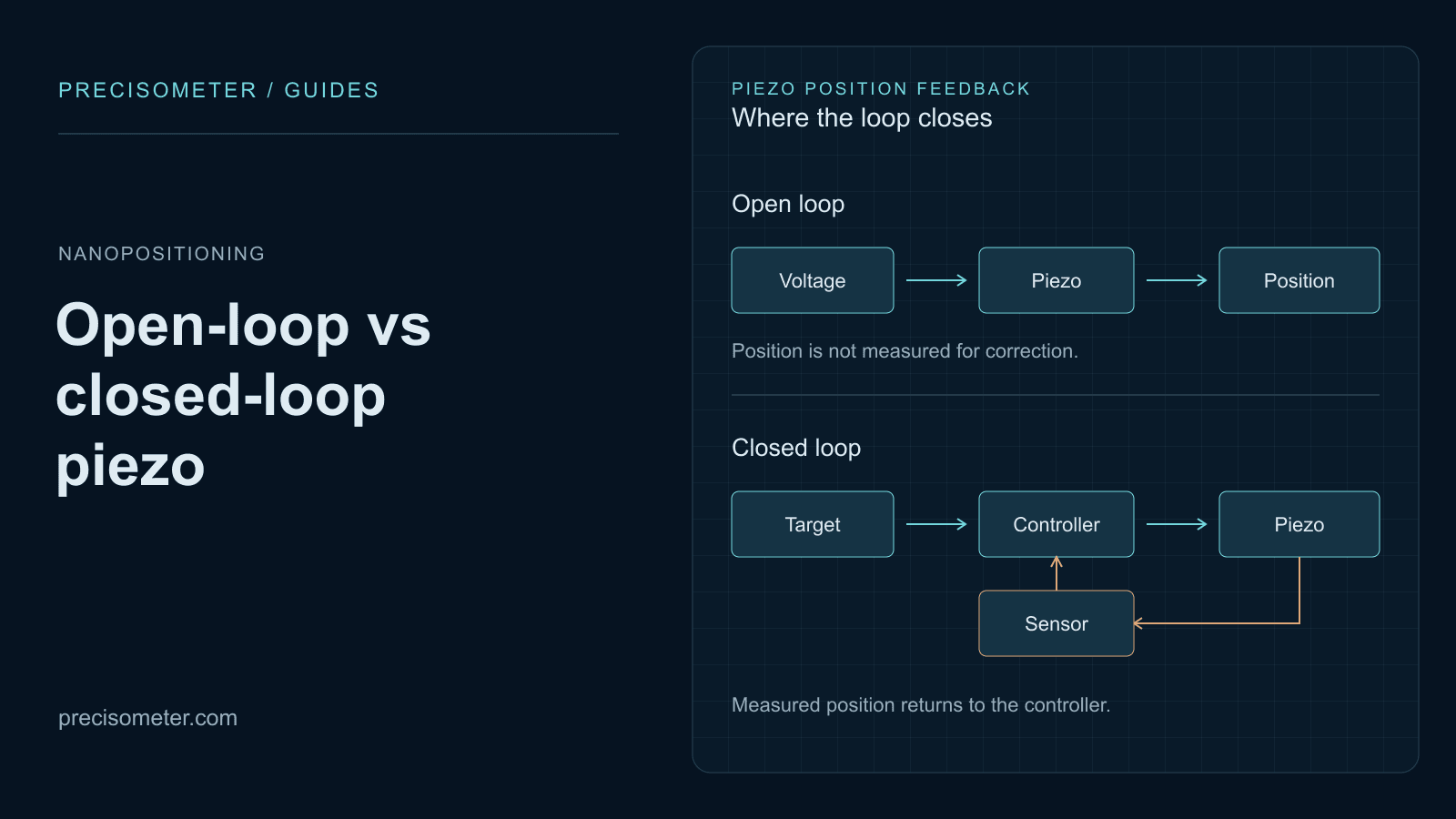 Nanopositioning
Why an open-loop piezo is wrong by 15 % of its travel, how creep grows with the logarithm of hold time, what strain-gauge and capacitive feedback actually fix — and the bandwidth and sensor noise a servo costs you in return.
Open guide