
Back to Home

Mightex · Polygon pattern illuminators

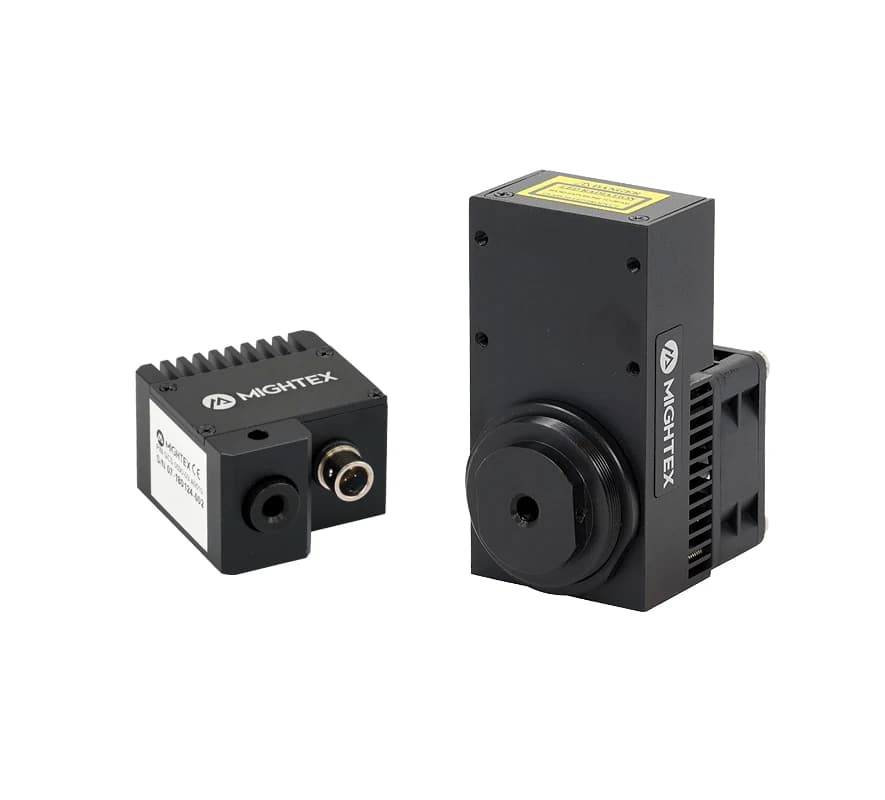
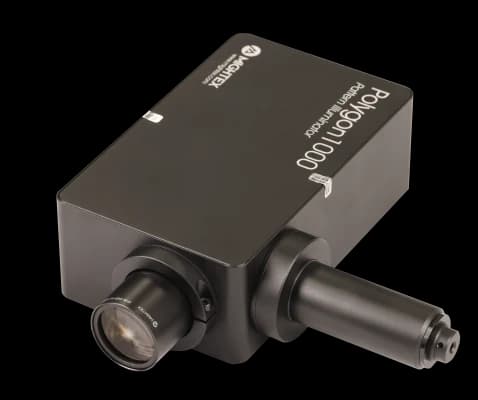
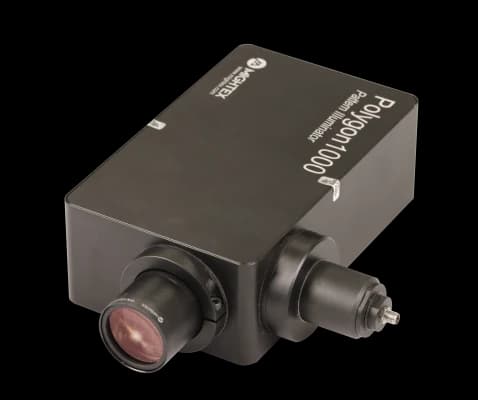
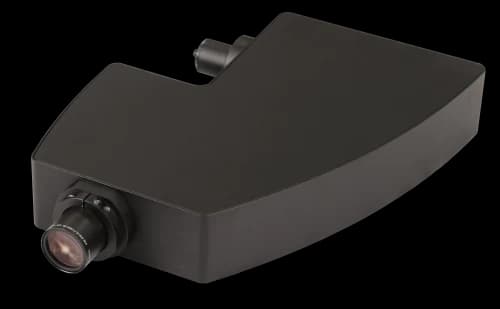
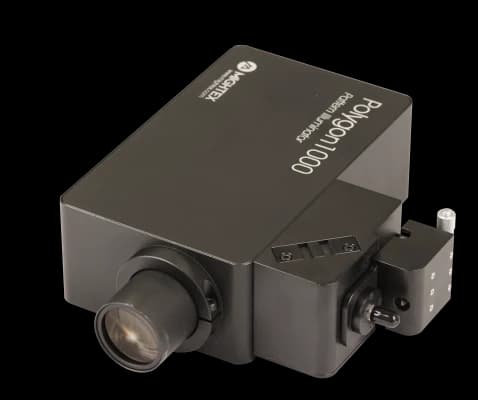
Polygon-UHC

Ultra-high-contrast DMD pattern illuminator (10,000,000:1) with an SMA fiber input for laser sources from 400 to 700 nm, for photosensitive preparations and 2-photon setups.

Optical input
SMA fiber (laser)
Wavelength range
400–700 nm
Max. frame rate
up to 6,600 fps (1-bit)
Contrast ratio
10,000,000:1
1 part number2 technical documents

Your enquiry

Part number DSI-K3-UHC-000

Discuss my setup

Quotation-based: tell us about the setup and we prepare a quotation for it.

Manufactured by Mightex. Precisometer is a Mightex distribution partner: we quote, integrate and support Mightex products, with in-person support in the Netherlands and Belgium.

Choose this when…

  • Background light outside the pattern must be as low as possible (contrast 10,000,000:1), with a laser source between 400 and 700 nm.

Based on: Mightex Polygon page; bioscience catalogue, 9th edition.

From Mightex

About the Polygon-UHC

The Polygon-UHC is built for experiments where light outside the pattern matters. Mightex specifies a contrast ratio of 10,000,000:1, defined as the intensity ratio of an all-on image to an all-off image, so background light is suppressed while several regions are illuminated at once.

Mightex lists four uses for the higher contrast: optogenetic grid scans with more grid positions for higher-resolution circuit mapping, less unwanted activation of light-sensitive tissue around the target, more grey levels for high-dynamic-range work such as retina studies, and integration with 2-photon microscopes for switching between patterned stimulation and 2-photon imaging.

Features

  • Contrast ratio of 10,000,000:1 (all-on to all-off intensity)
  • Accepts SMA-connectorized fiber input from laser sources
  • Wavelength range 400–700 nm
  • Infinity-path design; simultaneous multi-region illumination
  • Pattern switching up to 6.6 kHz
  • More grey levels for applications that need a high dynamic range
  • Integrates with 2-photon microscopes

Applications listed by Mightex

  • Optogenetic grid scans for circuit mapping
  • Retina-related studies
  • Patterned stimulation on 2-photon microscopes

Specifications

Technical specifications

Model overview
ParameterPolygon-UHC
Part numberDSI-K3-UHC-000
Optical inputSMA-connectorized fiber from laser sources
Wavelength range400–700 nm
Contrast ratio (all-on / all-off)10,000,000:1
Pattern switchingup to 6.6 kHz
Illumination field of view and resolution (circular field; Polygon UHC brochure). Projection area with a 1X objective; divide by the objective magnification for the field and pixel size at the specimen.
Field of viewDimensionLeicaNikonOlympusZeiss
StandardDiameter (mm)12.412.41110.2
StandardPixel size (µm)15.215.213.812.6
Control and timing (Mightex bioscience catalogue, 9th edition)
ParameterValue
Maximum frame rate (1-bit)6,600 fps
Input triggerTTL, BNC connector
Input trigger delay50 µs
Output triggerTTL, BNC connector
Output trigger delayUser programmable
Input uploading speed (USB3.0)up to 4 ms per frame

Reproduced from Mightex (official page), retrieved 2026-10-15.

Ordering and integration

What you need with it

Required, ordered separately

Options and companions

Combining this with other equipment? Ask for an integration check.

Downloads

Technical documents

Build your experiment

Patterned photostimulation on a microscope

Conceptual workflowFollows the three selection steps in Mightex’s Polygon guide (wavelength, Polygon model, microscope adaptor), with control added from the PolyScan page. It is not a verified configuration: we check how the parts fit your equipment before quoting.

  1. 1

    Light source

    Pick the wavelength for your opsin or chemistry, in the format the Polygon input accepts.

  2. 2

    Patterning

    The Polygon model follows from the source: lightguide, fiber, both, or ultra-high contrast.

  3. 3

    Microscope coupling

    An adaptor for your microscope make and model; an expander if the port is shared.

  4. 4

    Control and acquisition

    Software, triggering and a camera for calibration and imaging.

View enquiry list