Pulse energy, repetition rate, pulse width
NS-FH-10641064 nm near-infrared pulsed laser
1064 nmThe NS-FH-1064 is a 1064 nm nanosecond laser source. The specified pulse energy is 200 μJ at 200 kHz; 60 μJ at 1 MHz; 40 μJ at 1.5 MHz. Select energy, timing and cooling for the same configuration. Pulse duration sets how briefly the energy is delivered, while repetition rate sets the interval between pulses; average power alone does not describe the peak intensity at the sample. The quoted power range represents factory-set configurations; specify the required output rating when ordering.
Specifications
NS-FH-1064
19 specification rows
| Wavelength (nm) | 1064 |
|---|---|
| Operating mode | Pulsed |
| Pulse energy | 200 μJ at 200 kHz; 60 μJ at 1 MHz; 40 μJ at 1.5 MHz |
| Repetition rate | 0.2–10 MHz |
| Pulse width | 2–10 ns at 1.5 MHz |
| Cooling | Water cooled |
| Ave power stability (rms, 4 hours±3℃) | <2%, <1% |
| Warm-up time (minutes) | <10 |
| Transverse mode | TEM00 |
| Beam divergence, full angle (mrad) | <1 |
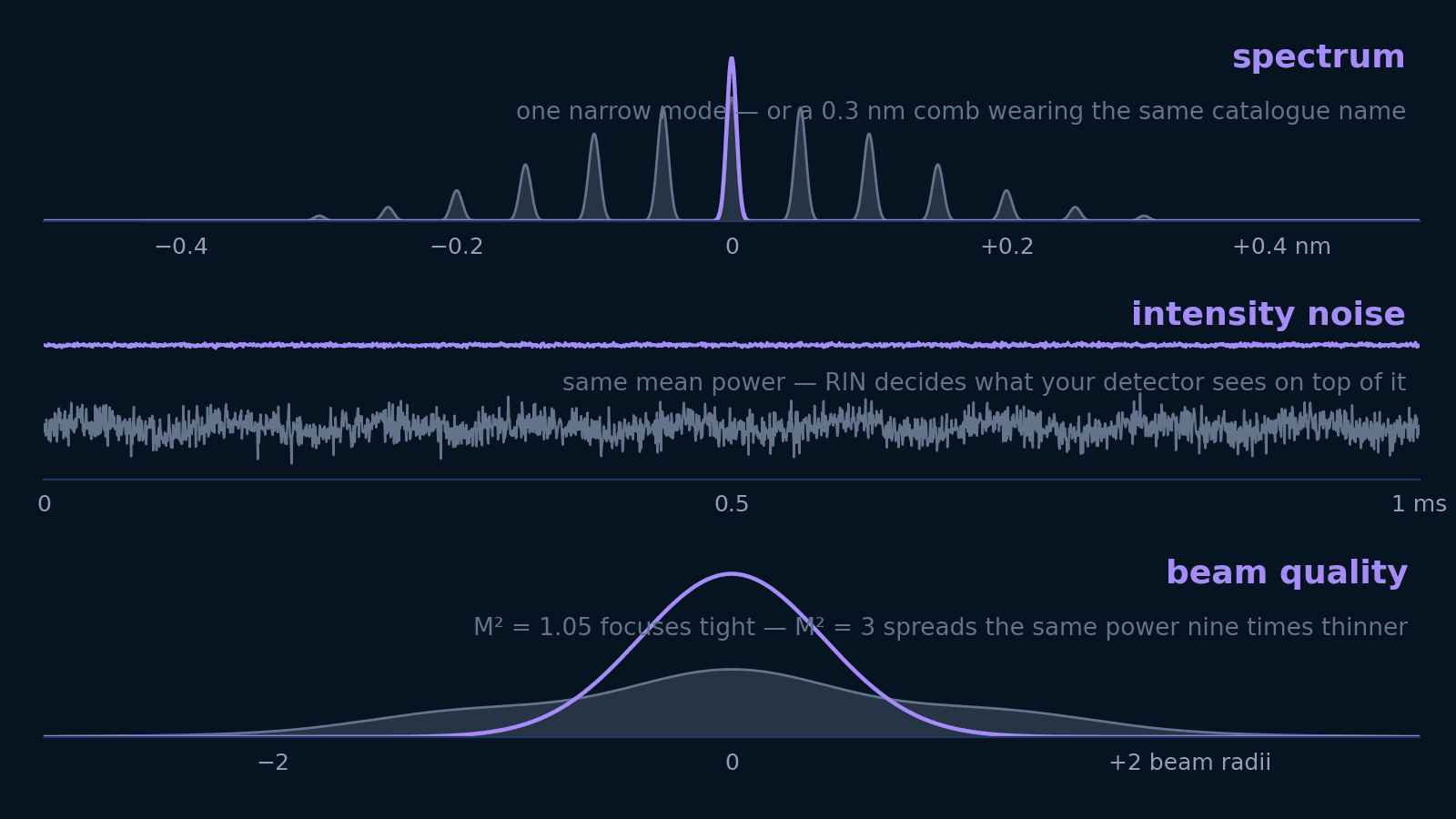
| M2 | <1.3 |
| Polarization ratio | >100:1 Vertical |
| Operating temperature (℃) | 15-35 |
| Power supply (100-240VAC) | RAD1PS |
| Expected lifetime (hours) | >10000 |
| Peak power (MW) | 1-20 |
| Beam diameter at the aperture (1/e2,mm) | <3 |
| M² | <1.3 |
| Beam height from base plate (mm) | 114 |
Select energy and timing together
Specify pulse energy, repetition rate, pulse duration, trigger requirements and cooling for the same configuration. The maximum energy and maximum repetition rate can describe different variants. Energy per pulse is quoted in μJ, mJ or J; pulse duration is quoted in ps, ns or ms.
Compare high-energy laser models →What do you need?
Tell us the pulse energy, pulse width, repetition rate, trigger and cooling requirements you need, and we'll reply with the matching configuration and lead time.
Model selection
Nearby series comparison
Compare NS-FH-1064 with the closest available models in the Pulsed Lasers family.
| Selection parameter | NS-FH-1064 (current) | FS-H-1064A | FS-H-1064B |
|---|---|---|---|
| Wavelength | 1064 nm | 1064 nm | 1064 nm |
| Optical power / pulse energy | 200 μJ at 200 kHz; 60 μJ at 1 MHz; 40 μJ at 1.5 MHz | 1-500 mW | 500-5000 mW |
| Operating mode / pulse width | Pulsed | Pulsed | Pulsed |
| Beam quality | <1.3 | <1.2 | <1.2 |
Related pulsed lasers
Compare the NS-FH-1064 with nearby pulsed lasers across the wavelength range.