Fast Z-sectioning
Move the objective instead of the sample, so optical sections can be stepped without disturbing live specimens.
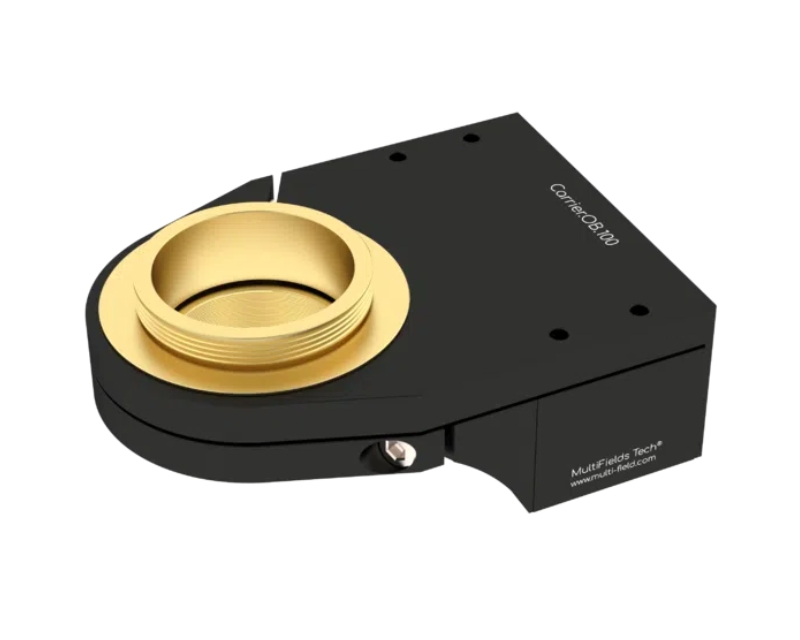
Opto-Mechanics · Ambient Piezo Stages - Objective scanners
Objective Z scanner series (Carrier.OB.C): M25 x 0.75 objective mount, flexure-guided piezo stack with capacitive closed-loop sensor and autofocus option; ordered as Carrier.OB100.C, OB200.C or OB400.C by travel.
Datasheet (PDF) ↗Catalog context
Carrier.OB.C is listed in the Ambient Piezo Stages - Objective scanners family.
Full specifications for this product are available on request. Contact us for the datasheet.
Application context
Move the objective instead of the sample, so optical sections can be stepped without disturbing live specimens.
Hold focus against thermal drift over acquisitions lasting minutes to hours.
Acquire Z-stacks at a rate set by the scanner rather than by the microscope frame.
Specifying this part
Moves the lens along the optical axis for focus stacks and z-series, leaving a liquid sample or mounted cell undisturbed. Travel options run 100, 200 and 400 µm; settling time rather than range is usually the limiting specification.
Most of the range is orderable as .HV (high vacuum), .UHV (ultra-high vacuum) or .NM (non-magnetic). The suffix changes materials, cabling and bake compatibility rather than the mechanics, so specify it against the chamber the stage will live in.
Full series comparison, controller pairing and mounting hardware on the ambient piezo stages overview, or work through the selection with the configurator.
Carrier.OB100.C
Objective Z scanner; 100 um Z travel; 1 nm closed-loop resolution; 250 Hz resonant frequency at 150 g load; M25 x 0.75 objective mount.
Carrier.OB200.C
Objective Z scanner; 200 um Z travel; 3 nm closed-loop resolution; 220 Hz resonant frequency at 150 g load; M25 x 0.75 objective mount.
Carrier.OB400.C
Objective Z scanner; 400 um Z travel; 5 nm closed-loop resolution; 165 Hz resonant frequency at 150 g load; M25 x 0.75 objective mount.
Carrier.OBHL100.C
High-load objective Z scanner; 100 um Z travel; 1 nm closed-loop resolution; 560 Hz resonant frequency at 150 g load for high-bandwidth focusing.
Before you specify
Engineering context for choosing this class of component, with the tradeoffs worked through on real specifications.
 Nanopositioning
Decide what to move — sample, objective or both — then turn field of view, stack depth, settling and synchronisation into stage specifications. Comparison tables, an acquisition-time calculator, three configurations and a purchasing checklist on documented objective scanners, clear-aperture XYZ stages and controllers.
Open guide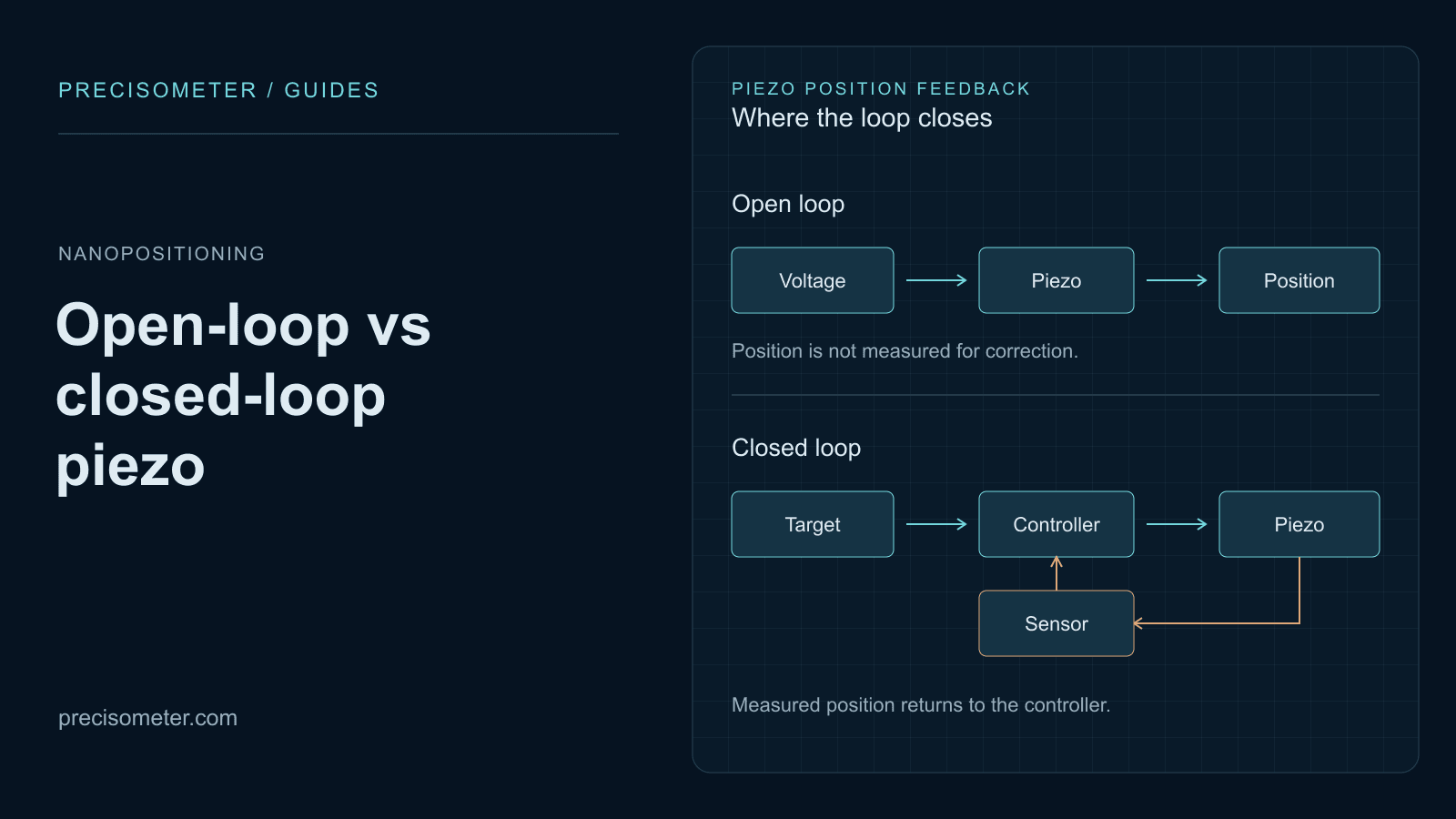 Nanopositioning
Why an open-loop piezo is wrong by 15 % of its travel, how creep grows with the logarithm of hold time, what strain-gauge and capacitive feedback actually fix — and the bandwidth and sensor noise a servo costs you in return.
Open guide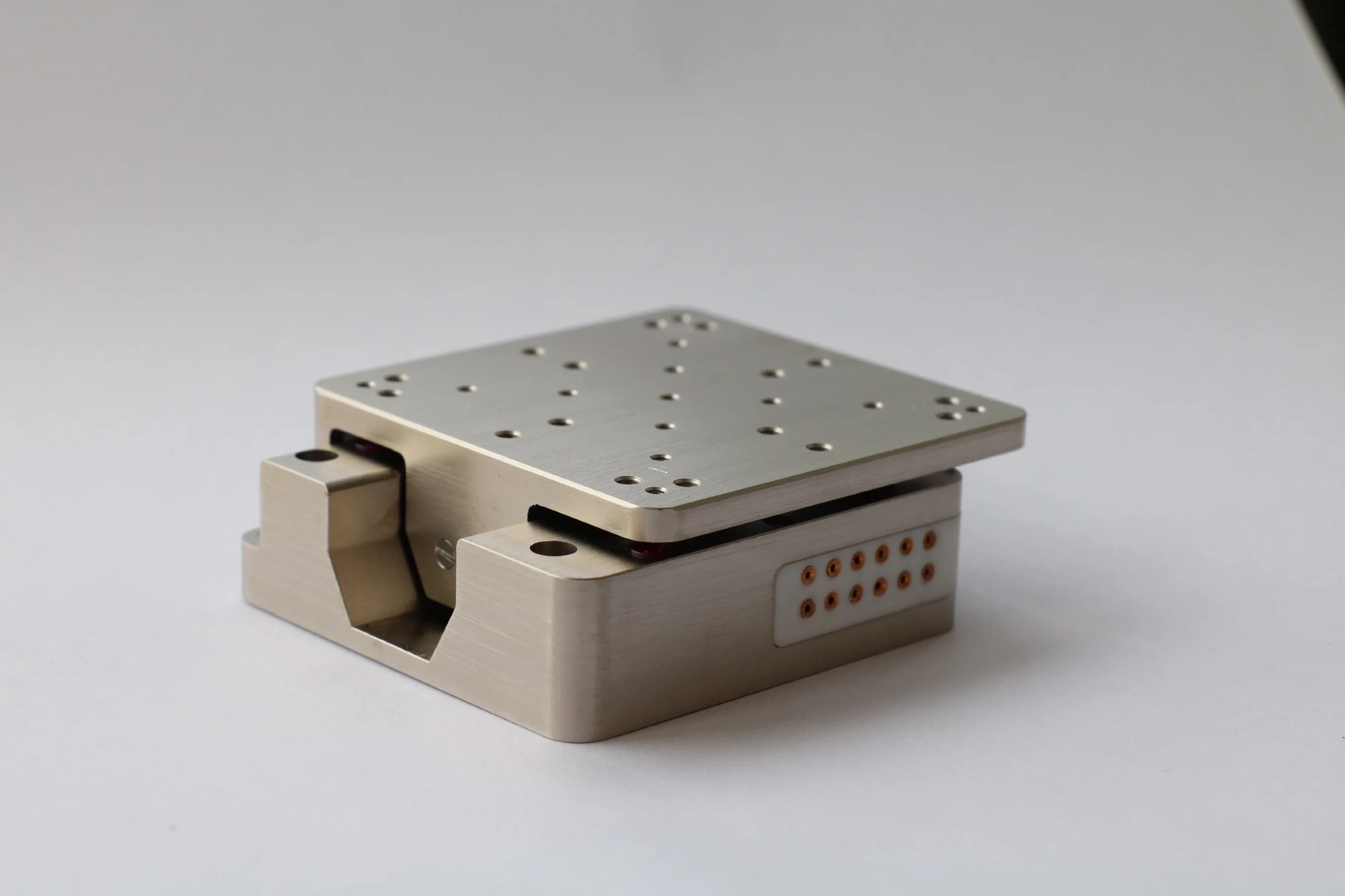 Nanopositioning
Piezo ceramic strains by one part in a thousand, so a 20 mm stack gives 20 µm. Every stage architecture is a different way around that limit — and each one wins a different experiment.
Open guide