Opto-Mechanics · Cryogenic Piezo Stages - Open-loop scanners
Scanner35-xy
Open-loop cryogenic XY flexure scanner; 100 x 100 um range at 300 K or 60 x 60 um at 4 K; friction-free flexure body; sub-nanometer positioning class; 75 V @300 K / 180 V @4 K drive range.
Datasheet (PDF) ↗CAD Model (STEP) ↗Specifications
| Active axes | X Y |
|---|---|
| Footprint × hight | 35 x 35 x 14.5 mm |
| Mass | 65 g |
| Work Environment | Default: 1.4 K~ 400 K, 1e-7 mbar, 35 Tesla |
| Mainbody | Default: Pure Ti, ULT: BeCu |
| Wires | Phosphor Bronze Twisted Paired Wires, 20cm |
| Pin materials | Polyster(glass fiber filled), BeCu |
| Pins number | 2 pins for each axis |
| Travel range @300 K | 100 x 100 um |
| Drive Voltage | Max. 75 V @300 K, Max. 180 V @4 K |
| Max. Load | 500 g |
| Capacitance @300 K | 8 uF |
| Resolution | 2 nm |
| Repeatibility | <10 nm |
Toepassingen
Fijnscan met lage dissipatie
Geen sensorexcitatie betekent geen extra warmtelast waar het koelbudget krap is.
Fijnpositionering binnen een grove stapel
Levert sub-nanometertrim boven een stick-slip-positioneerder die de slag heeft afgelegd.
Meting van relatieve beweging
Geschikt voor scans waarbij de waarneembare grootheid van relatieve verplaatsing afhangt, niet van absolute coördinaten.
Specifying this part
What this model has to survive, and what it needs around it
Scan range falls below 4 K
Piezoelectric coefficients drop as temperature falls, so a flexure scanner does not deliver its room-temperature range at base. The drive electronics recover part of it through voltage headroom — these scanners are rated to 75 V at 300 K and 180 V at 4 K. Specify against the low-temperature figure for your model, not the 300 K one.
Friction-free flexure drive
A piezo stack acting through flexure hinges, with no sliding contact anywhere in the mechanism. Motion is smooth, continuous and reproducible with no stick-slip signature — which is what scanning probe microscopy at low temperature requires of a fine axis.
Heat load at the cold plate
Stick-slip inertial drives dissipate energy per step and draw no holding current once stopped, so the steady-state load on the mixing chamber is the wiring loom rather than the motor. Anchor the loom at each temperature stage and thermalise the moving body with an FTC copper braid.
Non-magnetic construction
Titanium bodies and BeCu fasteners throughout, rated for operation to 35 T and down to 30 mK with the .ULT option, at 2 × 10⁻¹¹ mbar with .UHV. A single steel screw substituted at installation is enough to compromise a high-field assembly.
Full series comparison, controller pairing and mounting hardware on the cryogenic piezo stages overview, or work through the selection with the configurator.
Related products
Scanner16-xy
Open-loop cryogenic XY flexure scanner; 30 x 30 um range at 300 K or 12 x 12 um at 4 K; friction-free flexure body; sub-nanometer positioning class; 75 V @300 K / 180 V @4 K drive range.
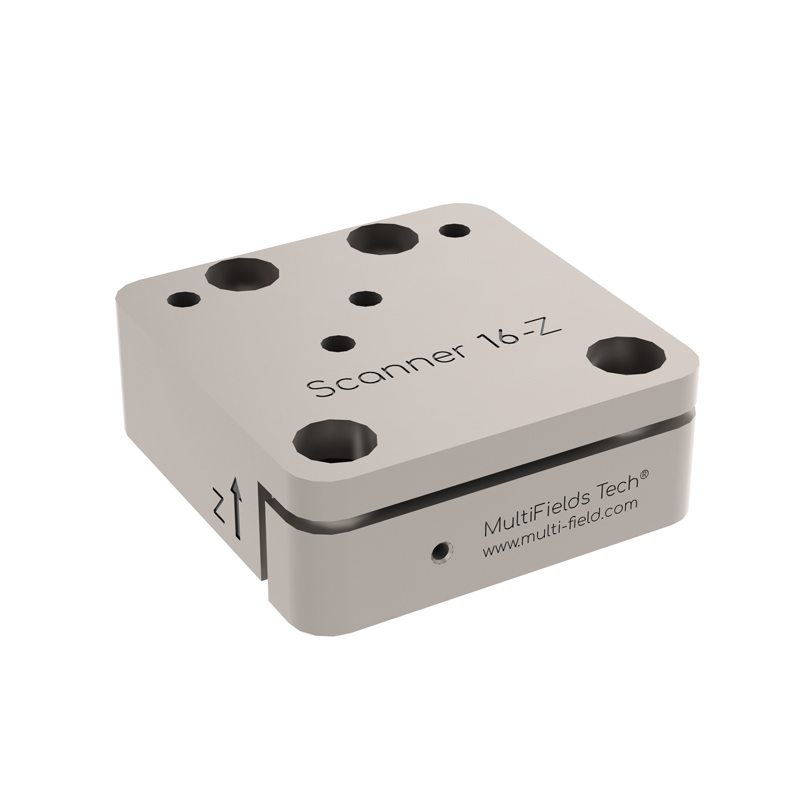
Scanner16-z
Open-loop cryogenic Z flexure scanner; 10 um range at 300 K or 6 um at 4 K; friction-free flexure body; sub-nanometer positioning class; 75 V @300 K / 180 V @4 K drive range.
Scanner25-xy
Open-loop cryogenic XY flexure scanner; 55 x 55 um range at 300 K or 24 x 24 um at 4 K; friction-free flexure body; sub-nanometer positioning class; 75 V @300 K / 180 V @4 K drive range.
Scanner25-z
Open-loop cryogenic Z flexure scanner; 20 um range at 300 K or 12 um at 4 K; friction-free flexure body; sub-nanometer positioning class; 75 V @300 K / 180 V @4 K drive range.