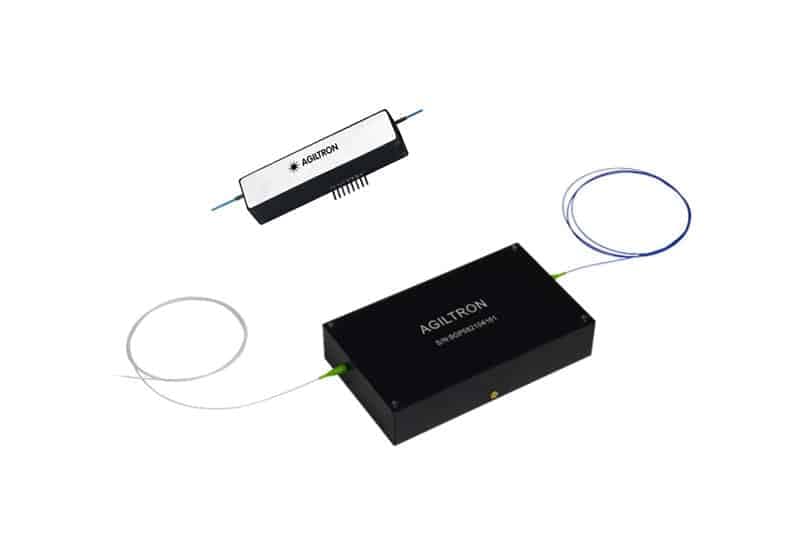
Collimation
MGL-S-588: Collimation benefits from a stable, focusable source. 588 nm emission fixes the compatible coatings and detector response, while the listed beam characteristic (TEM00) informs waist size and propagation.
Fiber output, PM options, seed formats
MGL-S-588 is a 588 nm Fiber laser. Used for collimation, laser medical treatment, scientific experiments, optical instrumentation. Fiber output laser High Stability Yellow Laser. Key specifications: output / average power 1~50 mW, operating mode CW, power stability (rms, 4 hours, ±3°c) <3%, <2%, <1%, (<0.5% optional). View specifications, datasheet and enquiry options from Precisometer.
Specifications
22 specification rows
| Output / average power | 1~50 mW |
|---|---|
| Beam / notes | Fiber output laser High Stability Yellow Laser |
| Operating mode | CW |
| Power stability (rms, 4 hours, ±3°C) | <3%, <2%, <1%, (<0.5% optional) |
| Transverse mode | TEM00 |
| M2 | <1.2 |
| Beam diameter at the aperture (1/e2, mm) | <1.0 |
| Beam divergence (mrad) | <1.5 |
| Polarization ratio | >100:1, Horizontal (Vertical optional) |
| Warm-up time (minutes) | <5 |
| Pointing stability over temperature (μrad/°C) | <8 |
| Shock tolerance (6ms) | 7g laterally, 15g vertically |
| Operating temperature (℃) | 10-35 |
| Modulation optional | DC-1kHz, 1kHz-10kHz, 10kHz-30kHz optional; TTL and Analog optional |
| Power supply (100-240VAC) | PSU-A-D/PSU-A-F |
| Expected lifetime (hours) | >10000 |
| Wavelength (nm) | 588±2 |
| Output power (mW) | 1-50 |
| M² | <1.2 |
| Pointing stability (μrad) (over 2 hours after warm-up and ±3°C) | <50 |
| Beam height from base plate (mm) | 19 |
| Power consumption (W) | <30 |
Application context
Applications named on this model’s datasheet, expanded with the model’s optical specifications.
MGL-S-588: Collimation benefits from a stable, focusable source. 588 nm emission fixes the compatible coatings and detector response, while the listed beam characteristic (TEM00) informs waist size and propagation.
MGL-S-588: 588 nm emission determines compatible optics, coatings and detectors for Laser medical treatment. The catalogued beam parameter (TEM00) helps predict how the source will focus and propagate through the instrument.
MGL-S-588: 588 nm emission determines compatible optics, coatings and detectors for Scientific experiments. The catalogued beam parameter (TEM00) helps predict how the source will focus and propagate through the instrument.
MGL-S-588: 588 nm emission determines compatible optics, coatings and detectors for Optical instrumentation. The catalogued beam parameter (TEM00) helps predict how the source will focus and propagate through the instrument.
System integration
Use these checks to connect MGL-S-588 to the surrounding optical, mechanical and control system. Every value shown is taken from this model's own specification record.
Technical FAQ
Operating temperature (℃): 10-35. Provide the stated cooling method and keep the laser-head base thermally coupled; temperature drift moves wavelength, output power and beam pointing.
Transverse mode: TEM00 · M2: <1.2. Size the downstream optics from the stated beam diameter and divergence rather than from the aperture of the housing, and confirm the polarisation state before specifying isolators or polarising optics.
Share wavelength, operating mode, output power or pulse energy, linewidth or pulse width, delivery, control, and safety requirements and we will qualify the matching configuration and lead time.
Model selection
Compare MGL-S-588 with the closest available models in the Fiber Lasers family. Confirm option-dependent values on the final configuration before ordering.
Compare the MGL-S-588 with nearby fiber lasers across the wavelength range.
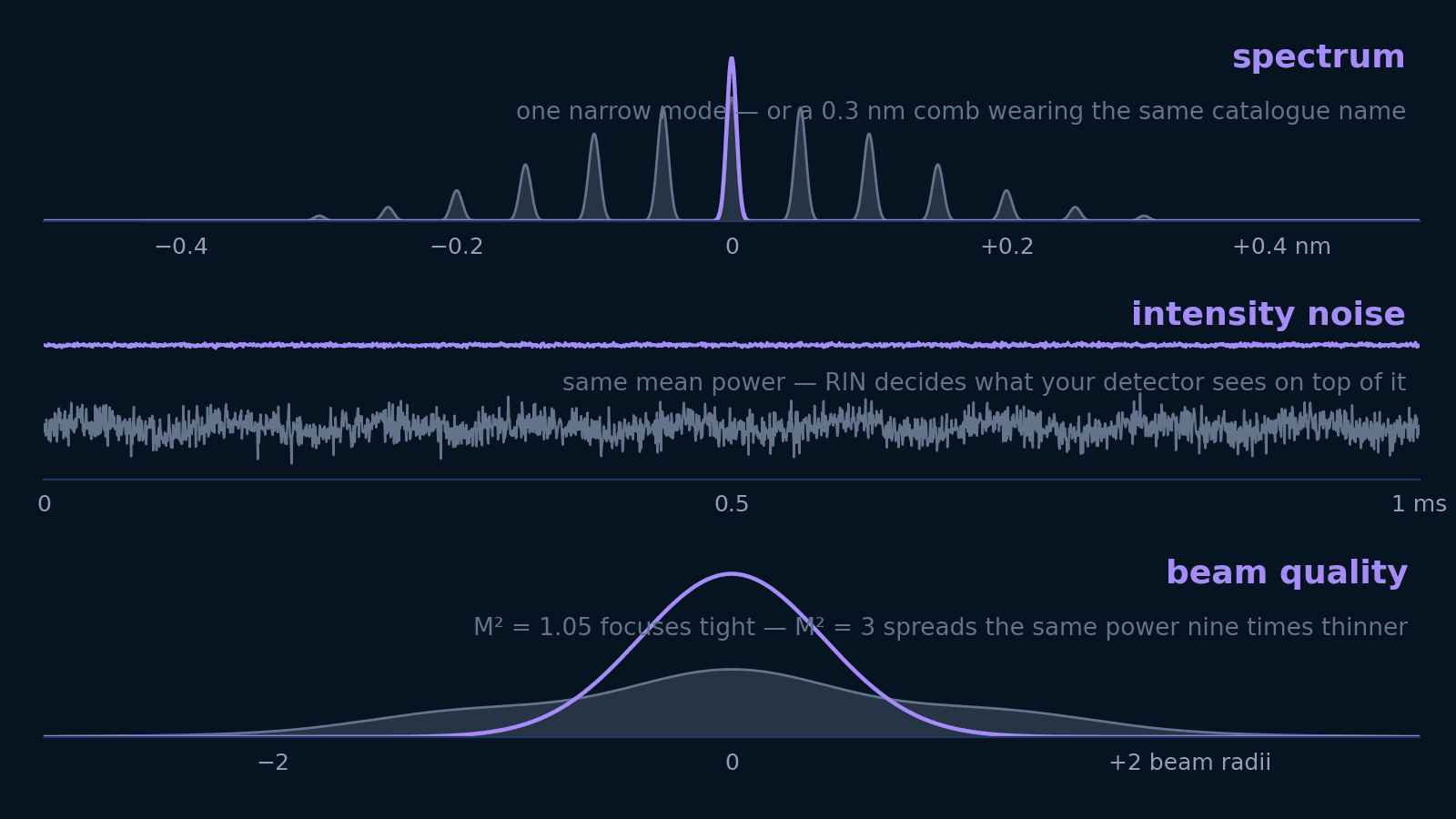
Choosing a laser
Which specifications decide the experiment, and which ones cost money without changing the result.
PhotonicsLinewidth, spectral width, RIN, M², and coherence length answer five different questions. Translate each into the units your experiment is designed in — and learn which ones not to pay for.
Open guide
PhotonicsSingle-mode fiber does not preserve polarization. Pin the state, erase it with a scrambler, or maintain it in PM fiber — which one your measurement needs, and the response time and extinction ratio that decide it.
Open guide