Joint geometry
Keep the line visible across edges, gaps and changes in surface angle.
Inspect, measure and process · Industry, inspection & flow
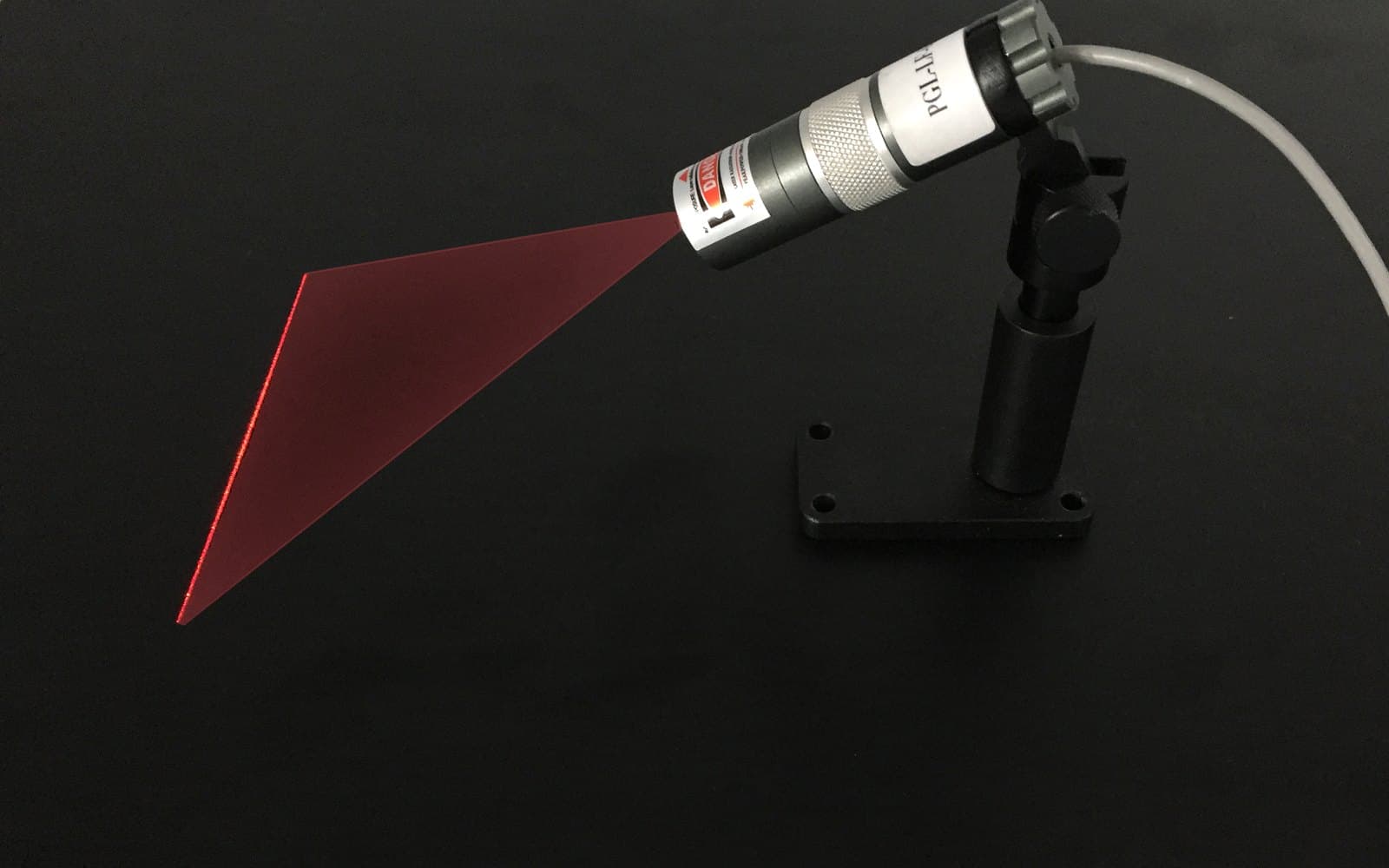
Locate the joint with a camera-visible reference line.
Keep the line visible across edges, gaps and changes in surface angle.
Choose wavelength and filtering around the camera and welding emission.
Keep exposure, mounting and robot motion consistent.
Why the source matters
The correct source is defined at the sample or process—not at the laser aperture. Wavelength and operating mode set the interaction; stability, delivery, timing, and control determine whether it stays useful in the complete system.
Application workflow
Three decisions turn the application into a practical source specification.
Define whether the line is viewed ahead of, beside or after the weld. Check camera visibility, joint geometry, standoff and mechanical clearance.
Test the actual material and process background. Select wavelength, camera bandpass filter, line width and power together to avoid glare and saturated pixels.
Synchronize modulation and camera exposure, protect the window from spatter, and verify the estimated seam position through the required robot motion.
Selection guide
These are starting architectures. Precisometer qualifies the final wavelength, output, delivery, control, and integration package against your setup.
Consider MDL-III or the visible wavelength configurations of MDL-XF-A, then verify camera contrast on the joint.
MDL-H and MDL-DF-808 provide near-infrared options. Match detector sensitivity and filtering before selecting power.
MDL-XR-Line reduces separate driver packaging. Confirm control signals, cooling, protective windows and the required enclosure.
Source architecture
375–1550 nm options · up to 15 W
Compact OEM head; separate driver
375–1550 nm options · up to 2.5 W
Separate head and power supply
450–1550 nm options · up to 15 W
Independent cooling; separate driver
405–808 nm options · up to 15 W
Independent cooling; separate driver
750–1060 nm options · up to 5 W
Independent cooling; separate driver
808 nm options · up to 20 W
Independent cooling; separate driver
375–1550 nm options · up to 5 W
Integrated driver and active cooling; optional RS232
Ready to specify
Specify joint geometry, working distance, camera view, welding background, line width, exposure timing, robot interface and protective-window arrangement.