Profile width
Select the fan angle and standoff for the required cross-section.
Inspect, measure and process · Industry, inspection & flow
Capture repeatable profiles across roads, rails and tunnel surfaces.
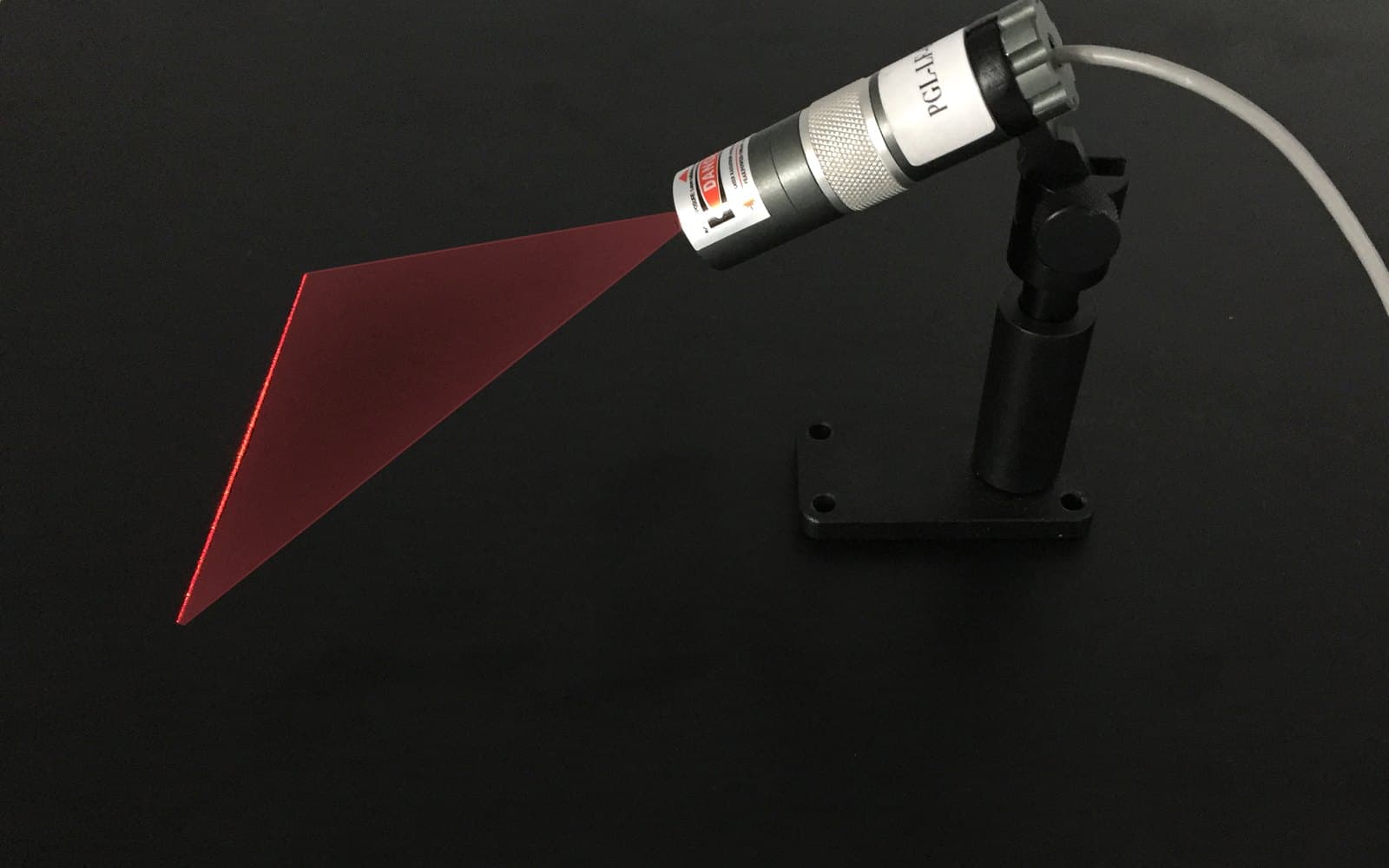
Select the fan angle and standoff for the required cross-section.
Coordinate camera timing with travel speed and spatial sampling.
Include vibration, temperature, ambient light and window contamination.
Why the source matters
The correct source is defined at the sample or process—not at the laser aperture. Wavelength and operating mode set the interaction; stability, delivery, timing, and control determine whether it stays useful in the complete system.
Application workflow
Three decisions turn the application into a practical source specification.
Specify cross-section width, standoff range, smallest defect or displacement, travel speed and sampling interval.
Compare wavelength and camera response on asphalt, metal, concrete or coatings. Validate uniformity and exposure across the complete useful line.
Design the mount, thermal path, enclosure and synchronized acquisition for the expected vibration and ambient conditions. The listed heads are specified for 10–35 °C operation; qualify any wider environmental requirement.
Selection guide
These are starting architectures. Precisometer qualifies the final wavelength, output, delivery, control, and integration package against your setup.
OEM-MF and MDL-III offer discrete choices from 375 to 1550 nm, with different power limits at each wavelength.
MDL-DF-808 offers up to 20 W at 808 nm with 75°, 90° or 110° fan-angle options.
MDL-XR-Line includes driver and active cooling. Environmental sealing and field qualification remain part of the inspection-system design.
Source architecture
375–1550 nm options · up to 15 W
Compact OEM head; separate driver
375–1550 nm options · up to 2.5 W
Separate head and power supply
450–1550 nm options · up to 15 W
Independent cooling; separate driver
405–808 nm options · up to 15 W
Independent cooling; separate driver
750–1060 nm options · up to 5 W
Independent cooling; separate driver
808 nm options · up to 20 W
Independent cooling; separate driver
375–1550 nm options · up to 5 W
Integrated driver and active cooling; optional RS232
Ready to specify
Specify standoff, profile width, vehicle speed, sampling interval, vibration, ambient light, temperature and the required enclosure.