Laser-source protection
Suppress returning light from downstream optics to reduce feedback into a high-performance laser source and support stable operation.
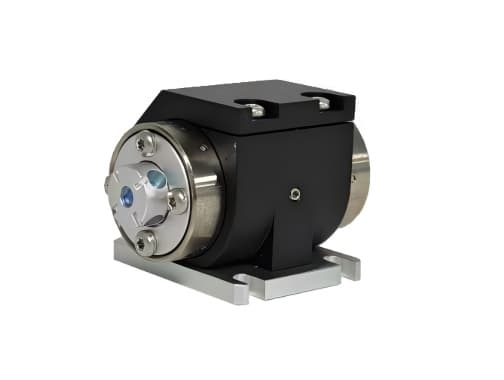
Protect your laser from destabilizing back-reflections with a free-space Faraday isolator. A magneto-optic rotator and a pair of polarizers transmit the forward beam while blocking returning light. Choose discrete UV, visible and infrared center wavelengths from 308 to 1064 nm, with low-absorption crystal optics and custom large-aperture options.
Compare the details
Compare the listed configurations and match the specifications to your setup.
15 specification rows.
Scroll horizontally to compare all columns
| Spectral band | Center wavelength options (nm) | Clear aperture options (mm) |
|---|---|---|
| Ultraviolet | 308 / 343 / 355 | 2.5 |
| Visible | 405 / 450 / 488 / 532 / 633 / 780 / 785 / 795 | 2.5 / 5 |
| Infrared | 852 / 920 | 2.5 / 5 |
| Infrared | 1030 / 1064 | 3 / 5 / 8 / 10 / 12 / 15 / 20 |
These are discrete center-wavelength options, not a continuous operating band. Custom large apertures of 10, 15, 20 and 25 mm are available on request; confirm the wavelength and aperture combination for your configuration.
| Parameter | Specification and test conditions |
|---|---|
| Isolation | ≥30 dB at 25 °C |
| Transmission | >90% at 25 °C |
| Laser-induced damage threshold | >10 J/cm² at 1064 nm, 10 ns, 10 Hz |
The damage threshold is specified at 1064 nm with 10 ns pulses at 10 Hz. Confirm power handling for other wavelengths, pulse durations, repetition rates and continuous-wave operation.
Scroll horizontally to compare all columns
| Model | C-HP-3-405 | C-HP-2-532 | C-HP-3-633 | C-HP-2.3-785 |
|---|---|---|---|---|
| Center Wavelength | 405 nm | 532 nm | 633 nm | 785 nm |
| Operating Wavelength Range | ±10 nm | ±10 nm | ±10 nm | ±10 nm |
| Peak Transmission | >90% | >93% | >93% | >93% |
| Clear Aperture | 3 mm | 2 mm | 3 mm | 2.3 mm |
| Isolation | ≥25 dB | ≥25 dB | ≥25 dB | ≥25 dB |
| Damage Threshold | 10 J/cm² at 10 ns | 10 J/cm² at 10 ns | 10 J/cm² at 10 ns | 10 J/cm² at 10 ns |
| Storage Temperature | -20 to 70 °C | -20 to 70 °C | -20 to 70 °C | -20 to 70 °C |
| Operating Temperature | 10 to 30 °C | 10 to 30 °C | 10 to 30 °C | 10 to 30 °C |
These four named C-HP models retain their own aperture, transmission and ≥25 dB isolation ratings. The configurable-range ≥30 dB specification above is not a revised rating for these models.
Build around your experiment
Share these details with your enquiry so we can match the component to your optical setup.
Application context
Suppress returning light from downstream optics to reduce feedback into a high-performance laser source and support stable operation.
Isolate the source from reflections in the measurement path. Match wavelength, beam aperture and polarization to the instrument before selecting a configuration.
Protect a free-space laser path from reverse-propagating light, with isolation and transmission selected for the source wavelength and optical power budget.
Technical FAQ
The configurable range lists 308, 343 and 355 nm with a 2.5 mm aperture; 405, 450, 488, 532, 633, 780, 785, 795, 852 and 920 nm with 2.5 or 5 mm apertures; and 1030 or 1064 nm with 3, 5, 8, 10, 12, 15 or 20 mm apertures. Custom large apertures, including 25 mm, can be requested. Each center wavelength is a separate configuration, so confirm the required wavelength, bandwidth and aperture together.
The configurable range specifies isolation of at least 30 dB and transmission above 90% at 25 °C. The four named C-HP standard models are listed separately with their own isolation of at least 25 dB, transmission, aperture and ±10 nm operating range.
The configurable-range laser-induced damage threshold is greater than 10 J/cm² at 1064 nm with 10 ns pulses at 10 Hz. Confirm the applicable limit for other wavelengths, pulse durations, repetition rates or continuous-wave operation when requesting a configuration.
Keep the specifications at hand when planning your setup.
Download datasheet (PDF)Talk through your setup
Add this component to your enquiry and include your requirements. We will help specify the variant, interfaces and mounting.