Trapping laser
1064 nm is a common starting point
Choose low intensity noise, stable pointing, TEM₀₀ beam quality, and enough power after every optic—not only at the source.
Explore components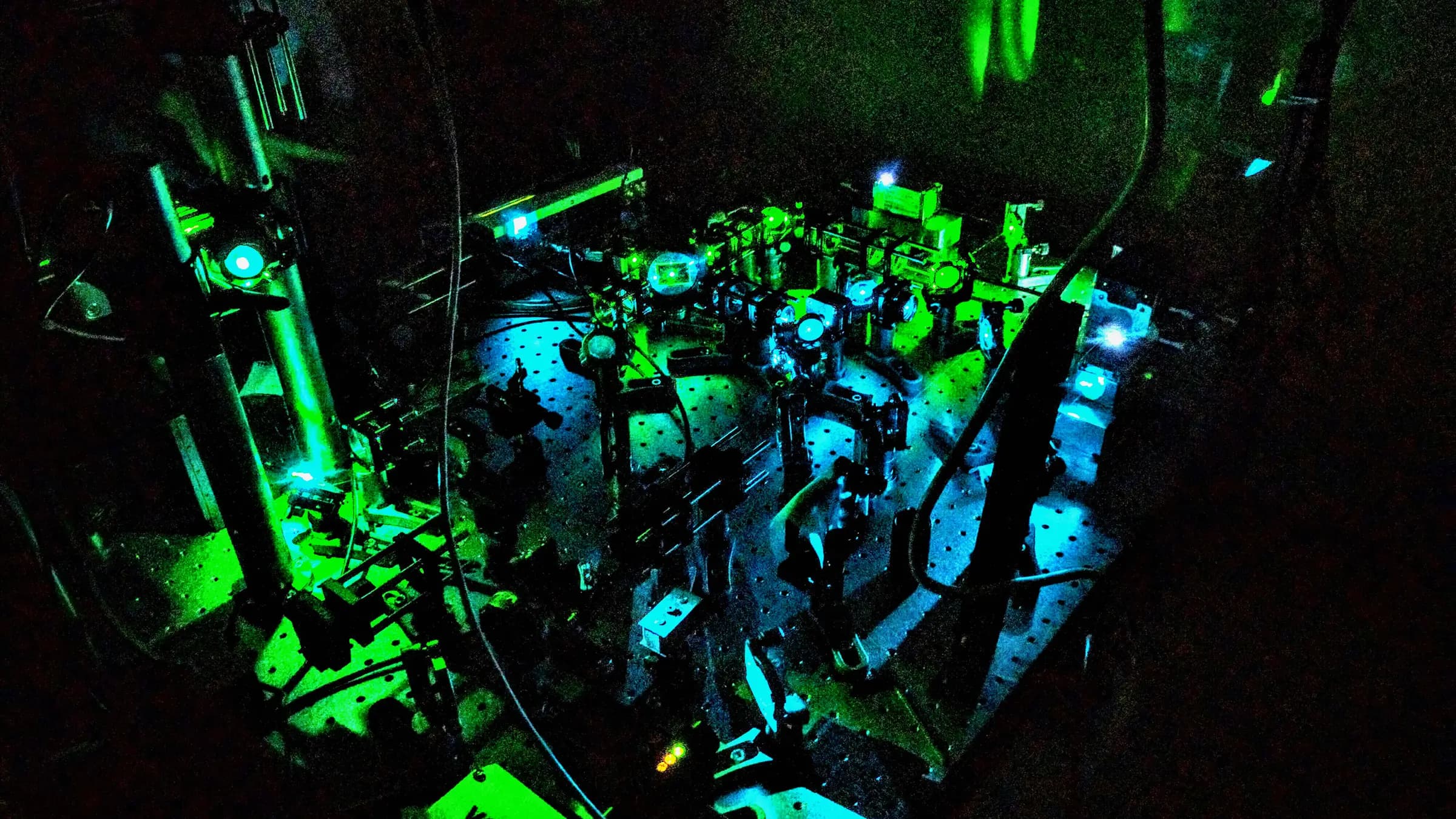
Optics laboratory, UCL Department of Physics & Astronomy, London · Photo: Isabel Llorente Garcia / UCL MAPS · CC BY 2.0
Optical trapping guide
From a stable laser and filled objective pupil to bead detection, calibration, and safety—a practical path from optical diagram to measurable force.
Start with the measurement
A single-beam gradient trap requires a steep intensity gradient around the focus. The objective must redirect enough light that the gradient force pulling a dielectric bead toward the focus overcomes radiation pressure, Brownian motion, fluid drag, and external disturbances.
Define bead material and diameter, medium viscosity, chamber geometry, force range, bandwidth, and measurement method first. These choices determine wavelength, objective, power, detector, mechanics, and calibration.
Core architecture
1064 nm is a common starting point
Choose low intensity noise, stable pointing, TEM₀₀ beam quality, and enough power after every optic—not only at the source.
Explore componentsIsolator · expander · steering
Protect the source, control polarization, expand the beam to fill the objective pupil, and provide two-axis alignment.
Explore componentsNA typically ≥1.2 for a strong 3D trap
Match immersion, working distance, correction collar, sample chamber, and beam diameter to the objective pupil.
Explore componentsCoarse XY/Z plus fine motion
Use a rigid low-drift stage with enough travel for loading and enough resolution to position the trap relative to the sample.
Explore componentsCamera + illumination + dichroic separation
Separate trapping and imaging wavelengths, then choose field of view, sampling, and frame rate for bead acquisition.
Explore componentsQPD, condenser, and fast electronics
Forward-scattered light on a quadrant detector enables bead-position measurement beyond camera frame rates.
Explore componentsInteractive trap-design lab
Relative stiffness
0.050 pN/nm
Thermal RMS motion
9.1 nm
Corner frequency
844 Hz
Educational estimate only. Stiffness uses a relative scaling model, not a component guarantee. Calibrate every real trap with the actual bead, medium, depth, and optical train.
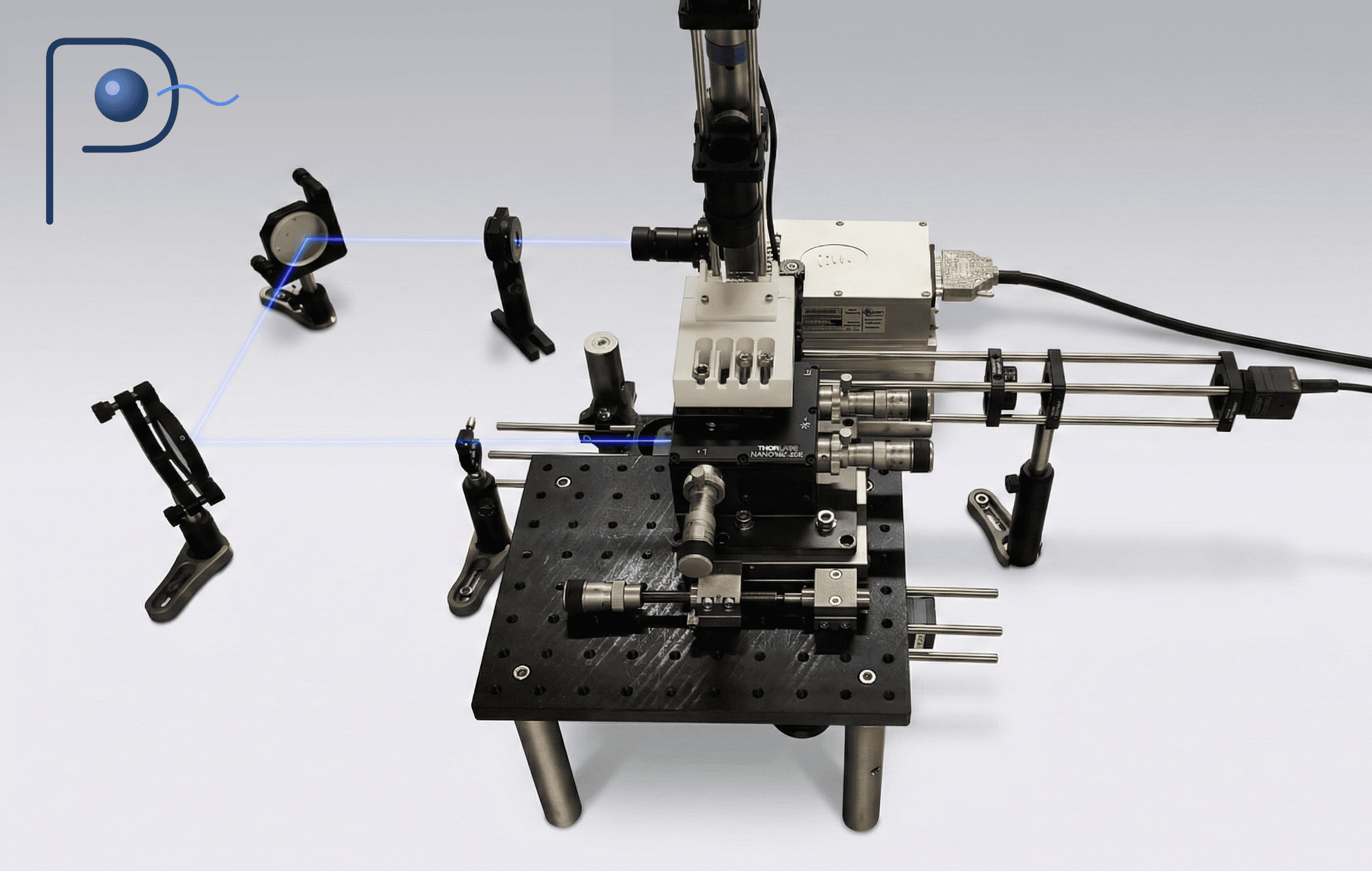
Alignment sequence
Measure power, polarization, beam quality, pointing, and noise before the microscope.
Move the trap without walking the beam across the objective pupil.
Expand and align the beam through the back aperture without clipping.
Use known beads and verify stable 3D confinement away from surfaces.
Image the condenser back focal plane onto the QPD and centre sum/difference signals.
Determine volts-to-position and stiffness under the actual measurement conditions.
Detection and calibration
A camera is excellent for finding beads. A QPD provides the bandwidth for thermal spectra and active microrheology. Calibrate position sensitivity first, then determine stiffness by equipartition, power-spectrum fitting, viscous drag, or active response.
Read the QPD signal-chain noteTwo ways to continue
Explore the OpenFlexure optical-tweezers project, or discuss a stable 1064 nm trapping and microrheology platform with our team.