Spectroscopy measurement systems
PlasmaD-TS Thomson-Scattering Diagnostics
A configurable optical diagnostic system measures laser light scattered by plasma electrons. Spectral filtering and gated detection support extraction of electron density and temperature.
Best suited to
Laboratory plasma studies requiring a non-contact electron diagnostic.
Selecting a configuration
Provide the density and temperature range, probe wavelength, collection angle and background-light level. Elastic-scatter rejection, alignment and intensity calibration are central to the system design.
Measurement & configuration
- Configured high-resolution spectrograph collection.
- Intensified camera or intensifier-module detection.
- Matched collection optics, synchronisation and calibration workflow.
Plan the signal path
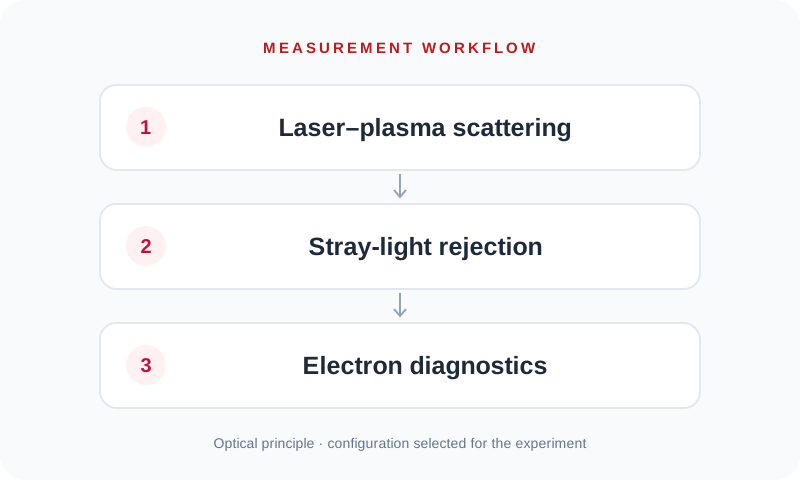
- 1Laser–plasma scattering
- 2Stray-light rejection
- 3Electron diagnostics
Specifications
| Technique | Laser Thomson scattering |
|---|---|
| Measured quantities | Electron temperature and density, with analysis model |
| Spectrograph examples | Omni-500i / Omni-750i |
| Grating examples | 1200 or 1800 lines/mm |
| Detector choices | IsCMOS / ICCD or IIM-coupled camera |
| Configuration | Experiment-specific optical and timing design |
Configuration note: Density range, temperature accuracy and complete-system resolution require an experiment-specific configuration. Specify laser and timing requirements with the collection geometry.
Related spectroscopy measurement systems
ST10 Ultrafast Time-Resolved Spectroscopy System
Time-resolved photoluminescence, semiconductor carrier dynamics and plasma emission.
ExploreFlame image-C-LIF Planar Fluorescence Imaging
Combustion radical distribution, fuel tracers and flame-front studies.
ExploreLIBS-Lab Laboratory Elemental Spectroscopy
Research into elemental spectra of solids, plants and other laboratory samples.
ExploreConfigure PlasmaD-TS
Send the wavelength interval, signal level, timing and sample requirements for your experiment.