Spectroscopy measurement systems
PlasmaD-LIF Laser-Induced Fluorescence Diagnostics
A tunable-excitation spectroscopy solution probes selected plasma species through laser-induced fluorescence. Gated detection separates the fluorescence signal in time and wavelength.
Best suited to
Species-selective plasma diagnostics and excitation-state research.
Selecting a configuration
Identify the gas species and transition before defining the laser range. Collection geometry, collisional quenching and calibration determine which physical quantities can be inferred from the signal.
Measurement & configuration
- Transition-specific tunable excitation.
- Omni spectrograph and intensified-camera detection.
- Configurable collection optics and experiment timing.
Plan the signal path
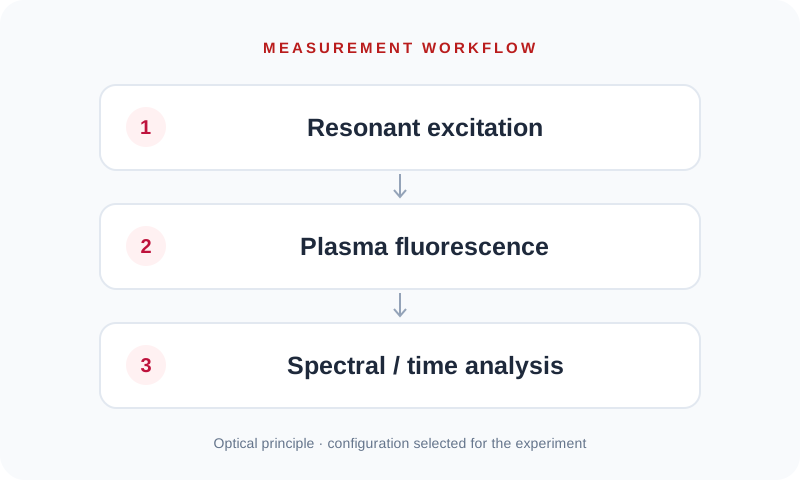
- 1Resonant excitation
- 2Plasma fluorescence
- 3Spectral / time analysis
Specifications
| Technique | Laser-induced fluorescence |
|---|---|
| Signal | Spectral and time-dependent fluorescence |
| Spectrograph examples | Omni-500i / Omni-750i |
| Grating examples | 1200 or 1800 lines/mm |
| Detector | Configured intensified camera |
| Optical design | Selected for species, line and plasma geometry |
Configuration note: Laser and timing hardware are selected for the experiment. The excitation range must cover the chosen species transition.
Related spectroscopy measurement systems
ST10 Ultrafast Time-Resolved Spectroscopy System
Time-resolved photoluminescence, semiconductor carrier dynamics and plasma emission.
ExploreFlame image-C-LIF Planar Fluorescence Imaging
Combustion radical distribution, fuel tracers and flame-front studies.
ExploreLIBS-Lab Laboratory Elemental Spectroscopy
Research into elemental spectra of solids, plants and other laboratory samples.
ExploreConfigure PlasmaD-LIF
Send the wavelength interval, signal level, timing and sample requirements for your experiment.