Spectroscopy measurement systems
OmniTR Transmission, Reflection & Absorption Systems
A configured scanning spectroscopy platform measures optical transmission and reflection, with absorption analysis where the measurement geometry supports it. Optical paths are selected for films, glass, lenses or infrared samples.
Best suited to
Optical material development, filter characterisation and laboratory quality control.
Selecting a configuration
Specify sample dimensions, wavelength range, angle and whether diffuse light must be collected. A result from one measurement geometry should not be assumed to represent total transmission or reflection.
Measurement & configuration
- Matched light source, monochromator, sample optics and detector.
- Automated wavelength scanning and data collection.
- Sample handling selected around the material or optical assembly.
Plan the signal path
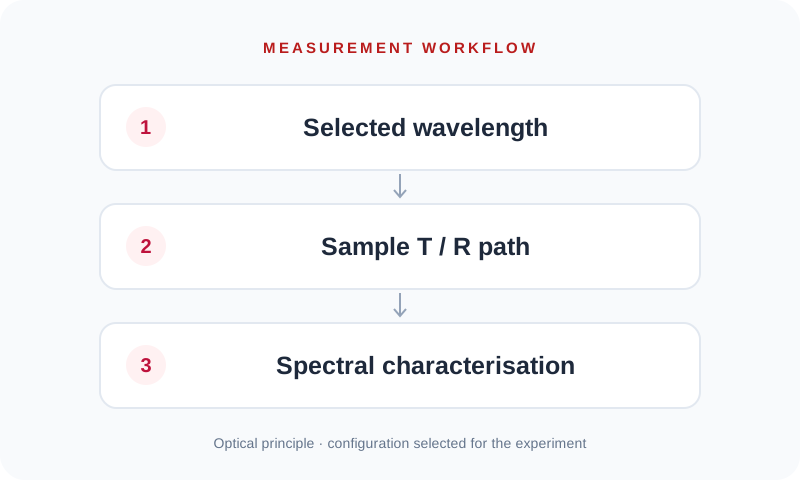
- 1Selected wavelength
- 2Sample T / R path
- 3Spectral characterisation
Specifications
| System architecture | Source + dispersion + sample + detector + software |
|---|---|
| Glass configuration range | 300–2500 nm |
| Glass spectral resolution | <5 nm |
| Glass scan step | 0.1–10 nm |
| Glass wavelength accuracy | Better than ±0.5 nm UV–Vis; ±1 nm NIR |
| Glass photometric accuracy | Within 1% UV–Vis; 2% NIR |
| Typical glass sample | 100 × 100 × 10 mm |
Configuration note: These figures describe the building-glass configuration only. Metrology, eye-protection, lens and time-resolved IR systems in the source are separate configurations.
Related spectroscopy measurement systems
ST10 Ultrafast Time-Resolved Spectroscopy System
Time-resolved photoluminescence, semiconductor carrier dynamics and plasma emission.
ExploreFlame image-C-LIF Planar Fluorescence Imaging
Combustion radical distribution, fuel tracers and flame-front studies.
ExploreLIBS-Lab Laboratory Elemental Spectroscopy
Research into elemental spectra of solids, plants and other laboratory samples.
ExploreConfigure OmniTR
Send the wavelength interval, signal level, timing and sample requirements for your experiment.