Broadband lamps & plasma sources
Composite Broadband Sources
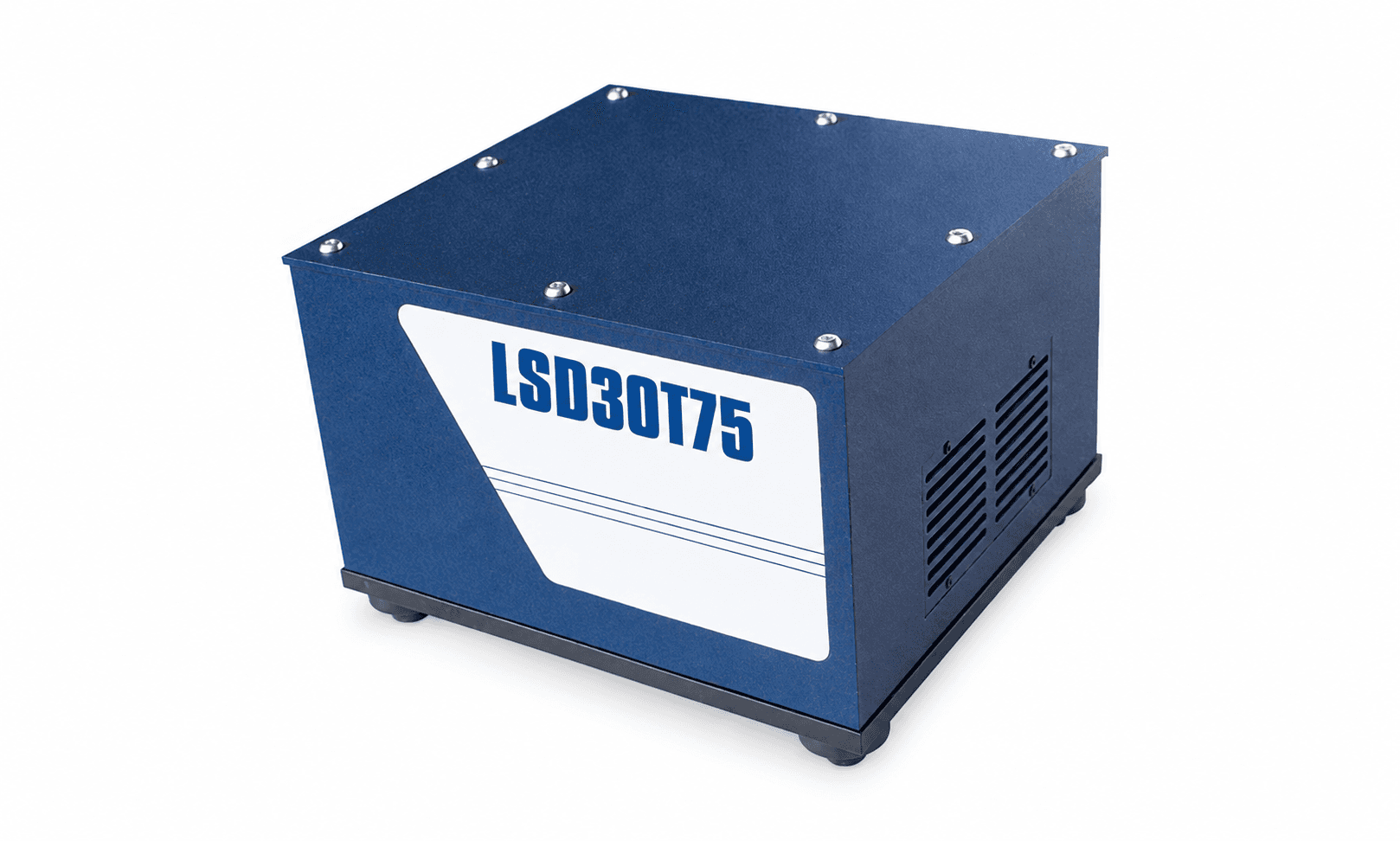
Complementary emitters combined in one source format. Bench versions switch between two lamps with a motorised mirror; the compact deuterium–tungsten version provides an SMA905 fibre interface for UV–visible–NIR spectroscopy.
Best suited to
Experiments needing complementary emitter spectra without rebuilding the illumination path.
Selecting a configuration
Choose the bench source for monochromator coupling or the compact fibre source for a fibre spectrometer. Coverage and switching behaviour depend on the selected assembly.
Measurement & configuration
- Motorised source-selection mirror in the bench assemblies.
- Adjustable 130–165 mm optical-axis height on bench sources.
- LSH-DT05 offers a manual / TTL shutter and SMA905 output.
Plan the signal path
- 1Complementary emitters
- 2Source selection / coupling
- 3Broadband experiment
Specifications
| LSH-DT05 spectral range | 200–1100 nm |
|---|---|
| LSH-DT05 light aperture | 0.5 mm |
| LSH-DT05 stability | 0.5% |
| LSH-DT05 input | 12 V DC / 1 A |
| LSH-DT05 dimensions | 180 × 125 × 51 mm |
Composite source formats
| Model | Emitter combination | Output format |
|---|---|---|
| LSD30T75 | 30 W deuterium + 75 W tungsten | Bench source; switching mirror |
| LST75SiN40 | 75 W tungsten + 40 W SiN | Bench source; switching mirror |
| LSH-DT05 | Deuterium + tungsten | Compact SMA905 fibre source |
Configuration note: The 200–1100 nm range and compact-source specifications refer to LSH-DT05 only. They are not transferred to the two bench assemblies.
Related broadband lamps & plasma sources
150 W & 450 W Xenon Arc Sources
Broadband UV, visible and near-infrared excitation on an optical bench.
ExploreTungsten-Halogen Light Sources
Continuous visible and near-infrared spectroscopy where a thermal lamp spectrum is suitable.
ExplorePhotocatalysis Xenon Light Sources
Photocatalysis, photochemistry and controlled broadband irradiation of research samples.
ExploreConfigure LSD30T75 / LST75SiN40 / LSH-DT05
Send the wavelength interval, signal level, timing and sample requirements for your experiment.