Spectroscopy Detectors · Photomultiplier tubes
PMTH Series
PMTH Room-Temperature Photomultiplier Tubes
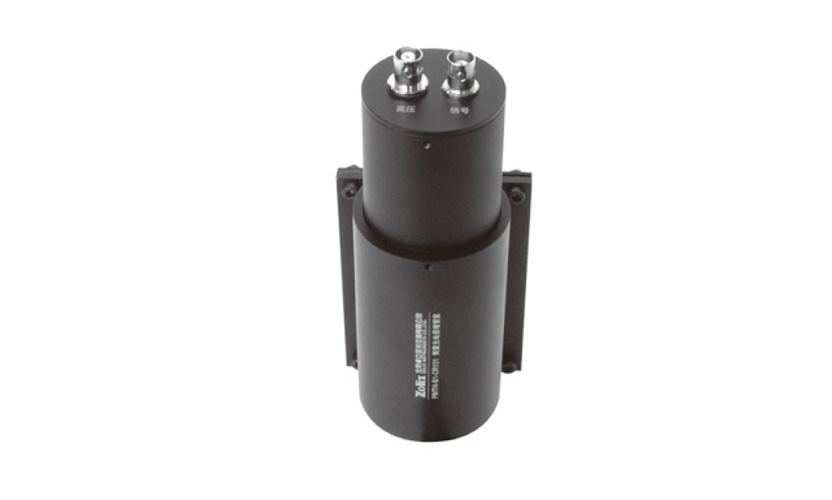
Light-tight photomultiplier detector housings with multiple tube options for high-sensitivity UV–visible spectroscopy and direct coupling to Omni-λ spectrographs.
Catalog context
Where PMTH Series fits
PMTH Series is listed as PMTH Room-Temperature Photomultiplier Tubes in the Photomultiplier tubes family. The local catalog record provides these first selection fields: Tube options: CR316-02, R1527/R1527P, CR131/CR131A, R928 and R2949; Spectral response: 185–900 nm, depending on tube; Maximum-response wavelength: 340–400 nm, depending on tube.
Specifications
| Tube options | CR316-02, R1527/R1527P, CR131/CR131A, R928 and R2949 |
|---|---|
| Spectral response | 185–900 nm, depending on tube |
| Maximum-response wavelength | 340–400 nm, depending on tube |
| Housing | Light-tight integrating housing |
| Spectrograph interface | Designed for Omni-λ series coupling |
| Accessories | High-voltage power-supply options available |
Complete source specification
Model-by-model comparison
The full manufacturer-published comparison is transcribed below so model differences remain visible rather than being reduced to a single range.
The manufacturer table uses merged cells across several tube variants. Grouped values below preserve that source layout; confirm the exact tube-level value when selecting a PMT.
| Parameter | CR316-02 | R1527 / R1527P | CR131 / CR131A / R928 | R2949 |
|---|---|---|---|---|
| Spectral response | 185–650 nm | 185–680 nm | 185–900 nm | 185–900 nm |
| Wavelength of maximum response | 340 nm | 400 nm | 400 ± 30 nm | 400 ± 30 nm |
| Cathode sensitivity | 48 mA/W | 60 mA/W | 74 mA/W | 68 mA/W |
| Dynode gain | 1.0 × 10⁷ | 6.7 × 10⁶ | 1.0 × 10⁷ | 1.0 × 10⁷ |
| Cathode luminous sensitivity | 40 µA/lm | 60 µA/lm | 140 / 250 µA/lm | 200 µA/lm |
| Anode luminous sensitivity | — | 400 A/lm | 1000 / 1500 / 2500 A/lm | 2000 A/lm |
| Anode dark current, typical | 5 nA | 0.1 nA | 3 nA | 2 nA |
| Anode dark current, maximum | 15 nA | 2 / 0.5 nA | 50 nA | 25 nA |
| Photocathode material | Sb-Cs | Dual-alkali | Multi-alkali | Confirm |
| Effective area | 8 × 24 mm | 8 × 24 mm | 8 × 24 mm | 8 × 6 mm |
| Dynode structure | Circular cage, 9 stages | Circular cage, 9 stages | Circular cage, 9 stages | Circular cage, 9 stages |
| Anode pulse rise time | 2.2 ns | 2.2 ns | 2.2 ns | 2.2 ns |
| Electron transit time | 22 ns | 22 ns | 22 ns | 22 ns |
| Anode-to-cathode supply voltage | 1250 V | 1250 V | 1250 V | 1250 V |
| Anode-to-last-dynode supply voltage | 250 V | 250 V | 250 V | 250 V |
Design and integration details
- Side-window PMT housing with electromagnetic and optical shielding.
- Standard BNC signal output and dedicated high-voltage input connector.
- Current output as standard; voltage output available as an option.
- Designed to couple to Zolix spectrographs and sample chambers.
Application and connection notes
- The HVC1800 supply provides 0–1500 V DC negative output, 0.5 mA maximum current and ±0.05%/h maximum voltage drift.
- HVC1800 voltage can be set manually or through a 0–10 V external-control input; enclosure size is 240 × 240 × 120 mm and weight is 3.4 kg.
Values are transcribed from the archived product table and diagrams. Confirm the final detector, electronics and spectrograph interface for your configuration.
Archived manufacturer product pageSystem integration
Integration and compatibility
Use these checks to connect PMTH Series to the surrounding optical, mechanical and control system. Every value shown is taken from this model's own specification record.
- Spectral response
- Spectral response: 185–900 nm, depending on tube · Maximum-response wavelength: 340–400 nm, depending on tube
- Responsivity varies strongly across the stated band. Read the figure at your own wavelength rather than at the peak the headline range implies.
- Output and bias
- Spectrograph interface: Designed for Omni-λ series coupling
- Confirm whether the module is biased and amplified internally or expects an external supply and transimpedance stage. The two builds are not interchangeable and the wrong assumption destroys detectors.
Technical FAQ
Integration questions for PMTH Series
What wavelengths does the PMTH Series detect?
Spectral response: 185–900 nm, depending on tube · Maximum-response wavelength: 340–400 nm, depending on tube. Responsivity varies strongly across the stated band. Read the figure at your own wavelength rather than at the peak the headline range implies.
How is the PMTH Series read out?
Spectrograph interface: Designed for Omni-λ series coupling. Confirm whether the module is biased and amplified internally or expects an external supply and transimpedance stage. The two builds are not interchangeable and the wrong assumption destroys detectors.