Spectroscopy Detectors · Near-infrared single-point detectors
DInGaAs Series
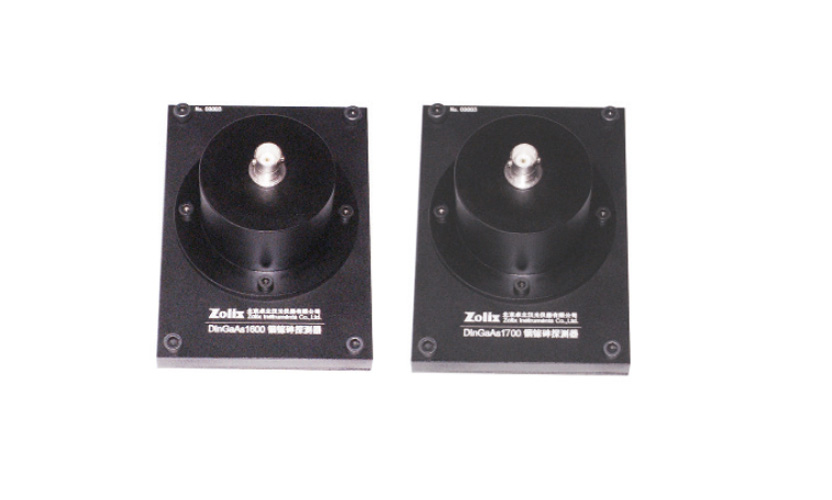
DInGaAs Near-Infrared Detectors
Three-millimetre active-area InGaAs detector options covering standard and extended near-infrared spectral measurements with current output.
Catalog context
Where DInGaAs Series fits
DInGaAs Series is listed as DInGaAs Near-Infrared Detectors in the Near-infrared single-point detectors family. The local catalog record provides these first selection fields: Models: DInGaAs1700-R03M / DInGaAs2600-R03M; Active-area diameter: 3 mm; Spectral range: 800–1700 nm / 800–2600 nm.
Specifications
| Models | DInGaAs1700-R03M / DInGaAs2600-R03M |
|---|---|
| Active-area diameter | 3 mm |
| Spectral range | 800–1700 nm / 800–2600 nm |
| Peak responsivity (minimum) | 0.9 A/W / 1.1 A/W |
| Signal output | Current |
Complete source specification
Model-by-model comparison
The full manufacturer-published comparison is transcribed below so model differences remain visible rather than being reduced to a single range.
| Parameter | DInGaAs1700-R03M | DInGaAs2600-R03M |
|---|---|---|
| Effective-area diameter | 3 mm | 3 mm |
| Spectral range | 800–1700 nm | 800–2600 nm |
| Peak responsivity, minimum | 0.9 A/W | 1.1 A/W |
| Dark current, maximum | 100 nA | 1000 nA |
| D*, typical | 2.3 × 10¹² | 4.1 × 10¹⁰ |
| NEP, typical | 1.2 × 10⁻¹³ | 6.5 × 10⁻¹² |
| Resistance | 1.5 MΩ | 320 Ω |
| Capacitance | 800 pF | 9000 pF |
| Rise time | 100 ns | 1 µs |
| Signal output | Current | Current |
Design and integration details
- Room-temperature InGaAs detectors covering standard and extended NIR ranges.
- Both models share the same mechanical construction.
- Three-millimetre active-area diameter with current output.
Application and connection notes
- Select the 1700 model for the standard InGaAs band or the 2600 model for extended-NIR coverage.
- A current preamplifier may be required by the downstream acquisition electronics.
Values are transcribed from the archived product table and diagrams. Confirm the final detector, electronics and spectrograph interface for your configuration.
Archived manufacturer product pageSystem integration
Integration and compatibility
Use these checks to connect DInGaAs Series to the surrounding optical, mechanical and control system. Every value shown is taken from this model's own specification record.
- Spectral response
- Spectral range: 800–1700 nm / 800–2600 nm · Peak responsivity (minimum): 0.9 A/W / 1.1 A/W
- Responsivity varies strongly across the stated band. Read the figure at your own wavelength rather than at the peak the headline range implies.
- Active area
- Active-area diameter: 3 mm
- Active area sets both the alignment tolerance and, through capacitance, the achievable bandwidth. A larger element is easier to hit and slower to read.
- Output and bias
- Signal output: Current
- Confirm whether the module is biased and amplified internally or expects an external supply and transimpedance stage. The two builds are not interchangeable and the wrong assumption destroys detectors.
Technical FAQ
Integration questions for DInGaAs Series
What wavelengths does the DInGaAs Series detect?
Spectral range: 800–1700 nm / 800–2600 nm · Peak responsivity (minimum): 0.9 A/W / 1.1 A/W. Responsivity varies strongly across the stated band. Read the figure at your own wavelength rather than at the peak the headline range implies.
What is the active area of the DInGaAs Series?
Active-area diameter: 3 mm. Active area sets both the alignment tolerance and, through capacitance, the achievable bandwidth. A larger element is easier to hit and slower to read.
How is the DInGaAs Series read out?
Signal output: Current. Confirm whether the module is biased and amplified internally or expects an external supply and transimpedance stage. The two builds are not interchangeable and the wrong assumption destroys detectors.