Space-constrained assemblies
Add a driven axis where there is no room for a full-size stage body.
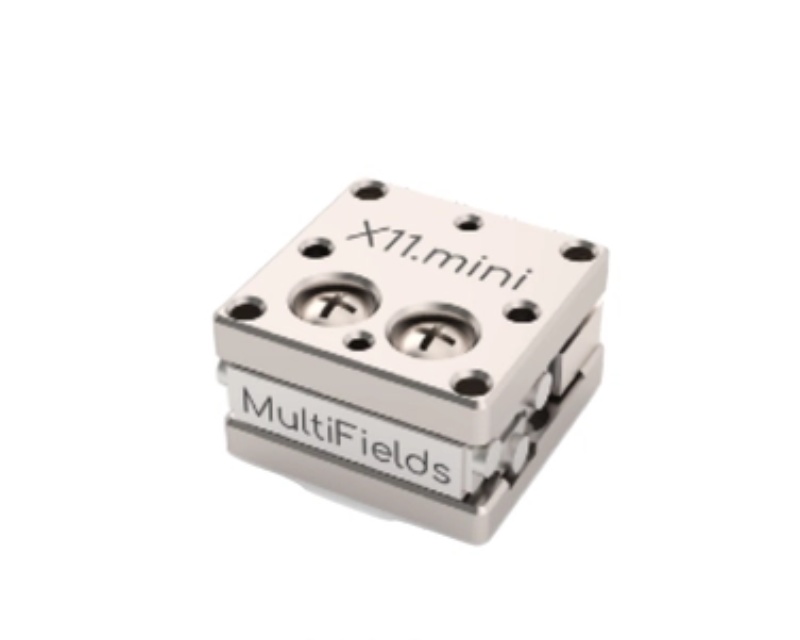
Opto-Mechanics · Ambient Piezo Stages - Mini linear stages
Ultra-compact Mini piezo nanopositioner; 11 x 11 x 6.5 mm footprint; 6 mm travel; sub-1 nm resolution; 50 g payload for tight optical or microscopy assemblies.
Datasheet (PDF) ↗CAD Model (STEP) ↗Catalog context
X11.mini is listed in the Ambient Piezo Stages - Mini linear stages family. The local catalog record provides these first selection fields: Active axes: X; Mass: 10 g; Travel range: 6 mm.
| Active axes | X |
|---|---|
| Mass | 10 g |
| Travel range | 6 mm |
| Max Driving Frequency | 20 kHz |
| Resolution (Open-loop) | <1 nm |
| Max. Payload (horizontal mounting) | 50 g |
| Minimum Incremental Motion(Close-loop) | N/A |
| Max. Push Force | 0.3 N |
| Holding Force | 0.5 N |
| Controller | MC-Newton.S series |
Application context
Add a driven axis where there is no room for a full-size stage body.
Advance a probe, fibre or needle into contact within a crowded measurement head.
Build compact XY or XYZ stacks whose total height stays inside a tight optical envelope.
System integration
Use these checks to connect X11.mini to the surrounding optical, mechanical and control system. Every value shown is taken from this model's own specification record.
Technical FAQ
Travel range: 6 mm · Resolution (Open-loop): <1 nm. Separate travel from resolution and both from repeatability. Repeatability is what an automated sequence actually depends on, and it is the figure most often absent from a headline specification.
Controller: MC-Newton.S series. Pair open-loop mechanics with the specified high-voltage or inertial driver, and closed-loop variants with the controller their capacitive, strain-gauge or encoder feedback requires. Matching connectors do not guarantee electrical compatibility.
Max. Payload (horizontal mounting): 50 g. Check the load rating in the orientation you will use it — a vertical or cantilevered load is a moment, not a mass — and match the base to an M6 pattern on a 25 mm grid or a 1/4"-20 pattern on a 1 inch grid.
Specifying this part
6 mm of travel with sub-nanometre open-loop resolution in a body small enough to sit inside a confined assembly. The trade is payload and velocity, both modest against the Lab series.
Most of the range is orderable as .HV (high vacuum), .UHV (ultra-high vacuum) or .NM (non-magnetic). The suffix changes materials, cabling and bake compatibility rather than the mechanics, so specify it against the chamber the stage will live in.
Full series comparison, controller pairing and mounting hardware on the ambient piezo stages overview, or work through the selection with the configurator.
Model selection
Compare X11.mini with the closest available models in the Ambient Piezo Stages - Mini linear stages family.
| Selection parameter | X11.mini (current) | X20.mini |
|---|---|---|
| Travel / adjustment | 6 mm | 10 mm |
| Resolution / sensitivity | <1 nm | 2 nm |
| Mounting interface | 50 g | 300 g |
Before you specify
Engineering context for choosing this class of component, with the tradeoffs worked through on real specifications.
 Nanopositioning
Decide what to move — sample, objective or both — then turn field of view, stack depth, settling and synchronisation into stage specifications. Comparison tables, an acquisition-time calculator, three configurations and a purchasing checklist on documented objective scanners, clear-aperture XYZ stages and controllers.
Open guide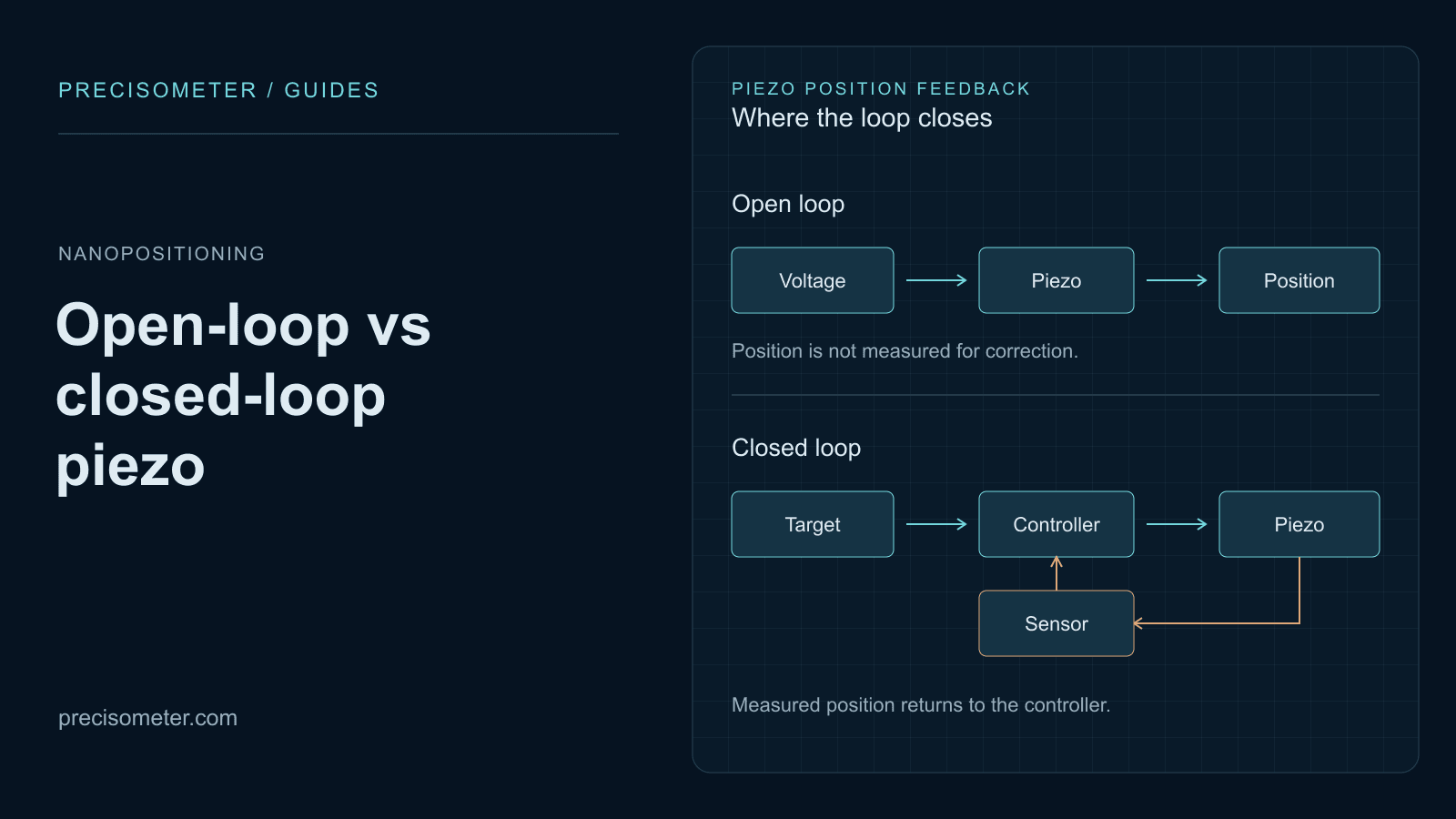 Nanopositioning
Why an open-loop piezo is wrong by 15 % of its travel, how creep grows with the logarithm of hold time, what strain-gauge and capacitive feedback actually fix — and the bandwidth and sensor noise a servo costs you in return.
Open guide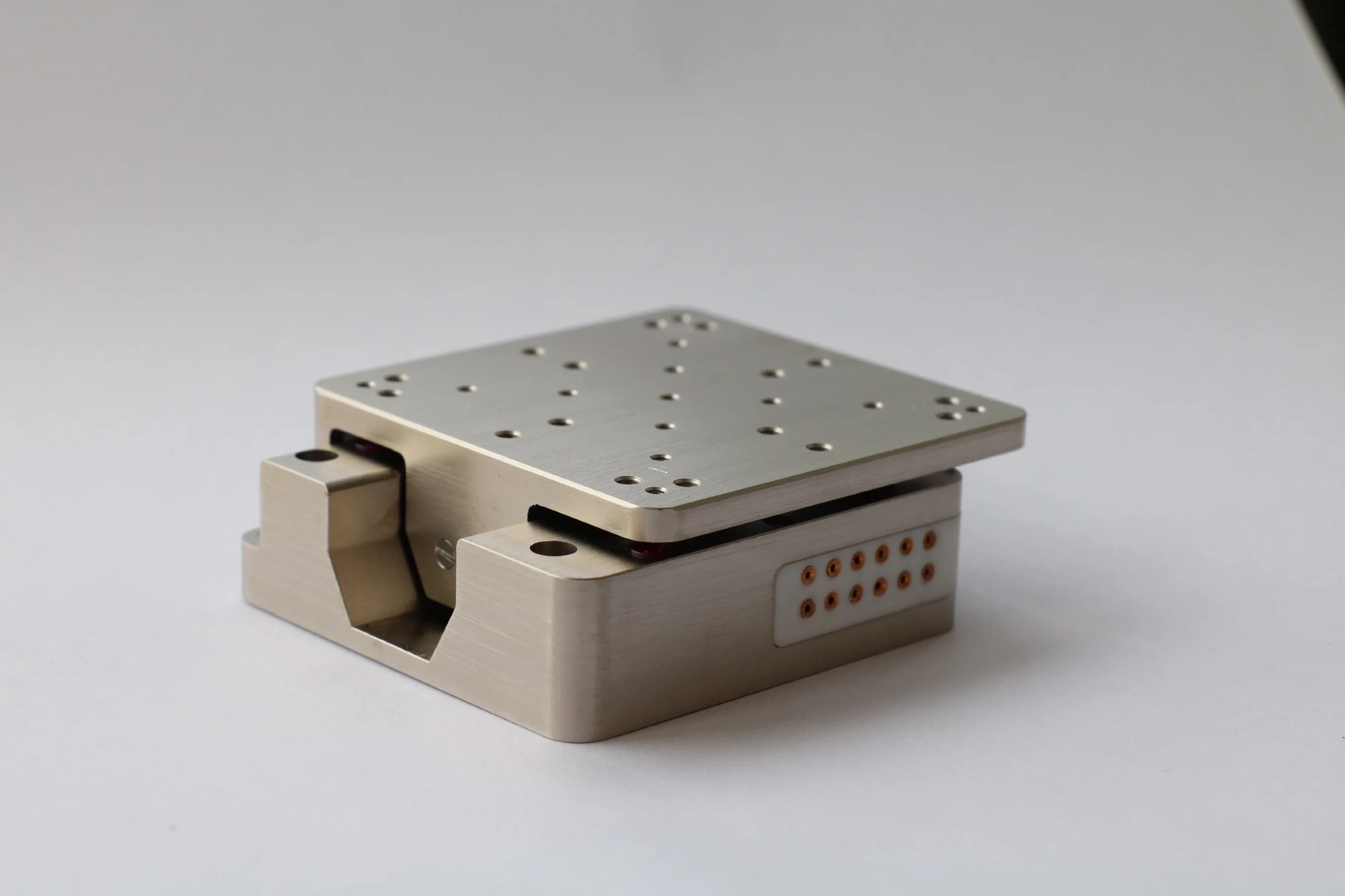 Nanopositioning
Piezo ceramic strains by one part in a thousand, so a 20 mm stack gives 20 µm. Every stage architecture is a different way around that limit — and each one wins a different experiment.
Open guide