Fiber Optical Amplifiers EDFA
5 components
Filter by wavelength, fiber and connector in the component finder →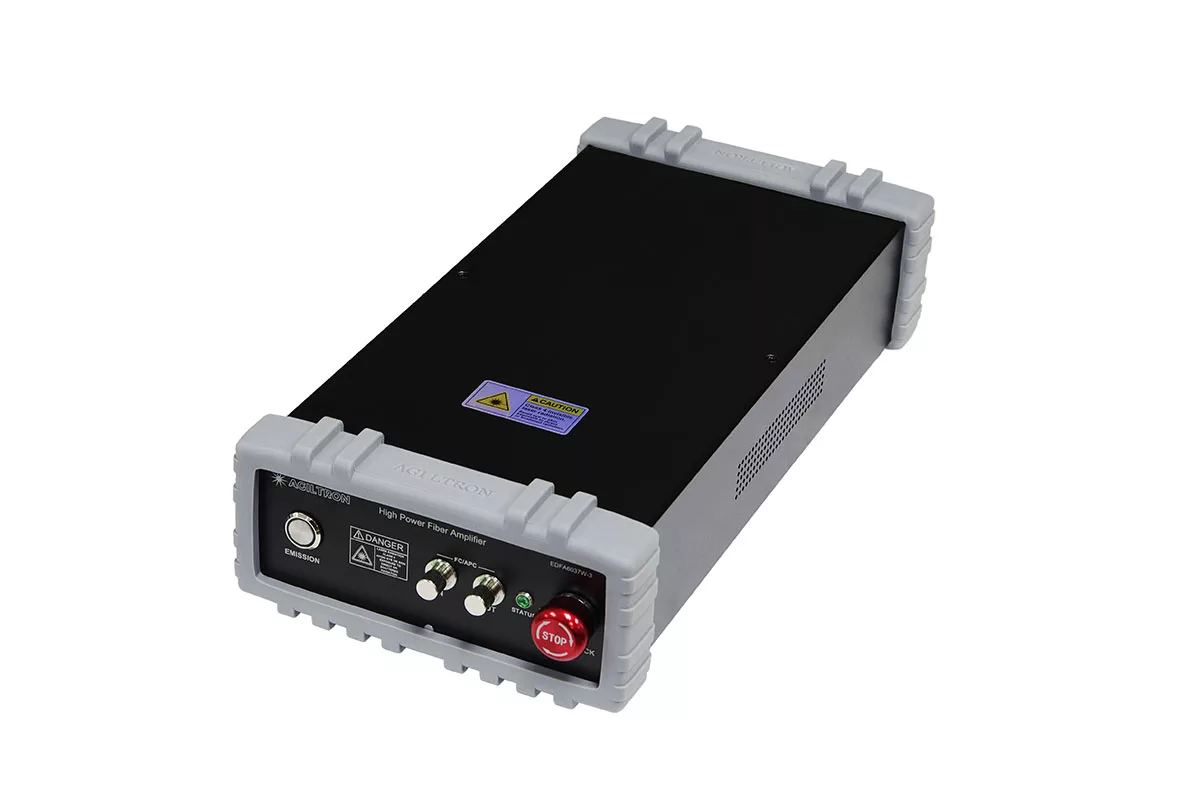
EDFA Amplifiers: Low Latency
The EDFL serials of erbium-doped fiber amplifier features a very short latency for applications which require minimum signal delay. The EDFL is built using semiconductor lasers, WDM, isolator, and erbium-doped fiber. The product has the advantages of high reliability, high power output, high gain, and low noise. Two configurations are available: A preamplifier for slight optical signal amplification and a Booster amplifier for maximum output power. We make both random polarization and polarization maintain versions. It has several package configuration choices. A Benchtop unit that is preset at the highest gain is suited for laboratory use. The Benchtop has a computer control interface and GUI. The compact module is suited for system integration with the universal control interface.
TypeWavelengthPowerGain7 datasheetsFiber Optical Amplifier EDFA: 1528-1565nm (< 26dBm), 1535-1565nm (< 43dBm)
Our Erbium-Doped Fiber Amplifier (EDFA) is a cost-effective solution for optical signal amplification, utilizing high-reliability semiconductor lasers, Wavelength Division Multiplexing (WDM) components, isolators, and erbium/ytterbium-doped fibers to deliver high power output, gain, low noise, and long operational life. Available in both preamplifier and booster configurations. It features a compact module with a universal control interface PCB for system integration, as well as a turnkey benchtop model with a computer interface and GUI for laboratory use. A pluggable model with a standardized host rack is available for network deployments. For power levels below 25dBm, the EDFA covers a wavelength range from 1528-1565nm, while for higher power levels, the wavelength range reduces to 1535-1565nm. For longer wavelength needs, L-band amplifiers are recommended.
TypePower/GainOutput ChannelPolarization14 datasheets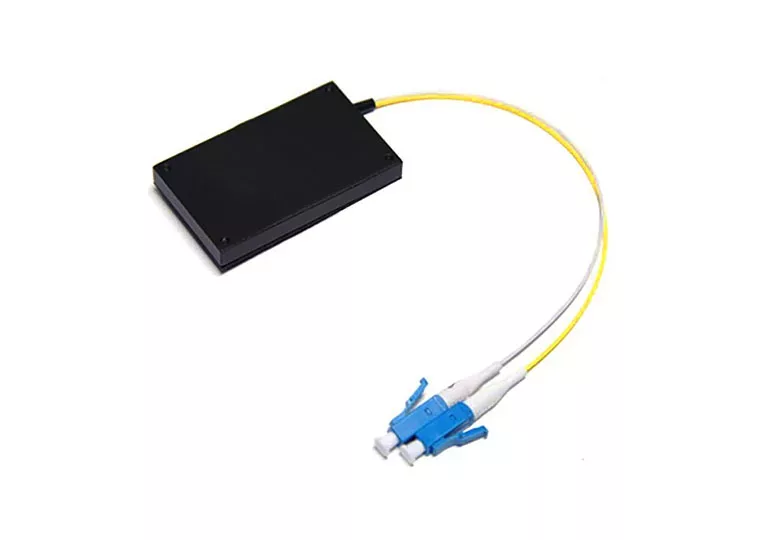
Mini Erbium Doped Fiber Amplifier 1528-1565nm
The Mini Erbium-Doped Fiber Amplifier (MEDF) is a high-performance, compact optical solution designed for reliable signal amplification at data rates up to 100 Gbps. This unit integrates an uncooled pump laser to minimize power consumption and features dual operating modes — Automatic Current Control (ACC) and Automatic Power Control (APC) — allowing users to choose between a constant pump current or a stabilized output power via a user-friendly USB-connected GUI. Built with high-quality components and internal isolators to prevent back-reflection, the MEDF is engineered for a 10-year operational lifespan, supported by advanced thermal management and real-time monitoring features like Loss of Signal (LOS) alarms and pump protection.
WavelengthPowerPolarizationPackage6 datasheets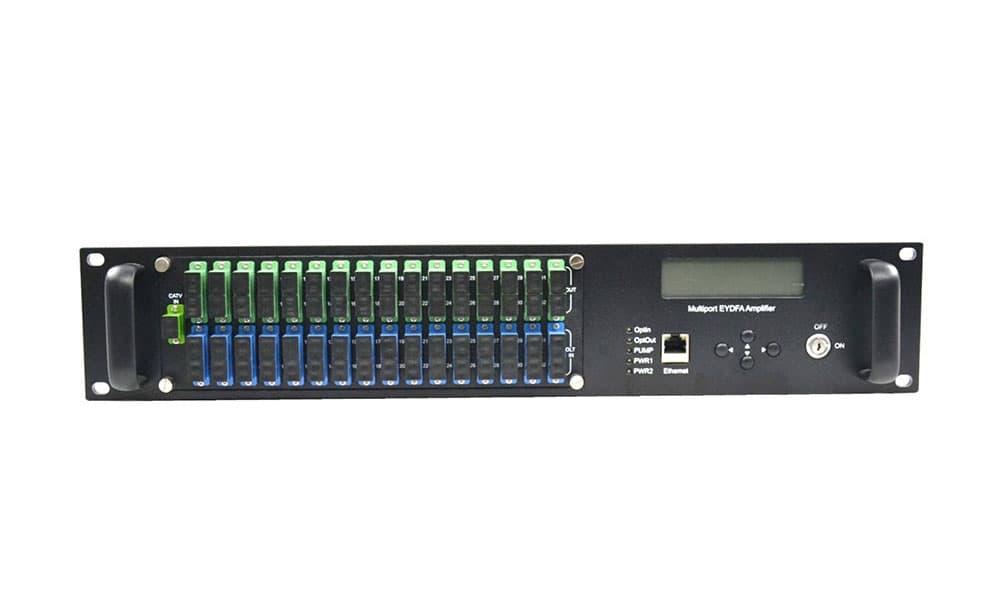
Multiport EDFAs 1528-1565nm
The EDAR Series are low-noise, high-performance Erbium-Doped Fiber Amplifiers (EDFAs) that provide the ideal building blocks for FTTx networks. It can amplify both analog and digital signals up to 100GHz. Integrated CWDM splitters are available to enable the routing of 1310 nm and 1490 nm data streams from the OLT to the ONU through the EDFA, reducing component count, lowering the FIT rate, and improving system performance. The EDAR Series provides a robust and reliable amplification solution for FTTx networks using RF video overlay. We provide solutions to handle mid to small-sized municipal networks while meeting the demanding requirements of large Tier 1 service providers. Our team of engineers and scientists will work with you to customize configurations. The EDFA has isolators on both input and output.
WavelengthPowerChannelPackage1 datasheetWide Temperature EDFA Amplifier -40 to 70 °C
Our Erbium doped fiber amplifier (EDFA) provides cost-effective solutions for high power optical amplification. It is built using semiconductor lasers, WDM, isolator, and erbium-doped fiber. The product has the advantages of high reliability, high power output, high gain and low noise. Two configurations are available: Pre-Amplifier for small optical signal amplification and Booster amplifier for maximum output power. We make both random polarization and polarization maintain versions. The compact module is suited for system integration with universal control interface. Remote control through GUI and UART is available, including power adjustment, input/output power monitoring, device temperature monitoring. The EDFA has isolators on both input and output.
TypeWavelengthPowerPolarization1 datasheet