Back to Home

Mightex · OASIS systems

OASIS Photometry

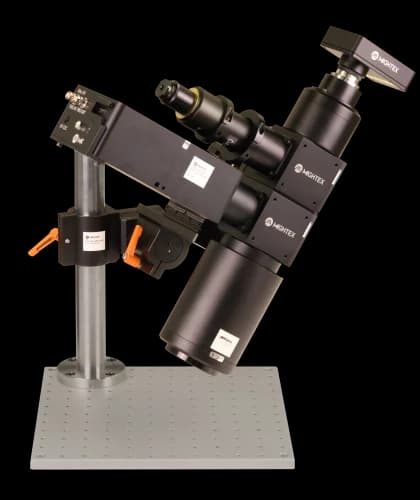
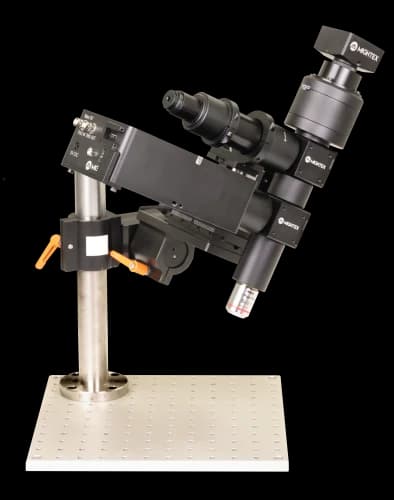
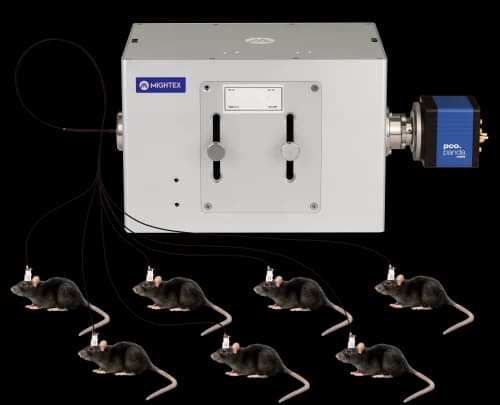
Turnkey fiber photometry system that records 1, 2, 5, 7 or up to 19 animals or regions at once, with up to three sensors plus an isosbestic channel and optional integrated optogenetics.

Animals / regions
1, 2, 5, 7 or up to 19
Channels
up to 3 sensors + isosbestic
Frame rate
up to 200 Hz
Optogenetics
Optional mini lasers

Your enquiry

Mightex configures this system to the experiment. Describe your preparation, wavelengths and equipment below and we will put the configuration together with you.

Discuss my setup

Quotation-based: tell us about the setup and we prepare a quotation for it.

Manufactured by Mightex. Precisometer is a Mightex distribution partner: we quote, integrate and support Mightex products, with in-person support in the Netherlands and Belgium.

Choose this when…

  • You need population fluorescence signals rather than single cells, from up to 19 animals or regions at once.
  • You want up to three sensors plus an isosbestic channel, optionally with mini-laser optogenetics through the same fiber.

Based on: Mightex OASIS Photometry and OASIS accessories pages.

How it differs from related in vivo imaging

Values this page lists that its neighbours in “OASIS systems” do not.

  • System: Fiber photometry

From Mightex

About the OASIS Photometry

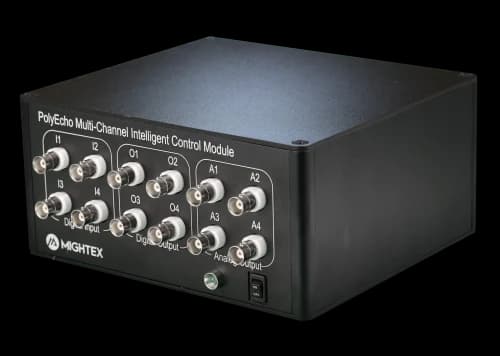
OASIS Photometry records population fluorescence through branched fiber patch cords and implanted fiber cannulae. A purpose-built PolyScan module acquires and displays traces for each wavelength and region in real time, de-interleaves the channels, fixes dropped frames and exports .csv files ready for analysis.

Three configurations are offered: Basic (one recording wavelength plus isosbestic), Multi-Colour (wavelengths for up to three sensors plus isosbestic), and Integrated Optogenetics, which adds Mightex mini lasers for independent stimulation of each fiber core during recording.

Features

  • Record 1, 2, 5, 7 or up to 19 animals or regions simultaneously with branched patch cords
  • Up to 3 sensors and an isosbestic channel; wavelengths for red and far-red sensors
  • Acquisition at up to 200 Hz; compatible with high-sensitivity cameras such as Photometrics and PCO
  • Integrated optogenetics module and mini lasers, with independent stimulation of each fiber core
  • Real-time traces with overlaid trigger timestamps; event-related snippeting
  • Automatic de-interleaving and .csv export

Applications listed by Mightex

  • Fiber photometry of calcium and neurotransmitter sensors
  • Multi-animal, high-throughput photometry
  • Simultaneous photometry and optogenetic stimulation through one fiber

Specifications

Technical specifications

Photometry fibers and cannulae (OASIS accessories page)
ParameterValue
Patch cord core diameter200 µm or 400 µm, 0.39 NA
Ferrule diameter1.25 mm or 2.5 mm
Furcations1, 2, 4, 7 or 19 branches
Rotary joint patch cordsAvailable
Cannula numerical aperture0.37 NA or 0.5 NA
Cannula protrusion length5 mm or 10 mm
Multi-site photometry probe12 × 6 array, up to 72 fibers; 100 µm core, 125 µm OD, 250 µm spacing

Reproduced from Mightex (official page), retrieved 2026-10-15.

Ordering and integration

What you need with it

Options and companions

Combining this with other equipment? Ask for an integration check.

Downloads

Technical documents

No downloadable document is published for this item.

We can send the technical information Mightex provides for it.

Request technical information

Build your experiment

Fiber photometry

Conceptual workflowParts named on Mightex’s OASIS Photometry and OASIS accessories pages. It is not a verified configuration: we check how the parts fit your equipment before quoting.

  1. 1

    Implant

    Fiber cannulae and mating sleeves.

  2. 2

    Patch cords

    Low-autofluorescence single or branched cords, with rotary joints if the animal turns.

  3. 3

    Recording system

    OASIS Photometry in Basic, Multi-Colour or Integrated Optogenetics configuration.

    • This page
  4. 4

    Synchronisation

    Time-stamp behaviour and stimulation events.

View enquiry list

Sources