Pulse energy, repetition rate, pulse width
MIL-PS-42354235 nm infrared pulsed laser
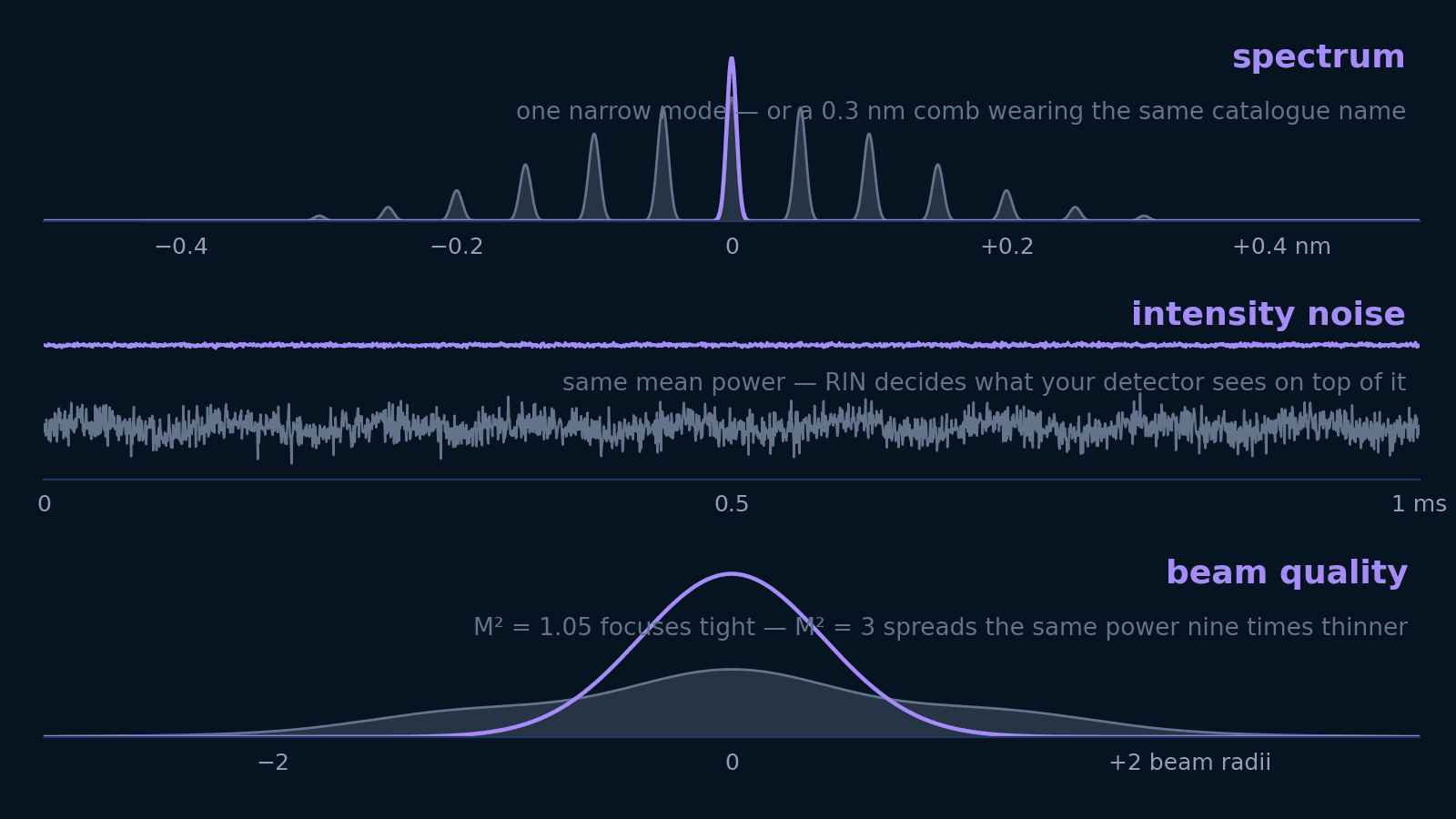
4235 nmThe MIL-PS-4235 is a 4235 nm picosecond diode-pumped solid-state laser. Laser diodes optically pump a solid gain medium inside a resonator. The pump supplies the energy; repeated passes through the gain medium amplify the laser light. Pulse duration sets how briefly the energy is delivered, while repetition rate sets the interval between pulses; average power alone does not describe the peak intensity at the sample. At the nominal 15 MHz repetition rate, pulses shorter than 700 ps arrive about 66.67 ns apart.
Specifications
MIL-PS-4235
15 specification rows
| Output / average power | 1~60 mW |
|---|---|
| Beam / notes | Picosecond Pulsed Mid-Infrared Laser |
| Operating mode | Pulsed |
| Ave power stability (rms, 4 hours±3℃) | <3%, <2%, <1% |
| Warm-up time (minutes) | <10 |
| Cooled method | Waterr cooled |
| Operating temperature (℃) | 15-30 |
| Power supply (100-240VAC) | RAD1PS |
| Expected lifetime (hours) | >10000 |
| Wavelength (nm) | 4235±10 |
| Pulse duration (ps) | <700@15MHz |
| Rep.rate | 15MHz |
| Beam divergence, full angle (mrad) | <3 |
| Beam diameter at the aperture (1/e2,mm) | <8 |
| Beam height from base plate (mm) | 120 |
What do you need?
Tell us the pulse energy, pulse width, repetition rate and beam delivery you need, and we'll reply with the matching configuration and lead time.
Model selection
Nearby series comparison
Compare MIL-PS-4235 with the closest available models in the Pulsed Lasers family.
| Selection parameter | MIL-PS-4235 (current) | EO-XS-2600-4410 | HPL-MIR-4200 |
|---|---|---|---|
| Wavelength | 4235 nm | 4200 nm | 4200 nm |
| Optical power / pulse energy | 1~60 mW | 1~1000 mW | 1~2 W |
| Operating mode / pulse width | Pulsed | Q-switched | Q-switched |
| Beam quality | <3 | <5 | <5 |
Related pulsed lasers
Compare the MIL-PS-4235 with nearby pulsed lasers across the wavelength range.