Back to Home

Microscopy Camera/Microscope Camera

U3CMOS18000KPA

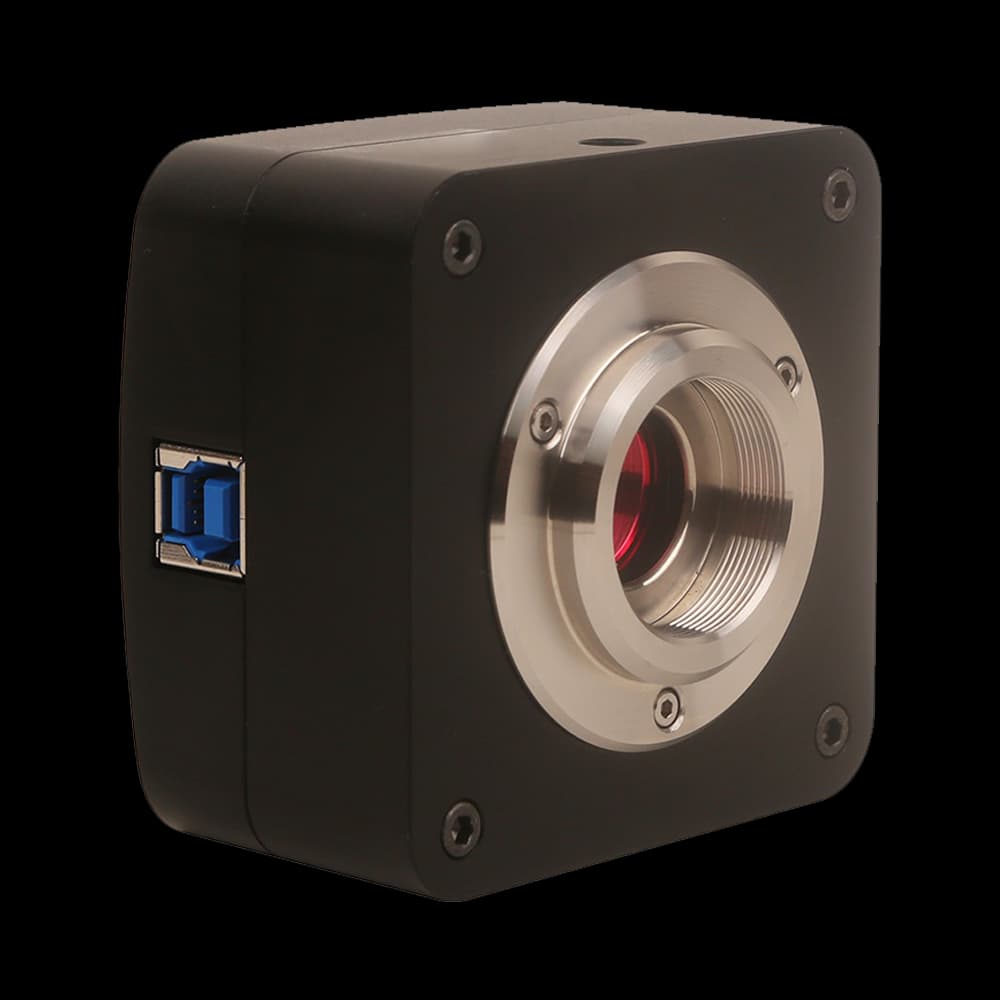
U3CMOS18000KPA Microscopy Camera/Microscope Camera with AR1820 (C) sensor, 18M (4912×3684) for professional imaging.

Sensor
AR1820 (C)
Resolution
18M (4912×3684)
Pixel Size
1.25 µm × 1.25 µm
Frame Rate
5.6 fps @ 4912×3684; 18.1 fps @ 2456×1842; 32.2 fps @ 1228×922
Interface
USB3.0
U3CMOS18000KPA

Application context

Why this design is used

Scientific imaging

U3CMOS18000KPA: The AR1820 (C) sensor, 18M (4912×3684) resolution, and 1.25 µm × 1.25 µm pixels defines the sensitivity, sampling and field coverage available for Scientific imaging. The 5.6 fps @ 4912×3684; 18.1 fps @ 2456×1842; 32.2 fps @ 1228×922 frame-rate listing also sets the fastest full-frame acquisition regime.

Instrument integration

U3CMOS18000KPA: The AR1820 (C) sensor, 18M (4912×3684) resolution, and 1.25 µm × 1.25 µm pixels defines the sensitivity, sampling and field coverage available for Instrument integration. The 5.6 fps @ 4912×3684; 18.1 fps @ 2456×1842; 32.2 fps @ 1228×922 frame-rate listing also sets the fastest full-frame acquisition regime.

Specifications

U3CMOS18000KPA

22 specification rows

The U3CMOS18000KPA is a microscopy camera in the U3CMOS series, built around a AR1820 (C) sensor, 18M (4912×3684) resolution, 1.25 µm × 1.25 µm pixels, frame rates up to 5.6 fps @ 4912×3684; 18.1 fps @ 2456×1842; 32.2 fps @ 1228×922, a USB3.0 interface. It suits microscopy camera/microscope camera where reliable imaging performance and interface compatibility matter.

Key Parameters

ModelU3CMOS18000KPA
SensorAR1820 (C)
Effective Pixels / Resolution18M (4912×3684)
Frame Rate (Full Resolution)5.6 fps @ 4912×3684; 18.1 fps @ 2456×1842; 32.2 fps @ 1228×922
Shutter TypeRolling Shutter
Color TypeColor

Imaging Performance

Pixel Size1.25 µm × 1.25 µm
Sensor Size6.14 mm × 4.61 mm
Diagonal1/2" (7.68 mm)
Dynamic Range65.8 dB
Bit Depth8-bit
Sensitivity0.62 V/lux·sec

Interface & Mechanical

Data InterfaceUSB3.0
GPIOAvailable on request
Lens MountC-mount
DimensionsAvailable on request
WeightAvailable on request
Power SupplyUSB3.0 interface power

Environment & Certification

Operating Temperature / Humidity10 °C ~ +50 °C / 30%~80%RH
Storage Temperature / Humidity20 °C ~ +60 °C / 10%~60%RH
Operating SystemWindows/Linux/macOS/Android multi-platform SDK (native C/C++, C#/VB.NET, Python, Java, DirectShow, TWAIN, etc.)
CertificationCE, FCC

System integration

Integration and compatibility

Use these checks to connect U3CMOS18000KPA to the surrounding optical, mechanical and control system. Every value shown is taken from this model's own specification record.

Lens and microscope interface
Lens Mount: C-mount
Use a lens image circle that covers the sensor and check flange distance before adding C/CS, F-mount or M42 adapters.
Sensor and sampling
Sensor: AR1820 (C) · Resolution: 18M (4912×3684)
Match pixel pitch to the diffraction-limited spot the optics deliver. Sampling finer than the optics resolve multiplies data volume without adding information; sampling coarser discards resolution you have paid for.
Interface and data rate
Frame Rate: 5.6 fps @ 4912×3684; 18.1 fps @ 2456×1842; 32.2 fps @ 1228×922 · Interface: USB3.0
Confirm the host can sustain the interface bandwidth continuously, not in burst. A camera that outruns the write path stalls acquisition rather than dropping quietly to a lower rate.
Hardware synchronization
GPIO: Available on request
Confirm edge polarity, pulse-width limits and whether each line is opto-isolated before connecting TTL or GPIO signals. A software exposure command is not equivalent to a hardware trigger.
Cooling and noise floor
Dynamic Range: 65.8 dB
Judge these figures at the exposure time you will actually use. Cooling matters where dark current accumulates over seconds; read noise dominates short exposures where it never does.

Technical FAQ

Integration questions for U3CMOS18000KPA

What lens mount is required for the U3CMOS18000KPA?

Lens Mount: C-mount. Use a lens image circle that covers the sensor and check flange distance before adding C/CS, F-mount or M42 adapters.

What sensor and pixel pitch does the U3CMOS18000KPA use?

Sensor: AR1820 (C) · Resolution: 18M (4912×3684). Match pixel pitch to the diffraction-limited spot the optics deliver. Sampling finer than the optics resolve multiplies data volume without adding information; sampling coarser discards resolution you have paid for.

How does the U3CMOS18000KPA connect to the acquisition computer?

Frame Rate: 5.6 fps @ 4912×3684; 18.1 fps @ 2456×1842; 32.2 fps @ 1228×922 · Interface: USB3.0. Confirm the host can sustain the interface bandwidth continuously, not in burst. A camera that outruns the write path stalls acquisition rather than dropping quietly to a lower rate.

Does the U3CMOS18000KPA support hardware triggering?

GPIO: Available on request. Confirm edge polarity, pulse-width limits and whether each line is opto-isolated before connecting TTL or GPIO signals. A software exposure command is not equivalent to a hardware trigger.

What is the noise performance of the U3CMOS18000KPA?

Dynamic Range: 65.8 dB. Judge these figures at the exposure time you will actually use. Cooling matters where dark current accumulates over seconds; read noise dominates short exposures where it never does.

Need help choosing?

Tell us your sensor, resolution, spectral range, frame-rate, interface, and software requirements and we will confirm the matching configuration and lead time.

Open camera finder

Model selection

Nearby series comparison

Compare U3CMOS18000KPA with the closest available models in the U3CMOS family. Confirm option-dependent values on the final configuration before ordering.

Selection parameterU3CMOS18000KPA (current)U3CMOS16000KPBU3CMOS16000KPA
SensorAR1820 (C)MN34230PLJ (C)MN34120 (C)
Resolution18M (4912×3684)16M (4648×3506)16M (4632×3488)
Sensor size6.14 mm × 4.61 mm17.60 mm × 13.30 mm6.18 mm × 4.66 mm
Pixel size / frame rate1.25 µm × 1.25 µm3.8 µm × 3.8 µm1.335 µm × 1.335 µm

Other cameras on the AR1820 sensor

The AR1820 appears in 2 models across the catalogue, differing in cooling, shutter, interface and colour filter. Compare them side by side before settling on a variant.