LED, picosecond & calibration sources
Picosecond Pulsed Diode Sources
Compact pulsed laser-diode sources with internal repetition-rate settings and external triggering. A synchronisation output connects the excitation source to time-resolved detection electronics.
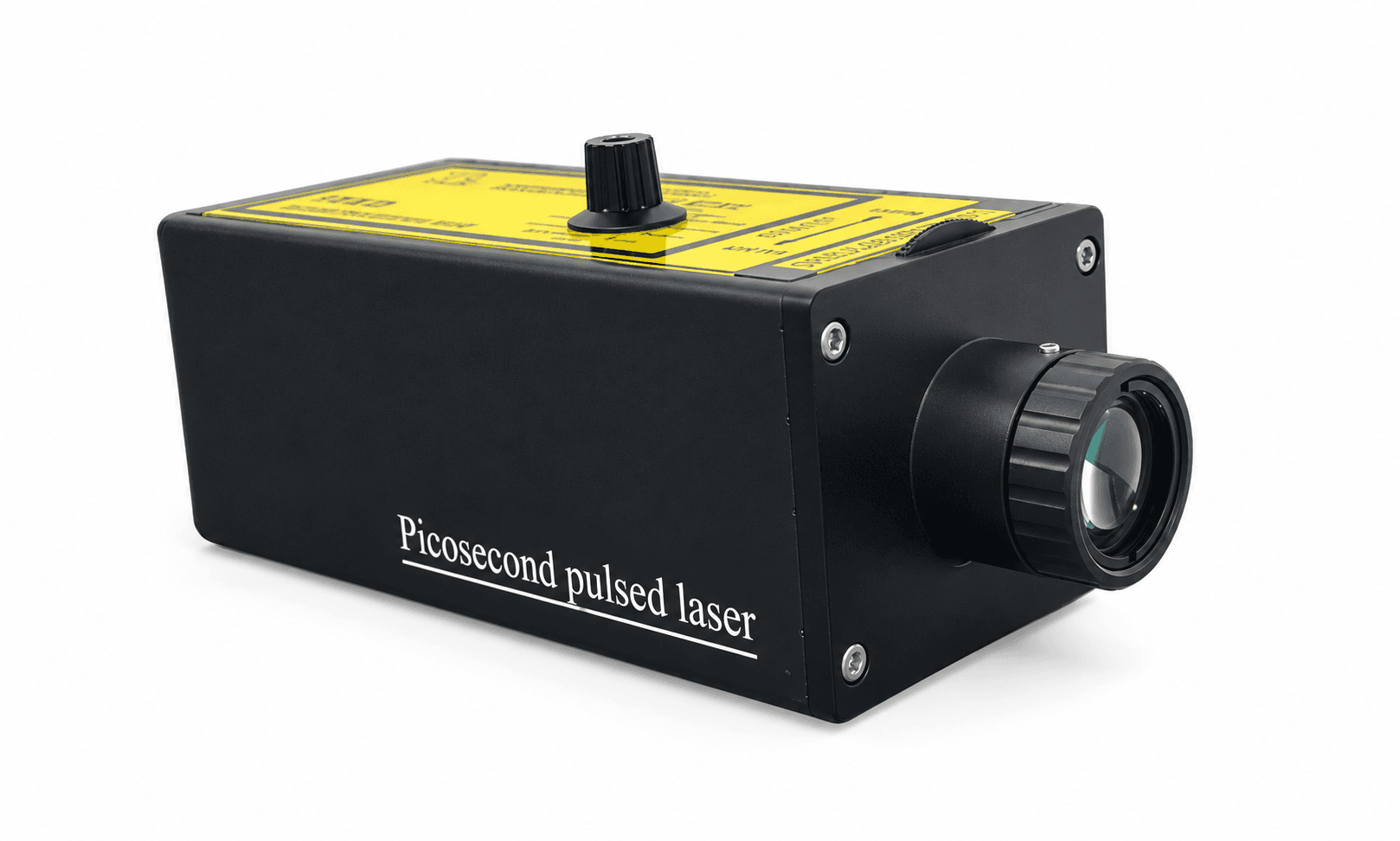
Best suited to
Fluorescence lifetime, time-resolved spectroscopy and synchronised pulsed excitation.
Selecting a configuration
Specify wavelength, average power, pulse width and timing interface. Peak optical power and average optical power are separate specifications.
Measurement & configuration
- Typical 50 ps pulses; published maximum below 100 ps.
- Ten internal rate settings from 10 Hz to 20 MHz.
- External single-shot to 20 MHz triggering and a synchronisation output.
Plan the signal path
- 1Internal / external timing
- 2Picosecond diode excitation
- 3Synchronous detection
Specifications
| Nominal wavelengths | 380, 405, 450, 520, 650, 880, 980 nm (±5 nm) |
|---|---|
| Pulse duration | 50 ps typical; <100 ps maximum |
| External trigger | 3–5 V TTL into 50 Ω; pulse ≥10 ns |
| Trigger insertion delay | Approximately 10 ns |
| Sync output | 3 V into 50 Ω; 15 ns pulse |
| Supply | 12 V DC; approximately 3 A |
Published optical power by wavelength
| Wavelength (nm) | Average at 20 MHz (mW) | Peak at 10 MHz (mW) |
|---|---|---|
| 380 | 0.3 | 300 |
| 405 | 0.2 | 300 |
| 450 | 0.15 | 150 |
| 520 | 0.3 | 300 |
| 650 | 0.1 | 100 |
| 880 | 0.1 | 100 |
| 980 | 0.25 | 250 |
Power columns use different published repetition-rate conditions. They must not be treated as interchangeable power ratings.
Related led, picosecond & calibration sources
Configure TPLD
Send the wavelength interval, signal level, timing and sample requirements for your experiment.