FI-RXF100-R
FI-RXF100-R FTIR Spectrometer
A research FTIR spectrometer with an external, adjustable high-precision aperture and a large sealed sample compartment that takes transmission cells, ATR accessories and in-situ diffuse reflectance cells for catalyst characterisation. Resolution better than 0.4 cm⁻¹, 8000–350 cm⁻¹.
0.4 cm⁻¹
Resolution, better than
8000–350 cm⁻¹
Spectral range
RT–800 °C
In-situ DRIFTS cell
25 kg
Weight
Overview
About the FI-RXF100-R
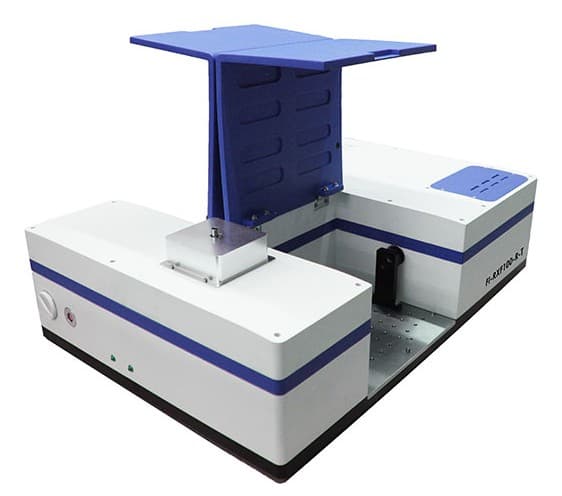
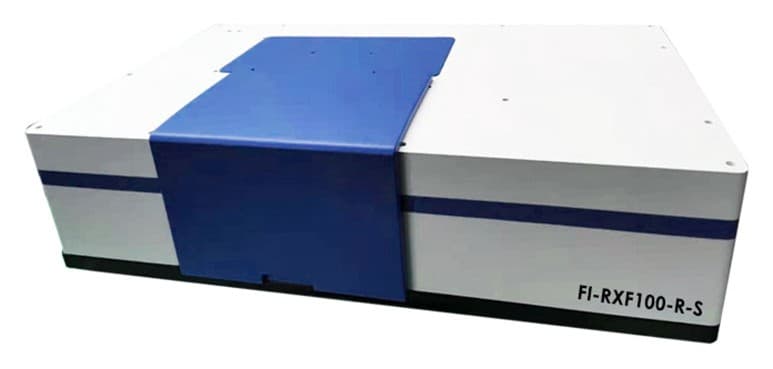
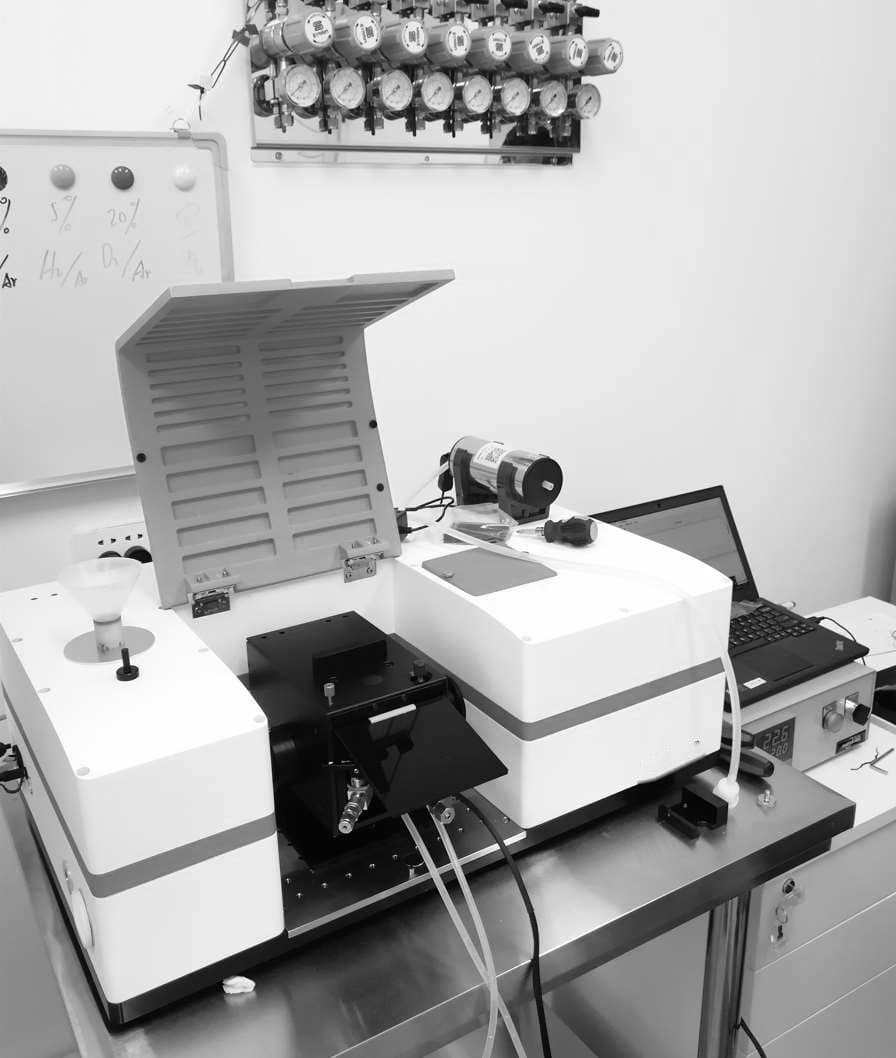
An integrated, fully sealed design with a moisture-resistant ZnSe beamsplitter and a high-sensitivity detector. The spacious sample compartment accepts infrared transmission cells, ATR accessories and diffuse reflectance cells. Even the auxiliary equipment of an in-situ diffuse reflectance experiment — temperature controller, gas lines — can be arranged neatly, so the whole in-situ set-up stays compact and uses little bench space.
An external, adjustable high-precision aperture lets you set the aperture to suit the sample’s thickness or colour at any time, without going through the software. Together with switchable gain steps, this shows the maximum infrared throughput through the sample in real time for the best signal-to-noise ratio. The FI-RXF100-R also takes other in-situ diffuse reflectance accessories and in-situ pyridine adsorption cells for catalyst characterisation, and is configured to the needs of your research project.
Features
Hardware
- Interferometer: excellent performance, reliability and stability, with strong immunity to interference
- Optics: gold-coated mirrors throughout, with reflectance more than 5 % higher than aluminium; oxidation-resistant for more stable optical performance
- Detectors: high-sensitivity DLaTGS, TE-cooled MCT or liquid-nitrogen-cooled MCT
- Solid-state laser: stable performance, service life over 10 years
- Source: high performance, long service life
Applications
Solid transmission
- Pressed pellets of solid powders; qualitative analysis of films; quantitative analysis of hot-pressed films
- Infrared-transparent materials such as glasses, jadeite, crystals and functionally modified materials
Solid ATR
- Powders measured directly, without pressing pellets
- Irregularly shaped samples, left intact after measurement
- Polymers, fibres and films; O-rings and rubbers
- Other samples that are difficult to measure in transmission
Liquid transmission
- Sealed liquid cells for quantitative measurement of organic solutions and volatile solvents
- Demountable liquid cells with variable path length for quantitative analysis
- Quantitative analysis of lubricating oils
- Liquid films on infrared windows for qualitative analysis
Gas measurement
- Straight-through gas cells in glass or stainless steel, optional temperature control, path lengths of 1.5, 3, 5 or 7 cm — for high concentrations
- Multi-pass gas cells in stainless steel, optional temperature control, path lengths of 50 cm, 100 cm, 5 m or custom — for low concentrations
- Corrosion-resistant gas cells in special materials to order, for example for TG-IR coupling or corrosive gases
Further applications
- Heatable in-situ transmission cell
- High-temperature in-situ diffuse reflectance cell
- Absolute transmittance of materials (collimated incidence)
- Diffuse transmittance (integrating-sphere accessory)
- Reflectance at 10°, 30°, 45° and 80°, and variable-angle accessories
- ATR with diamond, ZnSe or Ge crystals
- Routine transmission of solids, liquids and gases
- Custom accessories and demanding test conditions
The in-situ infrared principle
An infrared spectrum is recorded by measuring a background first and then the sample; the system calculates the transmittance or absorbance spectrum, and the two forms are interconvertible. To record the spectrum of a catalyst itself, measure the empty beam path under nitrogen as the background, then the catalyst wafer. To study adsorption and desorption, use the catalyst itself as the background and then admit probe molecules: the result is the infrared absorption of the probe molecules on the catalyst surface.
The large sample space of the FI-RXF100-R accommodates both in-situ transmission and in-situ diffuse reflectance measurements.
Catalyst characterisation
FTIR is increasingly valued in catalysis research. Characterising catalysts by infrared is simple and fast and uses practically no consumables apart from liquid nitrogen, and the methods are mature and widely accepted.
The two main infrared methods for catalysts are in-situ diffuse reflectance (DRIFTS) and in-situ transmission. Between them they provide:
- Reaction kinetics of the catalyst
- Online study of catalytic performance at high temperature, high pressure or high vacuum
- Reaction mechanisms and reaction pathways
- Adsorption sites and adsorption behaviour of the catalyst surface, from adsorption and desorption of probe gas molecules at different temperatures
- Acidity and basicity of the catalyst
- Experimental data for developing new catalysts
- Composition and structural analysis of catalyst samples
Technical Specifications
FI-RXF100-R Specifications
Spectrometer
| Interferometer | Cube-corner Michelson interferometer, suited to field conditions |
|---|---|
| Beamsplitter | Moisture-resistant ZnSe beamsplitter and moisture-resistant windows |
| IR source | Air-cooled ceramic source, 1550 K |
| Detector | High-sensitivity DLaTGS; liquid-nitrogen-cooled MCT optional |
| Spectral range | 8000–350 cm⁻¹ / 5000–500 cm⁻¹ |
| Spectral resolution | Better than 0.4 cm⁻¹ |
| Wavenumber accuracy | Better than 0.005 cm⁻¹ |
| Dimensions (L × W × H) | 685 × 415 × 223 mm |
| Weight | 25 kg |
In-situ diffuse reflectance cell
| Reaction chamber | Chemically resistant stainless steel with a removable stainless-steel dome |
|---|---|
| Windows | Two BaF₂ infrared windows and a sapphire window; excitation light enters through the third window for photochemical and photocatalytic in-situ studies |
| Temperature range | Room temperature to 800 °C |
| Pressure range | 133 kPa (1000 torr) to 0.133 mPa (10⁻⁶ torr) |
| Connections | Water-cooling quick couplings, two K-type thermocouples, three reaction-gas ports; compression, push-in or KF vacuum fittings to vacuum and gas-dosing systems |
| Compatibility | Raman and infrared diffuse reflectance measurements |
Figures
Photos, Drawings and Spectra
Datasheet
Full specification sheet for the FI-RXF100-R.
Compare