Spectroscopy Detectors · Silicon photodetectors
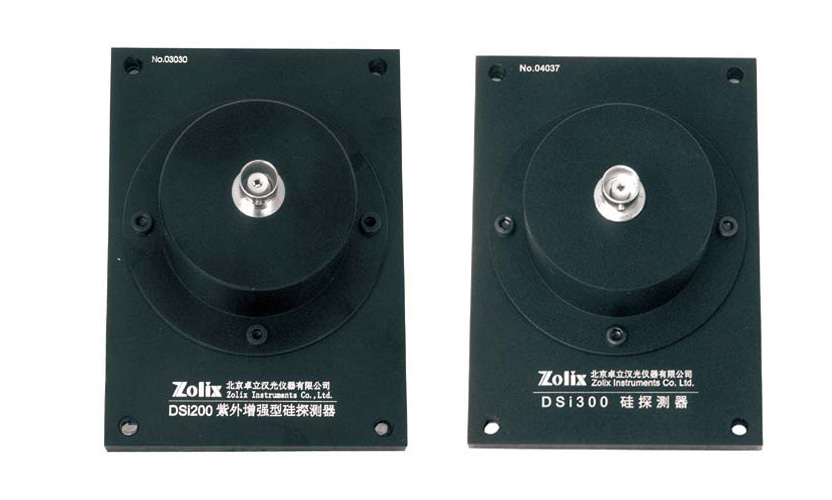
DSi200 / DSi300
DSi Silicon Photodetectors
Large-area silicon photodetectors in UV-enhanced and blue-enhanced versions, with current output and spectral response extending to 1100 nm.
Catalog context
Where DSi200 / DSi300 fits
DSi200 / DSi300 is listed as DSi Silicon Photodetectors in the Silicon photodetectors family. The local catalog record provides these first selection fields: Models: DSi200 (UV enhanced) / DSi300 (blue enhanced); Effective area: 100 mm² (Ø11.28 mm); Spectral range: DSi200: 200–1100 nm; DSi300: 350–1100 nm.
Specifications
| Models | DSi200 (UV enhanced) / DSi300 (blue enhanced) |
|---|---|
| Effective area | 100 mm² (Ø11.28 mm) |
| Spectral range | DSi200: 200–1100 nm; DSi300: 350–1100 nm |
| Peak wavelength | 820 nm / 970 nm |
| Peak responsivity | 0.52 A/W / 0.60 A/W |
| Operating temperature | −10 to +60 °C |
| Signal output | Current |
Complete source specification
Model-by-model comparison
The full manufacturer-published comparison is transcribed below so model differences remain visible rather than being reduced to a single range.
| Parameter | DSi200 — UV enhanced | DSi300 — blue enhanced |
|---|---|---|
| Effective area | 100 mm² (Ø11.28 mm) | 100 mm² (Ø11.28 mm) |
| Spectral range | 200–1100 nm | 350–1100 nm |
| Peak wavelength | 820 nm | 970 nm |
| Peak responsivity | 0.52 A/W | 0.60 A/W (> 0.55) |
| Specified responsivity | 0.14 A/W (> 0.09) at 254 nm | 0.20 A/W (> 0.15) at 410 nm |
| Rise time | 5.9 µs | 2 µs |
| Operating temperature | −10 to +60 °C | −10 to +60 °C |
| Storage temperature | −20 to +70 °C | −20 to +70 °C |
| Shunt resistance | 10 MΩ (> 5 MΩ) | > 10 MΩ |
| Noise-equivalent power | 4.5 × 10⁻¹³ W/√Hz | 2.0 × 10⁻¹³ W/√Hz |
| Maximum operating current at 0 V bias | 0.1 mA | 10.0 mA |
| Junction capacitance at 0 V bias | 4500 pF | 8800 pF |
| Signal output | Current | Current |
| Output polarity | P | P |
Design and integration details
- Large 100 mm² active area in UV-enhanced and blue-enhanced versions.
- BNC current output and direct mounting flange for Omni-λ monochromator slit assemblies.
- ZAMP transimpedance amplifier recommended when voltage output or improved sensitivity is required.
- Direct current-input connection is possible when the downstream instrument supports it.
Application and connection notes
- Use a ZAMP preamplifier with oscilloscopes, lock-in amplifiers or DCS103 acquisition when current-to-voltage conversion is needed.
- DCS300PA already integrates a signal amplifier, so an additional preamplifier is not required.
Values are transcribed from the archived product table and diagrams. Confirm the final detector, electronics and spectrograph interface for your configuration.
Archived manufacturer product pageSystem integration
Integration and compatibility
Use these checks to connect DSi200 / DSi300 to the surrounding optical, mechanical and control system. Every value shown is taken from this model's own specification record.
- Spectral response
- Spectral range: DSi200: 200–1100 nm; DSi300: 350–1100 nm · Peak wavelength: 820 nm / 970 nm
- Responsivity varies strongly across the stated band. Read the figure at your own wavelength rather than at the peak the headline range implies.
- Output and bias
- Signal output: Current
- Confirm whether the module is biased and amplified internally or expects an external supply and transimpedance stage. The two builds are not interchangeable and the wrong assumption destroys detectors.
Technical FAQ
Integration questions for DSi200 / DSi300
What wavelengths does the DSi200 / DSi300 detect?
Spectral range: DSi200: 200–1100 nm; DSi300: 350–1100 nm · Peak wavelength: 820 nm / 970 nm. Responsivity varies strongly across the stated band. Read the figure at your own wavelength rather than at the peak the headline range implies.
How is the DSi200 / DSi300 read out?
Signal output: Current. Confirm whether the module is biased and amplified internally or expects an external supply and transimpedance stage. The two builds are not interchangeable and the wrong assumption destroys detectors.