Spectroscopy Detectors · Near- and mid-infrared single-point detectors
DInGaAs1700-TE / DInGaAs2600-TE
DInGaAs TE-Cooled InGaAs Detectors
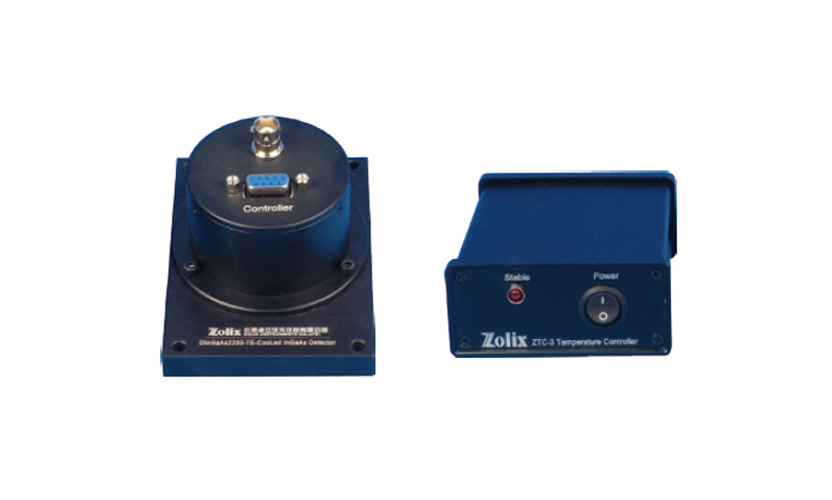
Two-stage thermoelectrically cooled InGaAs detector heads covering the standard and extended near-infrared bands, with current output and regulated −40 °C detector operation.
Catalog context
Where DInGaAs1700-TE / DInGaAs2600-TE fits
DInGaAs1700-TE / DInGaAs2600-TE is listed as DInGaAs TE-Cooled InGaAs Detectors in the Near- and mid-infrared single-point detectors family. The local catalog record provides these first selection fields: Models: DInGaAs1700-TE / DInGaAs2600-TE; Spectral range: 800–1700 nm / 800–2600 nm; Peak responsivity: 0.9 A/W / 1.2 A/W.
Specifications
| Models | DInGaAs1700-TE / DInGaAs2600-TE |
|---|---|
| Spectral range | 800–1700 nm / 800–2600 nm |
| Peak responsivity | 0.9 A/W / 1.2 A/W |
| Cooling | Thermoelectric (TE) |
| Operating temperature | −40 °C |
| Temperature stability | ±0.5 °C |
| Temperature controller | ZTC |
| Source naming note | The parent category card says DInAs; the detailed product body, hardware label, response curve and table identify DInGaAs/InGaAs |
Complete source specification
Model-by-model comparison
The full manufacturer-published comparison is transcribed below so model differences remain visible rather than being reduced to a single range.
The manufacturer parent-card title says DInAs, while the product body, response curve, hardware label and specification table consistently identify TE-cooled InGaAs models. The detailed model designation is used here.
| Parameter | DInGaAs1700-TE | DInGaAs2600-TE |
|---|---|---|
| Effective-area diameter | 3 mm | 3 mm |
| Spectral range | 800–1700 nm | 800–2600 nm |
| Peak responsivity | 0.9 A/W | 1.2 A/W |
| D*, typical | 8.4 × 10¹³ | 4.9 × 10¹¹ |
| NEP, typical | 3.2 × 10⁻¹⁵ | 5.5 × 10⁻¹³ |
| Operating temperature | −40 °C | −40 °C |
| Temperature stability | ±0.5 °C | ±0.5 °C |
| Ambient temperature | +10 to +40 °C | +10 to +40 °C |
| Signal output | Current | Current |
| Output polarity | P | P |
| Temperature controller | ZTC | ZTC |
Design and integration details
- Two-stage TE-cooled InGaAs detectors covering 0.8–2.6 µm.
- Both variants use the same detector-head construction.
- ZTC temperature controller is required for cooled operation.
- ZAMP transimpedance amplifier is recommended for current-to-voltage conversion and improved sensitivity.
Application and connection notes
- The detailed source content identifies these models as DInGaAs1700-TE and DInGaAs2600-TE; the parent category card incorrectly labels the family DInAs.
- DCS300PA integrates a signal amplifier; an extra preamplifier is generally unnecessary with that acquisition system.
Values are transcribed from the archived product table and diagrams. Confirm the final detector, electronics and spectrograph interface for your configuration.
Archived manufacturer product pageSystem integration
Integration and compatibility
Use these checks to connect DInGaAs1700-TE / DInGaAs2600-TE to the surrounding optical, mechanical and control system. Every value shown is taken from this model's own specification record.
- Spectral response
- Spectral range: 800–1700 nm / 800–2600 nm · Peak responsivity: 0.9 A/W / 1.2 A/W
- Responsivity varies strongly across the stated band. Read the figure at your own wavelength rather than at the peak the headline range implies.
- Noise and cooling
- Cooling: Thermoelectric (TE) · Temperature stability: ±0.5 °C
- Compare NEP or dark current at the operating temperature and bandwidth you will actually use; both figures improve with cooling and degrade with bandwidth, so a single number without conditions is not comparable.
Technical FAQ
Integration questions for DInGaAs1700-TE / DInGaAs2600-TE
What wavelengths does the DInGaAs1700-TE / DInGaAs2600-TE detect?
Spectral range: 800–1700 nm / 800–2600 nm · Peak responsivity: 0.9 A/W / 1.2 A/W. Responsivity varies strongly across the stated band. Read the figure at your own wavelength rather than at the peak the headline range implies.
What is the noise floor of the DInGaAs1700-TE / DInGaAs2600-TE?
Cooling: Thermoelectric (TE) · Temperature stability: ±0.5 °C. Compare NEP or dark current at the operating temperature and bandwidth you will actually use; both figures improve with cooling and degrade with bandwidth, so a single number without conditions is not comparable.