Spectroscopy Detectors · Near-infrared linear arrays
DField-NIR Series
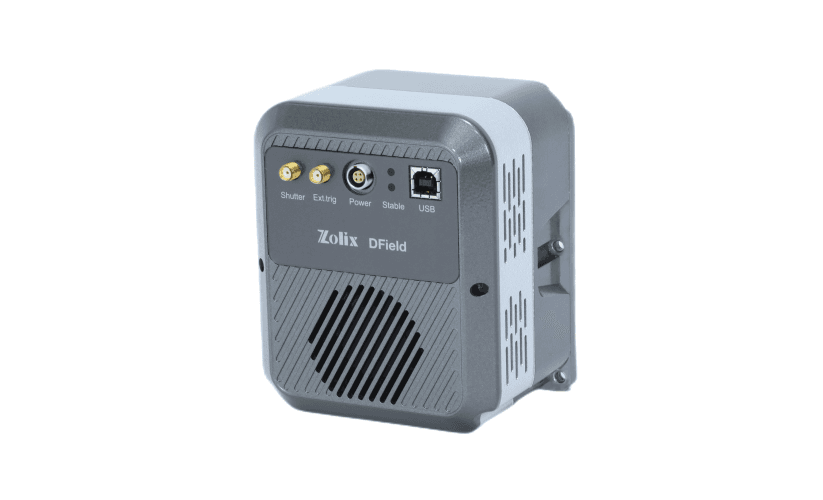
DField Series InGaAs Linear Array Detectors
- Models: DField-NIR-D1 / DField-NIR-D3 / DField-NIR-D7
- Spectral ranges: 0.85–1.45 µm / 0.9–1.7 µm / 0.9–2.2 µm
- Pixel size: D1: 25 × 500 µm; D3/D7: 25 × 250 µm
- Image area: D1: 12.8 × 0.5 mm; D3/D7: 12.8 × 0.25 mm
- Active pixels: 512
- A/D resolution: 16 bit
Product range
Where DField-NIR Series fits
- Category: Spectroscopy Detectors
- Family: Near-infrared linear arrays
Specifications
| Models | DField-NIR-D1 / DField-NIR-D3 / DField-NIR-D7 |
|---|---|
| Spectral ranges | 0.85–1.45 µm / 0.9–1.7 µm / 0.9–2.2 µm |
| Pixel size | D1: 25 × 500 µm; D3/D7: 25 × 250 µm |
| Image area | D1: 12.8 × 0.5 mm; D3/D7: 12.8 × 0.25 mm |
| Active pixels | 512 |
| A/D resolution | 16 bit |
| Integration time | D1/D3: 1 ms–120 s; D7: 1 ms–1 s |
| Cooling temperature at 25 °C ambient | D1/D7: −20 °C; D3: −10 °C |
| Trigger | Software and external trigger |
| I/O | Trigger input and shutter-control output |
| Communication | USB 2.0 |
| Supply | 12 V DC |
| Dimensions | 99 × 119 × 78 mm |
| Weight | 1 kg |
Product comparison
Check a reference product
Considering DField-NIR Series for an existing setup? Send us the reference product number and your required specifications. Our engineers can help check the function, configuration, dimensions and interfaces.
Ask our engineers →Complete source specification
Model-by-model comparison
The full manufacturer-published comparison is transcribed below so model differences remain visible rather than being reduced to a single range.
| Parameter | DField-NIR-D1 | DField-NIR-D3 | DField-NIR-D7 |
|---|---|---|---|
| Spectral range | 0.85–1.45 µm | 0.9–1.7 µm | 0.9–2.2 µm |
| Pixel size | 25 × 500 µm | 25 × 250 µm | 25 × 250 µm |
| Image area | 12.8 × 0.5 mm | 12.8 × 0.25 mm | 12.8 × 0.25 mm |
| Dynamic range, low gain | 14,000 | 14,000 | 14,000 |
| Dynamic range, high gain | 7,000 | 7,000 | 7,000 |
| Active pixels | 512 | 512 | 512 |
| A/D resolution | 16 bit | 16 bit | 16 bit |
| Integration time | 1 ms–120 s | 1 ms–120 s | 1 ms–1 s |
| Cooling temperature at 25 °C ambient | −20 °C | −10 °C | −20 °C |
| Trigger mode | Software / external | Software / external | Software / external |
| Input / output | Trigger input / shutter output | Trigger input / shutter output | Trigger input / shutter output |
| Communication | USB 2.0 | USB 2.0 | USB 2.0 |
| Supply | 12 V DC | 12 V DC | 12 V DC |
| Dimensions | 99 × 119 × 78 mm | 99 × 119 × 78 mm | 99 × 119 × 78 mm |
| Weight | 1 kg | 1 kg | 1 kg |
Design and integration details
- Three InGaAs array configurations cover 0.85–2.2 µm.
- 512 active pixels with 16-bit conversion.
- Software and external triggering plus a shutter-control output.
- Large dynamic range with selectable low- and high-gain modes.
Application and connection notes
- Choose the wavelength cut-off first: D1 to 1.45 µm, D3 to 1.7 µm or D7 to 2.2 µm.
- The source gallery includes spectral-responsivity and mechanical-dimension drawings.
Values are transcribed from the archived product table and diagrams. Confirm the final detector, electronics and spectrograph interface for your configuration.
System integration
Integration and compatibility
- Spectral response: Spectral ranges: 0.85–1.45 µm / 0.9–1.7 µm / 0.9–2.2 µm
- Active area: Pixel size: D1: 25 × 500 µm; D3/D7: 25 × 250 µm · Active pixels: 512
- Noise and cooling: Cooling temperature at 25 °C ambient: D1/D7: −20 °C; D3: −10 °C
Technical FAQ
Integration questions for DField-NIR Series
What wavelengths does the DField-NIR Series detect?
- Spectral ranges: 0.85–1.45 µm / 0.9–1.7 µm / 0.9–2.2 µm. Responsivity varies strongly across the stated band. Read the figure at your own wavelength rather than at the peak the headline range implies.
What is the active area of the DField-NIR Series?
- Pixel size: D1: 25 × 500 µm; D3/D7: 25 × 250 µm · Active pixels: 512. Active area sets both the alignment tolerance and, through capacitance, the achievable bandwidth. A larger element is easier to hit and slower to read.
What is the noise floor of the DField-NIR Series?
- Cooling temperature at 25 °C ambient: D1/D7: −20 °C; D3: −10 °C. Compare NEP or dark current at the operating temperature and bandwidth you will actually use; both figures improve with cooling and degrade with bandwidth, so a single number without conditions is not comparable.