Opto-mechanics
How to choose an optical table
Mass is not the specification. What matters is where the isolators resonate, how the top bends, and how quiet your floor already is.
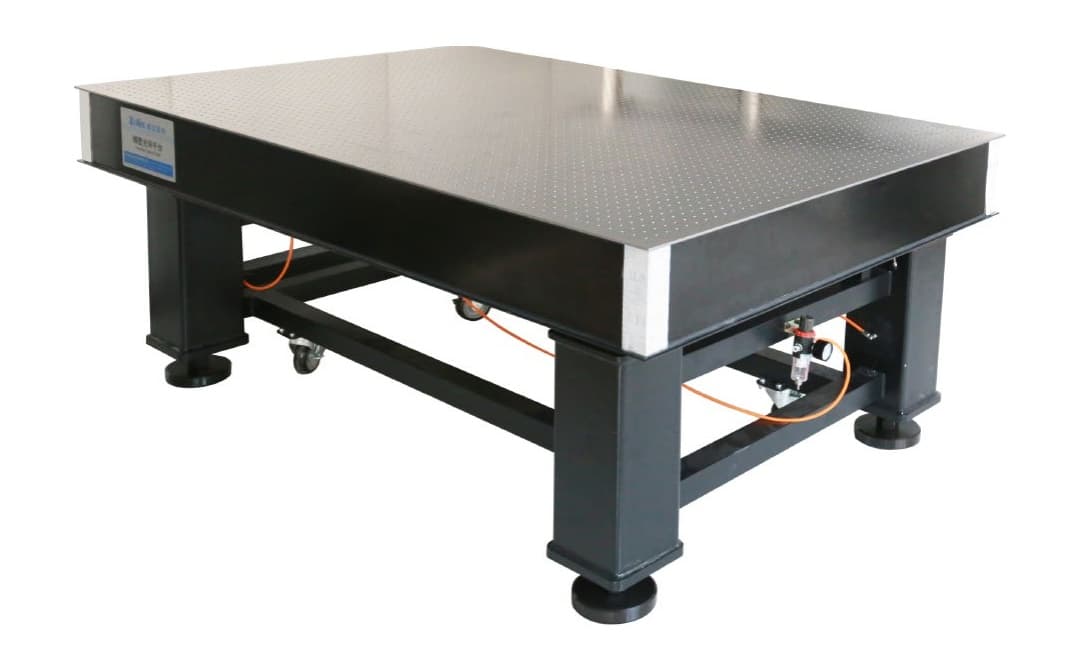
Isolate the floor
The legs do this, not the top. Their natural frequency decides which frequencies are reduced and which are amplified.
Resist your own forces
Shutters, stages and fans push on the table from above. Here the tabletop’s stiffness and damping matter, not the isolators.
Hold alignment
Flatness, thermal stability and a reliable thread grid are what keep a setup aligned between sessions.
Interactive isolation lab
Below √2·f₀ a table makes things worse
Support type
Transmissibility
75× down
Tabletop velocity
0.17 µm/s
Residual motion
1.33 nm
Gain at resonance
6.3×
Transmissibility curve
Amplifies below 2.1 Hz · isolates above it
1.33 nm residual against a 20 nm budget, with 75× attenuation at this frequency.
A rigid single-mass model of the isolators only. It says nothing about the tabletop’s own bending resonances, which set the high-frequency limit — for those, read the published compliance curve of the specific table rather than any formula.
Table catalogThe counter-intuitive part
A stiffer support is not a better one
Isolation only begins above √2 times the isolator natural frequency. Below that the mounts transmit more motion than the floor carries, worst of all at resonance where the gain is roughly 1/2ζ. A heavy table on rigid legs resonates somewhere in the tens of hertz — squarely inside the band that pumps, air handling and footfall occupy — so it can be measurably worse than the bench it replaced.
That single fact orders the whole product range. Air springs are not a luxury feature; they are the mechanism that drags f₀ down to 1–2 Hz so that everything above about 3 Hz is attenuated. Damping does not move the crossover — it only trades a lower resonance peak for slightly worse isolation far above it.
Four levels of support
Buy the one your floor and your measurement justify
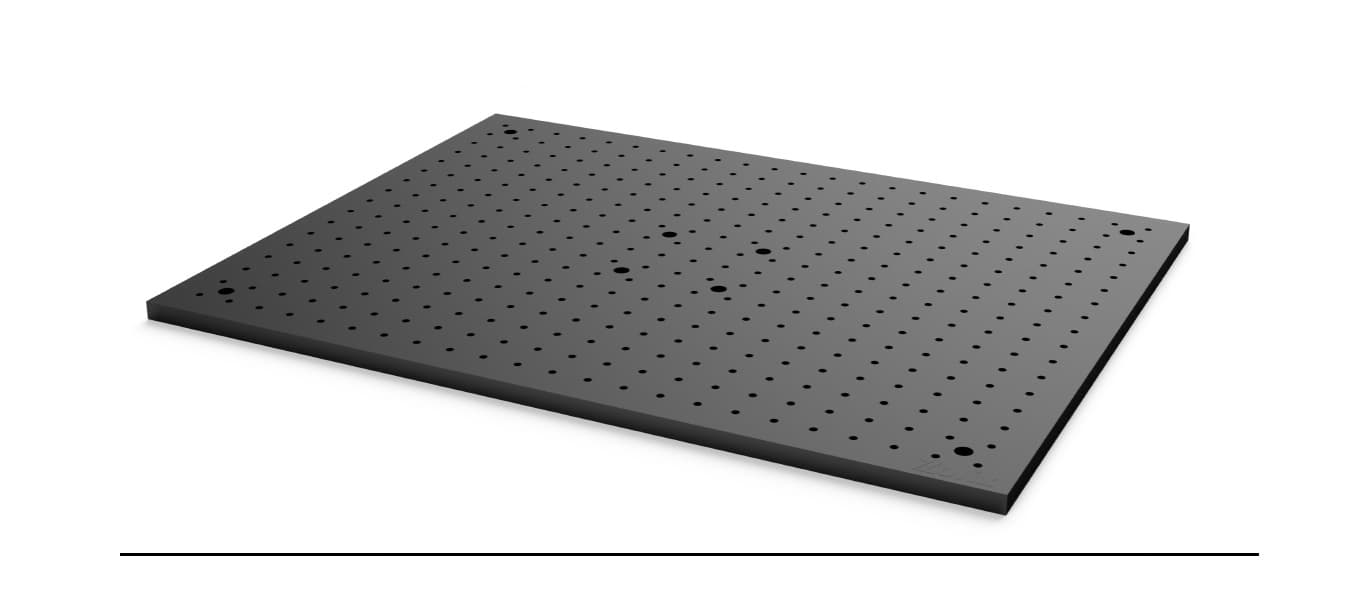
Breadboard on a bench
A flat, tapped, rigid surface — and nothing more. Correct when the bench is already quiet or the measurement is insensitive. Its natural frequency sits inside the building’s band, so it can amplify.
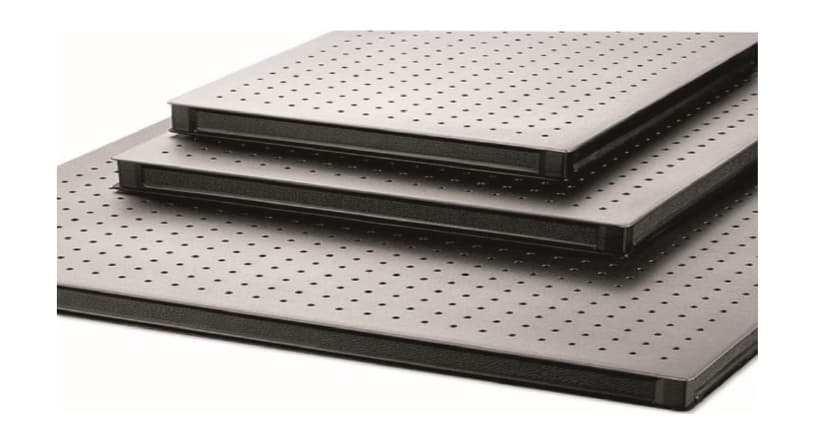
Honeycomb breadboard
A honeycomb core buys bending stiffness without the mass of solid steel, pushing the board’s own resonances up. Individually sealed holes keep spills out of the core.
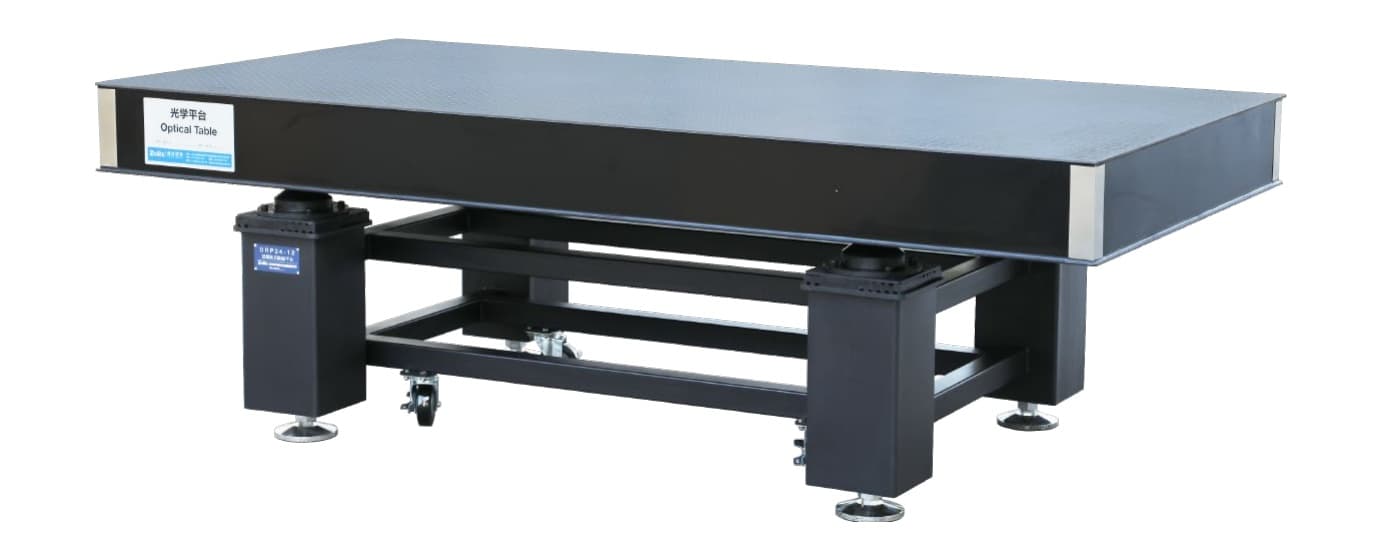
Passive damped table
Damped supports without an air supply. The natural frequency stays relatively high, so isolation starts higher up — but the resonance peak is small and there is no compressor to maintain.
Pneumatic table
Air springs put the natural frequency near 1–2 Hz, which is the only way to isolate the 10–50 Hz band buildings actually shake in. Needs clean, dry air and levelling.
Where a single frame will not do — a heavy instrument, an awkward footprint, an existing bench worth keeping — ZSR-P individual-isolator tables and ZDH standalone isolators let you isolate the payload rather than buy a whole table. Or browse the full catalog.
Then the top itself
What the tabletop specification is telling you
Compliance curve
The honest specification. It shows dynamic deflection per unit force against frequency, including the top’s own bending resonances. Compare curves, not thickness.
Honeycomb core
Bending stiffness comes from separating two steel skins. A thicker core pushes the first resonance up far more efficiently than adding solid mass.
Flatness
Typically quoted over the whole surface, often 0.02–0.05 mm on premium tops. It sets how much your mounts have to take up before anything is aligned.
Sealed holes
Individually cupped threads stop spills and swarf entering the core, where they cannot be cleaned out and will damp unpredictably.
Before you order
Six checks
- Measure the floor before choosing isolators. A single afternoon with a geophone or accelerometer decides between a breadboard and a pneumatic table.
- Identify the dominant disturbance frequency. Isolation is a function of frequency, so a table that solves 30 Hz may do nothing for 2 Hz building sway.
- Check the payload against the isolator working range — an under-loaded air spring does not reach its designed natural frequency.
- Confirm clean dry air, or choose passive damping. A pneumatic table fed by a wet compressor becomes an expensive rigid bench.
- Leave the thread grid and edge access you will need in two years, not the layout you have drawn today.
- Plan delivery: dimensions, floor loading, doorways and lifting points. A table that will not enter the room isolates nothing.
Before any quote
Contact us — we will measure your floor.
We can visit your site and run the vibration measurement ourselves, or help you carry out the tests with your own equipment. Either way you get real numbers for your room — the actual floor spectrum and the frequencies that matter — before we quote a table, rather than guessing at an isolator specification.
Before you specify
Guides that cover this decision
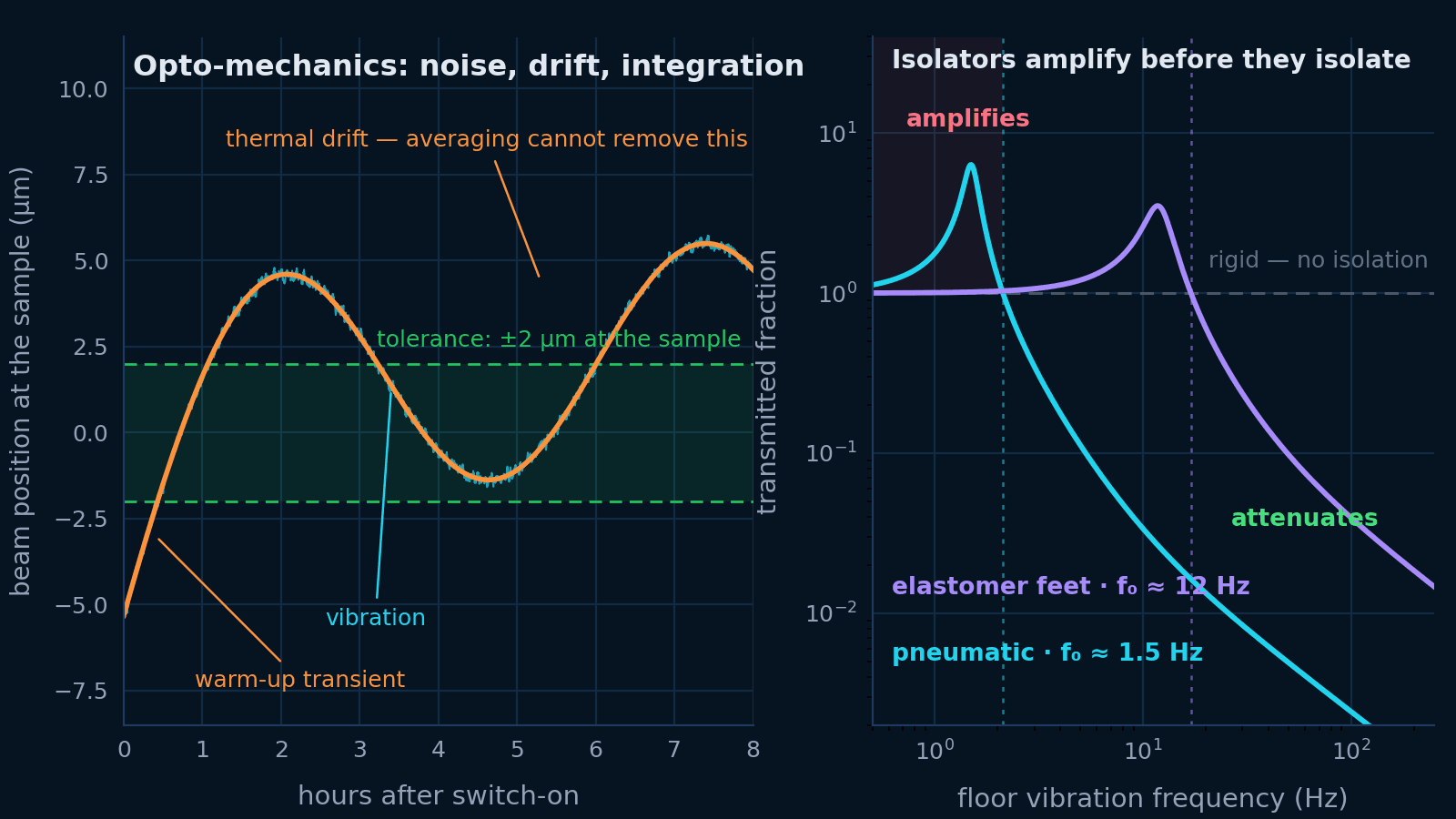 Opto-mechanics
Building a stable opto-mechanical rig
Vibration, thermal drift and mechanical integration are one problem. Budget the motion at the sample, then specify the table, the isolation, the mounts and the beam height that budget asks for.
Open guide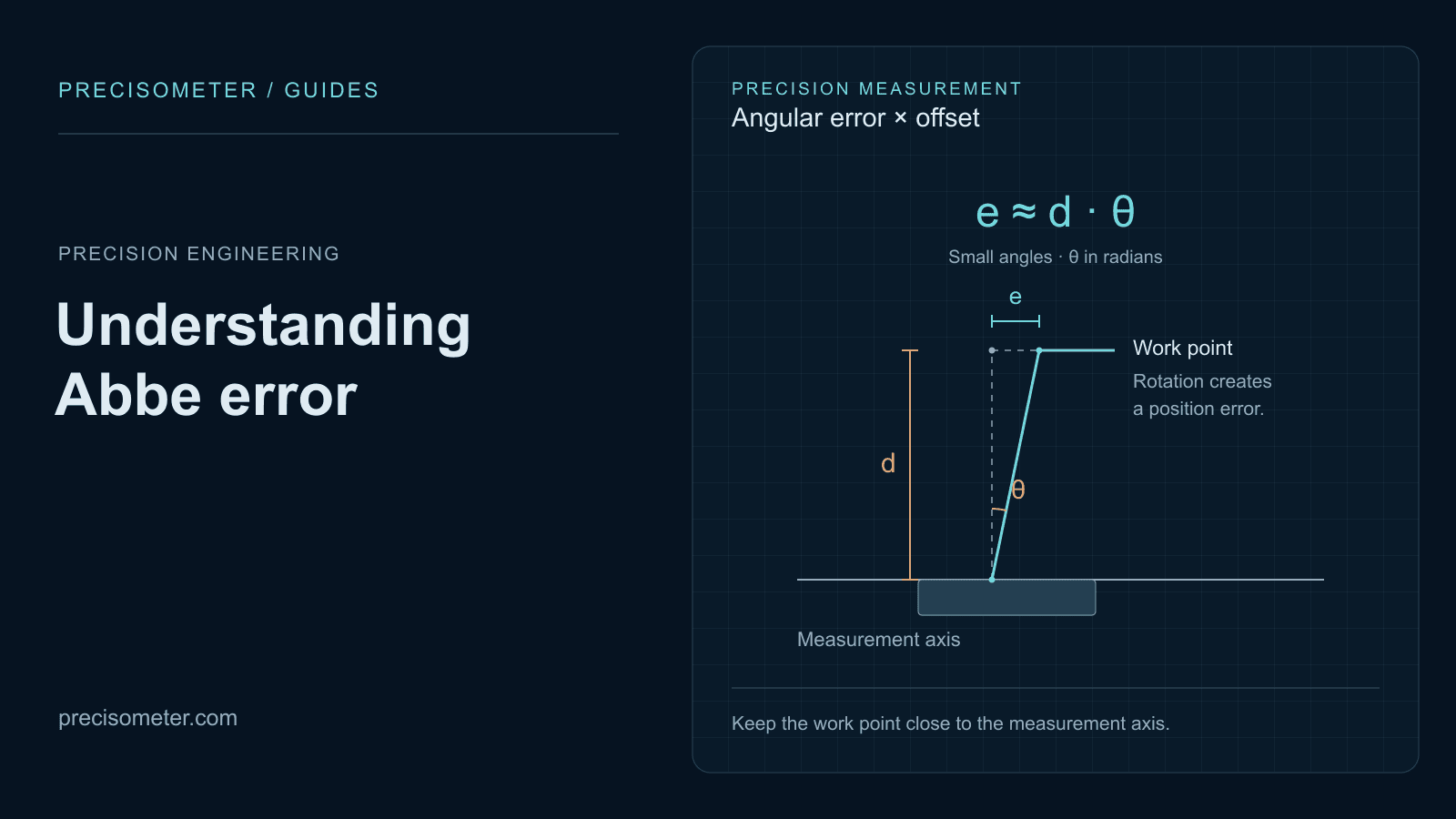 Precision engineering
Abbe error: what it is and how to calculate it
Angular error multiplied by offset — the largest geometric error in most precision machines, first order rather than second, and absent from every datasheet because half the product belongs to you.
Open guide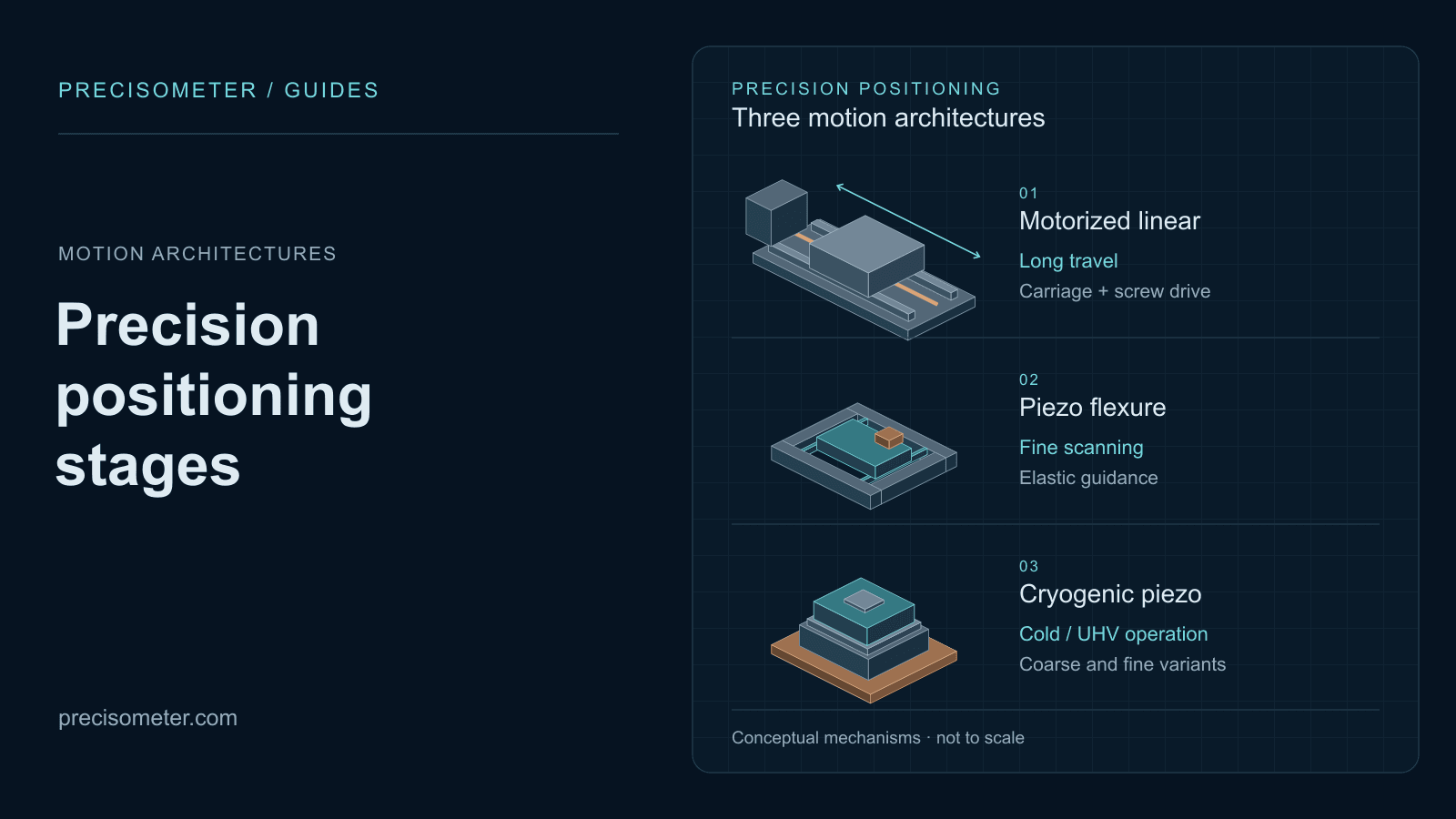 Precision motion
How to Choose a Precision Positioning Stage: Linear, Piezo, or Cryogenic Piezo?
Match travel, resolution, speed, load, vacuum, temperature, and magnetic field requirements to motorized linear, ambient piezo, or cryogenic piezo positioning architectures.
Open guide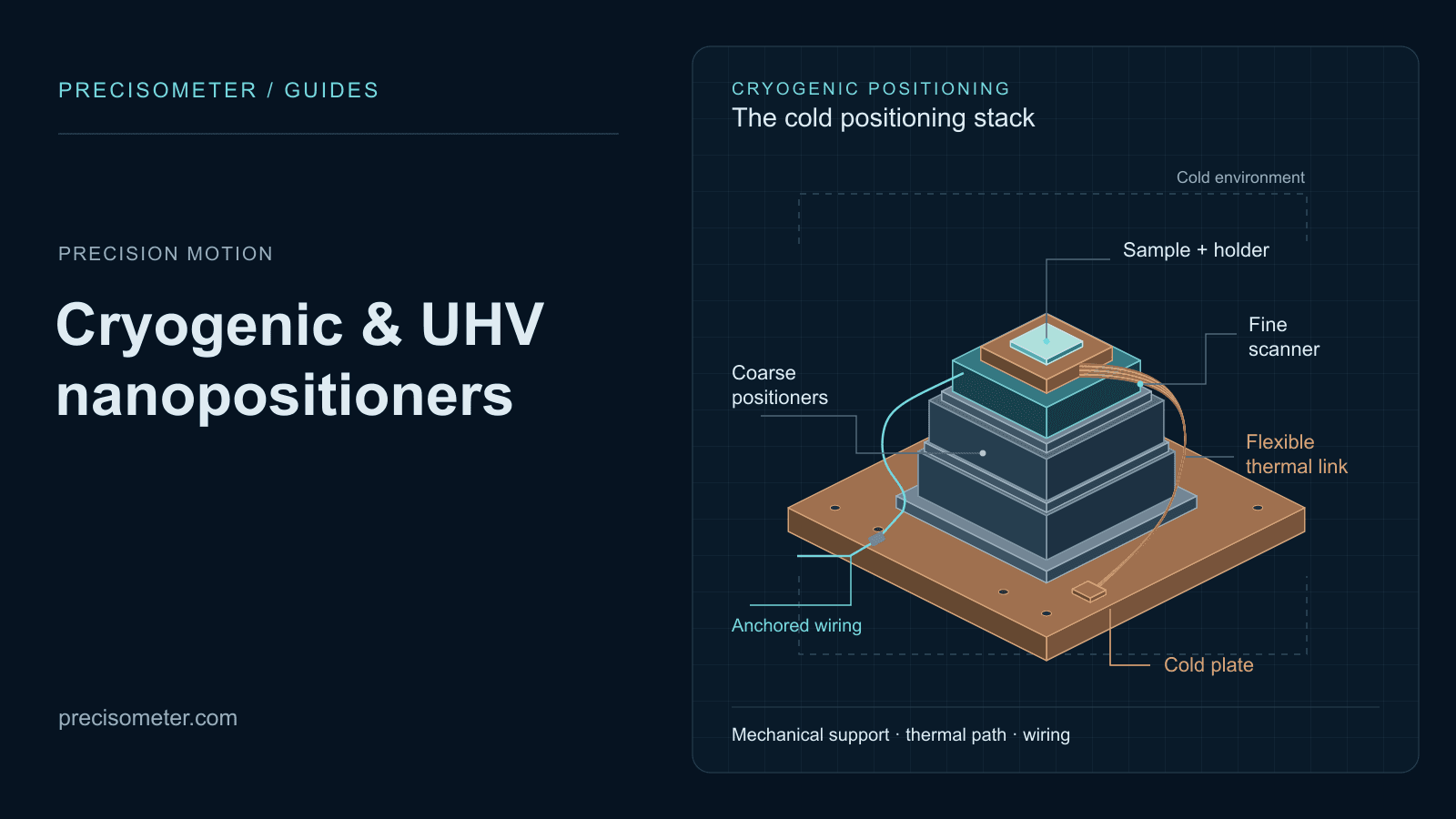 Precision motion
Selecting nanopositioners for cryogenic and UHV systems
Translate temperature, pressure, travel, payload, feedback, and motion requirements into a defensible cryogenic-stage shortlist.
Open guideConfigure it
Tell us the room and the experiment.
Size, support type and tabletop follow from the floor you have and the stability you need.