SLM, narrow linewidth, coherence
MSL-DU-639-W639 nm red narrow-linewidth single-frequency laser
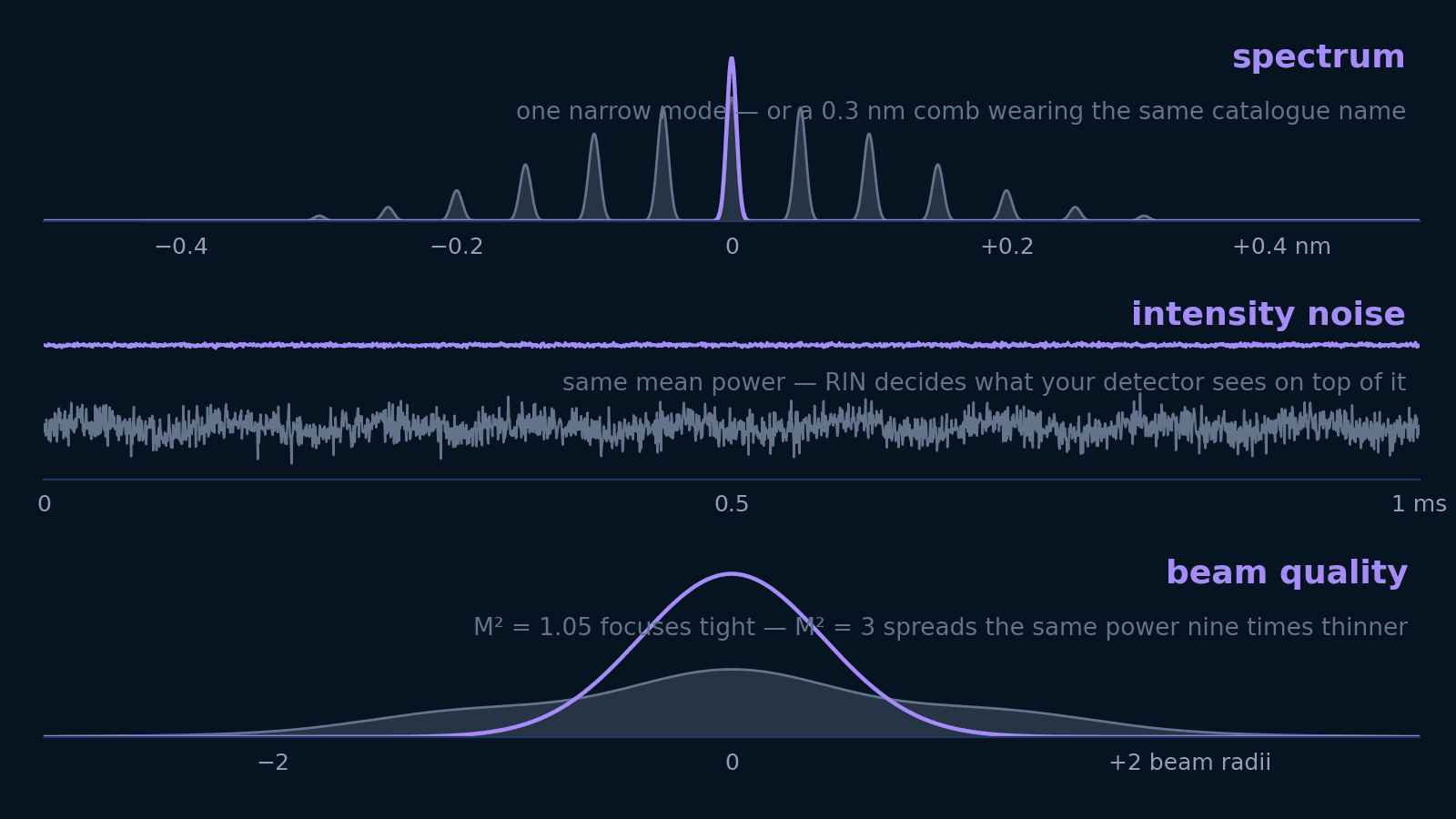
639 nmThe MSL-DU-639-W is a 639 nm continuous-wave laser source. Single-longitudinal-mode operation selects one resonator frequency. Linewidth describes the spread around that frequency, while frequency drift describes how its center moves over time. This distinction matters when matching the source to a narrow resonance or an interferometer.
Specifications
MSL-DU-639-W
22 specification rows
| Output / average power | 1~750 mW |
|---|---|
| Spectral linewidth | <1 MHz |
| M² | <1.2 |
| Operating mode | CW |
| Power stability (rms, 4 hours, ±3°C) | <3%, <2%, <1% |
| Transverse mode | TEM00 |
| Longitudinal mode | Single |
| Beam divergence (mrad) | <1.5 |
| Polarization ratio | >100:1, Horizontal (Vertical optional) |
| Pointing stability over temperature (urad/°C) | <8 |
| Warm-up time (minutes) | <30 |
| Cooled method (water cooled) | WCH-580 |
| Operating temperature (°C) | 10-35 |
| Power supply (100-240VAC) | PSU-SR |
| Expected lifetime (hours) | >10000 |
| Wavelength (nm) | 639±1 |
| Coherent length (m) | >40 |
| Frequency shift (MHz) (over ±2°C and 8hrs) (optional) | <±100 MHz (±0.15pm) |
| Noise of amplitude (rms, 20Hz-20MHz) | <1%, <0.5% |
| Beam diameter at the aperture (1/e2, mm) | <1.5 |
| Pointing stability (urad) (over 2 hours after warm-up and ±3°C) | <50 |
| Beam height from base plate (mm) | 47.4 |
What do you need?
Tell us the output power, linewidth and beam delivery you need, and we'll reply with the matching configuration and lead time.
Model selection
Nearby series comparison
Compare MSL-DU-639-W with the closest available models in the Single-Frequency Lasers family.
| Selection parameter | MSL-DU-639-W (current) | MSL-DU-639-W | 639 |
|---|---|---|---|
| Wavelength | 639 nm | 639 nm | 639 nm |
| Optical power / pulse energy | 1~750 mW | 1~750 mW | 1~650 mW |
| Operating mode / pulse width | CW | CW | — |
| Beam quality | <1.2 | <1.2 | <1.1 |
Related single-frequency lasers
Compare the MSL-DU-639-W with nearby single-frequency lasers across the wavelength range.