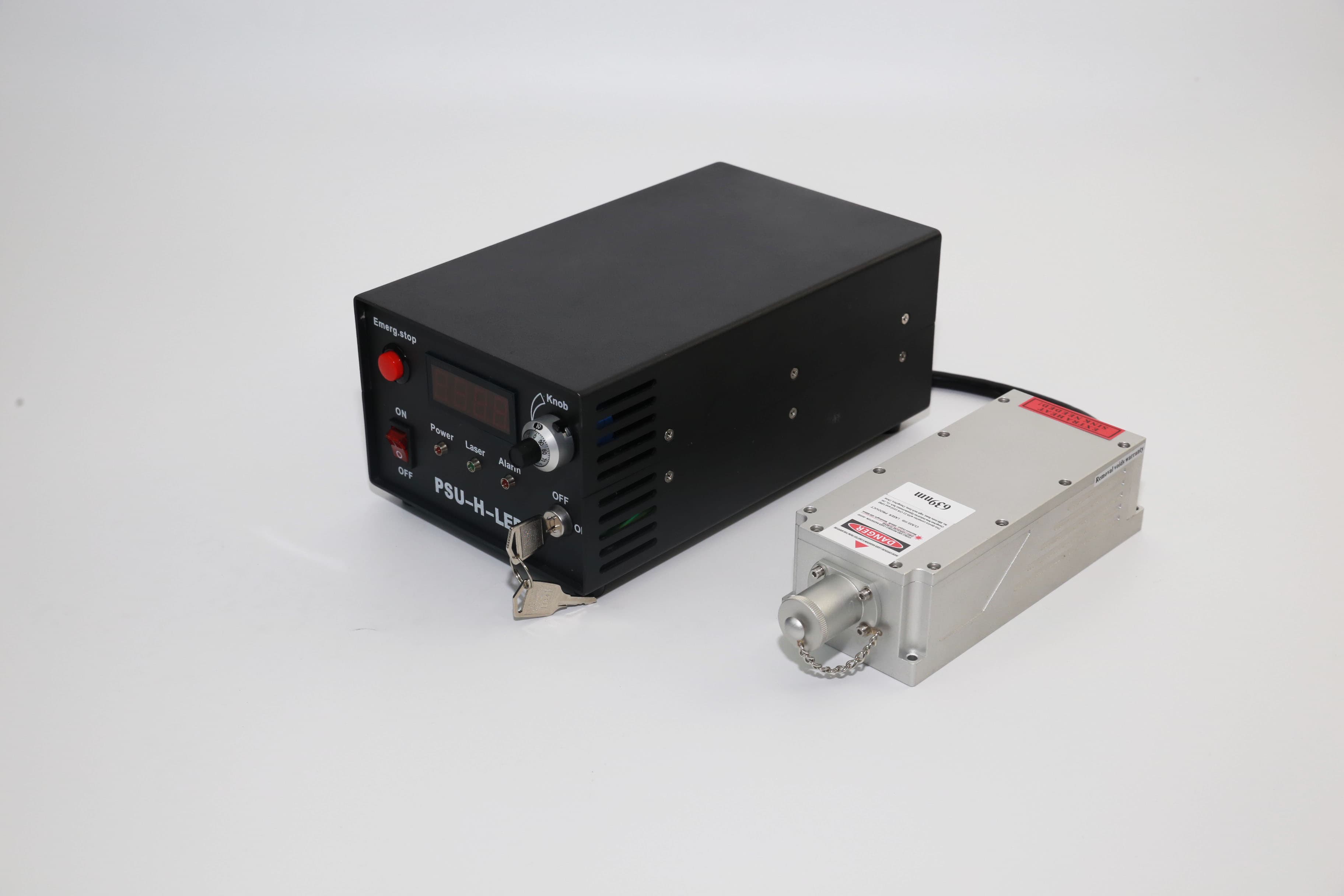
Flow cytometry
MLL-U-671-SM: 671 nm emission can be matched to the absorption or excitation band used in Flow cytometry. Power stability and beam pointing should be confirmed because both affect quantitative image or fluorescence intensity.
Power stability, linewidth, beam quality
MLL-U-671-SM is a 671 nm CW laser. Used for flow cytometry, dna sequencing, medical imaging, collimation. Laser. Key specifications: output / average power 1~250 mW, operating mode CW, transverse mode TEM00 (single mode fiber output). View specifications, datasheet and enquiry options from Precisometer.
Specifications
19 specification rows
| Output / average power | 1~250 mW |
|---|---|
| Beam / notes | Laser |
| Operating mode | CW |
| Transverse mode | TEM00 (single mode fiber output) |
| M2 | <1.1 |
| Fiber numerical aperture | 0.10-0.15 |
| Fiber type | SM fiber (PM fiber optional) |
| Noise of amplitude (rms, 20Hz-20MHz) | <1% |
| Fiber connector | FC/APC |
| Fiber jacket | PVC (black) |
| Fiber length | 1m |
| Polarization (optional) | >50:1 after PM fiber |
| Warm-up time (minutes) | <10 |
| Operating temperature (°C) | 10-35 |
| Power supply (100-240VAC) | PSU-H-FDA |
| Expected lifetime (hours) | >10000 |
| Wavelength (nm) | 671±1 |
| Output power (mW) | 1-250 |
| M² | <1.1 |
Application context
Typical uses for this laser type, with the selection logic tied to the model record.
MLL-U-671-SM: 671 nm emission can be matched to the absorption or excitation band used in Flow cytometry. Power stability and beam pointing should be confirmed because both affect quantitative image or fluorescence intensity.
MLL-U-671-SM: 671 nm emission can be matched to the absorption or excitation band used in DNA sequencing. Power stability and beam pointing should be confirmed because both affect quantitative image or fluorescence intensity.
MLL-U-671-SM: 671 nm emission can be matched to the absorption or excitation band used in Medical imaging. Power stability and beam pointing should be confirmed because both affect quantitative image or fluorescence intensity.
MLL-U-671-SM: Collimation benefits from a stable, focusable source. 671 nm emission fixes the compatible coatings and detector response, while the listed beam characteristic (TEM00 (single mode fiber output)) informs waist size and propagation.
System integration
Use these checks to connect MLL-U-671-SM to the surrounding optical, mechanical and control system. Every value shown is taken from this model's own specification record.
Technical FAQ
Fiber type: SM fiber (PM fiber optional) · Fiber connector: FC/APC. Match the listed connector and fiber mode exactly; SMA905, FC/PC and FC/APC are not interchangeable, and a single-mode launch requires mode-field as well as numerical-aperture matching.
Operating temperature (°C): 10-35. Provide the stated cooling method and keep the laser-head base thermally coupled; temperature drift moves wavelength, output power and beam pointing.
Transverse mode: TEM00 (single mode fiber output) · M2: <1.1. Size the downstream optics from the stated beam diameter and divergence rather than from the aperture of the housing, and confirm the polarisation state before specifying isolators or polarising optics.
Share wavelength, operating mode, output power or pulse energy, linewidth or pulse width, delivery, control, and safety requirements and we will qualify the matching configuration and lead time.
Model selection
Compare MLL-U-671-SM with the closest available models in the CW Lasers family. Confirm option-dependent values on the final configuration before ordering.
| Selection parameter | MLL-U-671-SM (current) | MLL-U-671 | MLL-FN-671 |
|---|---|---|---|
| Wavelength | 671 nm | 671 nm | 671 nm |
| Optical power / pulse energy | 1~250 mW | 1~500 mW | 500~1000 mW |
| Operating mode / pulse width | CW | CW | CW |
| Beam quality | TEM00 (single mode fiber output) | TEM00 | TEM00 |
Compare the MLL-U-671-SM with nearby cw lasers across the wavelength range.
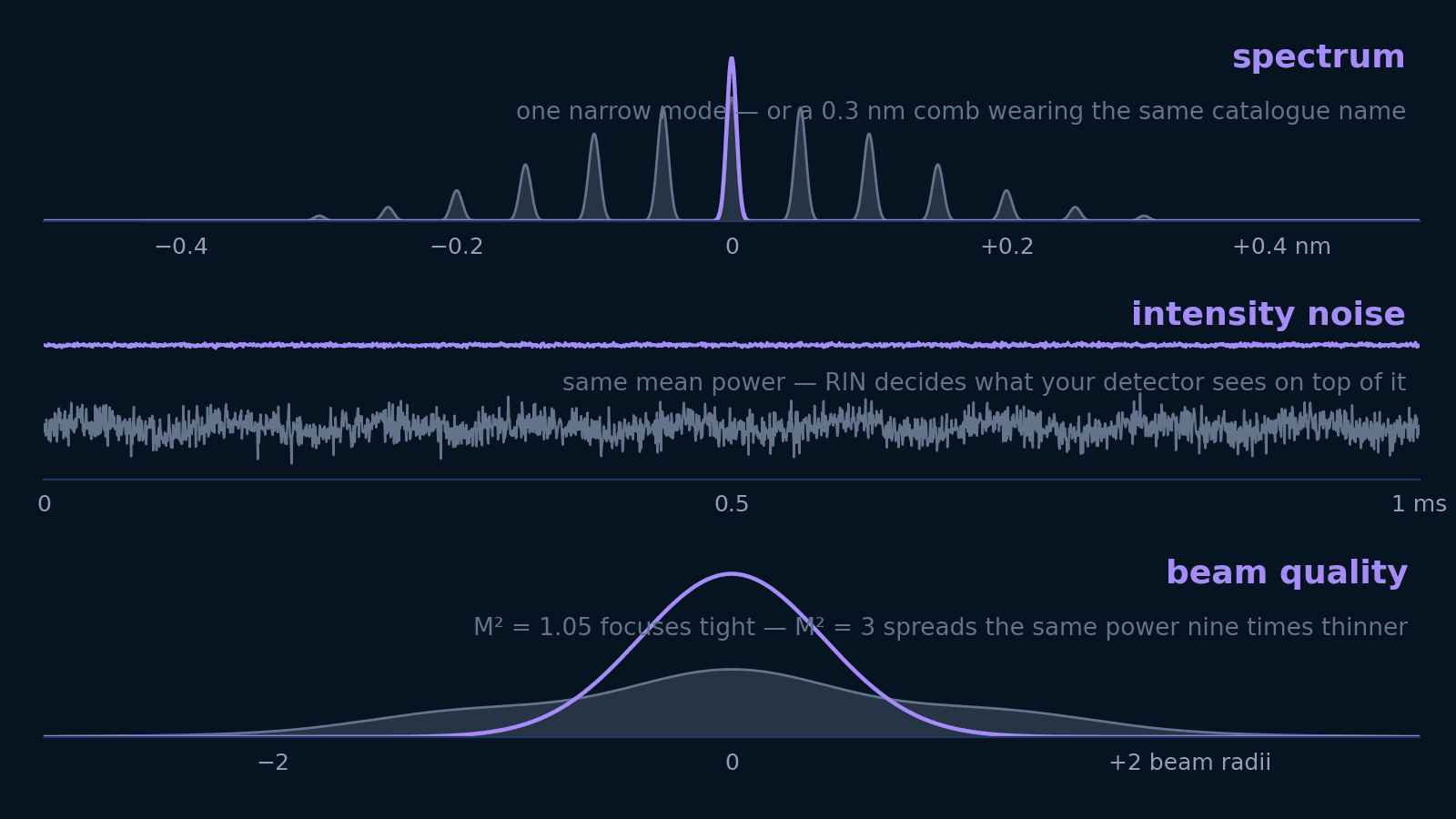
Choosing a laser
Which specifications decide the experiment, and which ones cost money without changing the result.
PhotonicsLinewidth, spectral width, RIN, M², and coherence length answer five different questions. Translate each into the units your experiment is designed in — and learn which ones not to pay for.
Open guide
Optical trappingWhy wavelength is decided by photodamage, focal heating, and detector bandwidth rather than trapping force — and what laser noise costs you in piconewtons.
Open guide
Confocal microscopyConnect fluorophores, pinhole size, Airy units, spatial sampling, scan timing, modulation, and power after the fiber in one practical design workflow.
Open guide