Supercontinuum sources
Supercontinuum White-Light Sources
Three pulsed broadband fibre-source configurations: a nanosecond platform, a picosecond platform and a 450 ps UV-extended version. Compare their spectral coverage and repetition rates around the excitation and detection requirements.
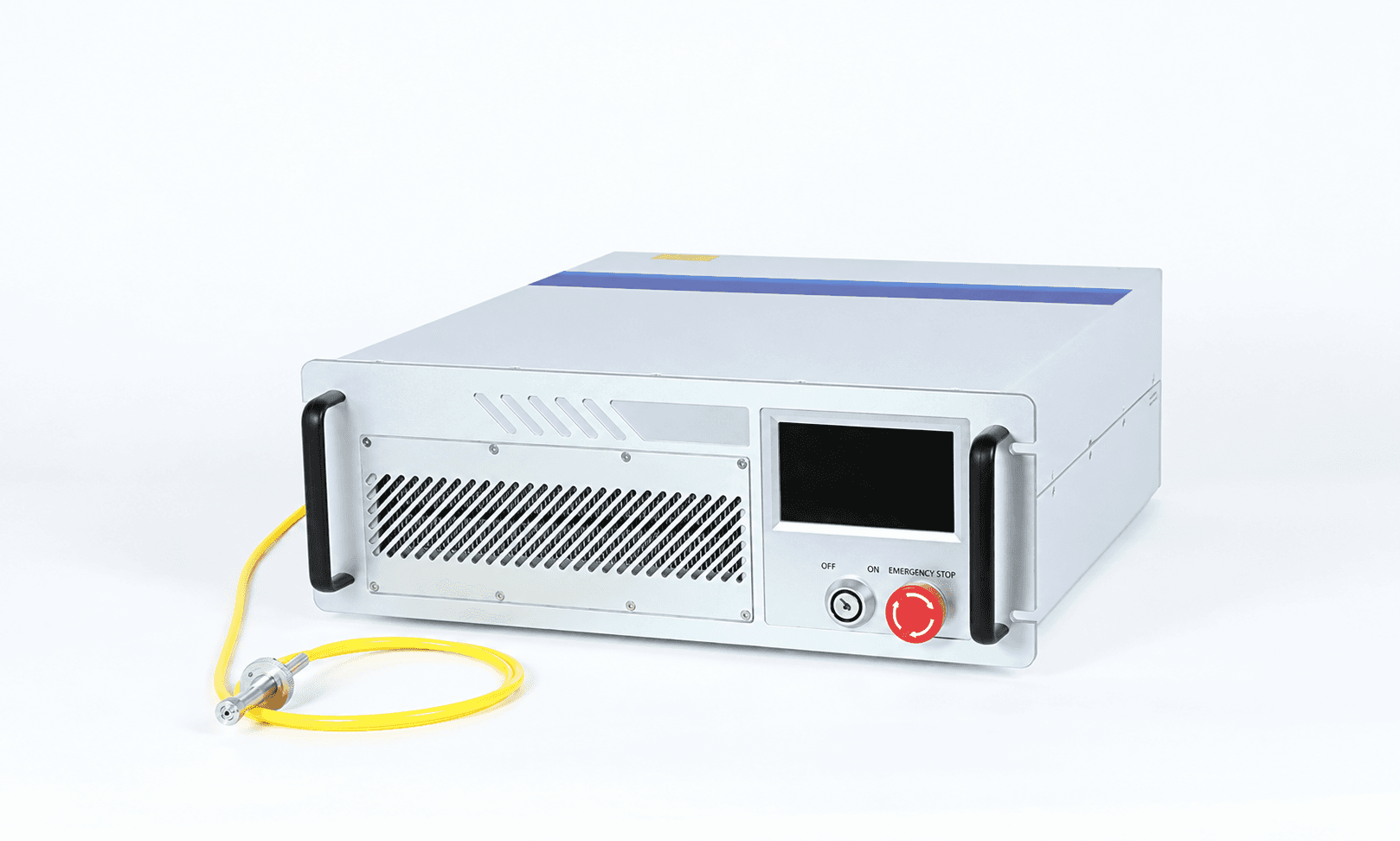
Best suited to
Broadband pulsed illumination, wavelength selection and spectroscopy across visible and infrared bands.
Selecting a configuration
Choose pulse format and repetition rate before total power. Power available in a selected band depends on spectral density, filtering and coupling; total broadband power is not the power at one wavelength.
Measurement & configuration
- Published beam quality M² below or approximately 1.1, subject to model and wavelength.
- Random or unpolarised broadband output.
- SC-N and SC-P provide 1.5 m output fibre and BNC TTL synchronisation.
Plan the signal path
- 1Pulsed fibre source
- 2Supercontinuum generation
- 3Broadband excitation
Specifications
| SC-N pulse format | Nanosecond |
|---|---|
| SC-P pulse format | Picosecond |
| SC-P-UVE pulse duration | 450 ps |
| SC-N / SC-P stability | <0.5% RMS |
| SC-P-UVE stability | 0.5% RMS |
Supercontinuum configuration comparison
| Model | Coverage | Total power | Repetition rate |
|---|---|---|---|
| Gloria-SC-N | 420–2300 nm | 7 W | 100 kHz–1 MHz |
| Gloria-SC-P | 420–2200 nm | 7.5 W | 160 kHz–80 MHz |
| Gloria-SC-P-UVE | 380–2400 nm | Up to 7 W | 1.5–3 MHz |
SC-P-UVE beam quality is specified at wavelengths above 430 nm. Published ranges and power figures describe each model configuration; verify spectral density at the wavelength of interest.
Configure Gloria-SC-N / SC-P / SC-P-UVE
Send the wavelength interval, signal level, timing and sample requirements for your experiment.