Laser beam conditioning
Linear Variable Long-Wave-Pass Filter: Substrate, coating band and surface figure set the transmitted or reflected wavefront, and the damage threshold sets the power the optic can carry.
Optics, filters & coatings
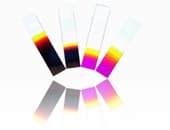
The coating thickness varies along the filter, so the long-wave-pass cut-off wavelength changes gradually across its length. Commonly used to cut off higher-order grating diffraction, placed in front of the CCD of a fibre-optic spectrometer as a continuously variable order-sorting filter. The quartz substrate is coated by ion sputtering for minimum autofluorescence and a high laser damage threshold.
| Parameter | Value |
|---|---|
| Standard size | 41.4 mm × 9.5 mm × 1 mm |
| Substrate | Quartz |
| Coating process | Ion sputtering |
| Typical use | Continuously variable order-sorting filter in front of the line-scan detector (CCD) of a fibre-optic spectrometer |
Application context
Application fit depends on the ordered configuration; catalog values are separated from fields that still require confirmation.
Linear Variable Long-Wave-Pass Filter: Substrate, coating band and surface figure set the transmitted or reflected wavefront, and the damage threshold sets the power the optic can carry.
Linear Variable Long-Wave-Pass Filter: Edge steepness, blocking depth and passband transmission at the working angle decide how well the excitation is separated from the signal.
Engineering reference
Linear Variable Long-Wave-Pass Filter is a configurable free-space optical component in the Optics, filters and coatings family. The final part number should be released only after the optical, mechanical, electrical and environmental fields below are matched to the intended instrument.
A free-space optic is specified by the wavelength band and angle of incidence its coating is designed for, the clear aperture the beam actually uses, and the substrate, surface quality and damage threshold the application demands. Catalogue figures are quoted at a reference wavelength and angle; performance shifts away from them.
Selection guidance describes the engineering fields that must be checked. It does not assign an option-dependent value that is absent from the catalog record.
Technical FAQ
Confirm wavelength and coating band, angle of incidence and polarization, size and clear aperture, substrate and surface quality, power handling, and mounting and environment. These fields are coupled, so the final part number should be checked against the complete instrument rather than selected from the model name alone.
A free-space optic is specified by the wavelength band and angle of incidence its coating is designed for, the clear aperture the beam actually uses, and the substrate, surface quality and damage threshold the application demands. Catalogue figures are quoted at a reference wavelength and angle; performance shifts away from them. Freeze the optical, mechanical and electrical interfaces before releasing the surrounding assembly.
Approve the configuration-specific specification, mechanical drawing, connector or pinout definition, environmental suffix and acceptance-test limits supplied with the quotation. Any field absent from the local record remains a confirmation item, not an assumed capability.