Optical Filters
Dichroic Mirrors &Optical Filters
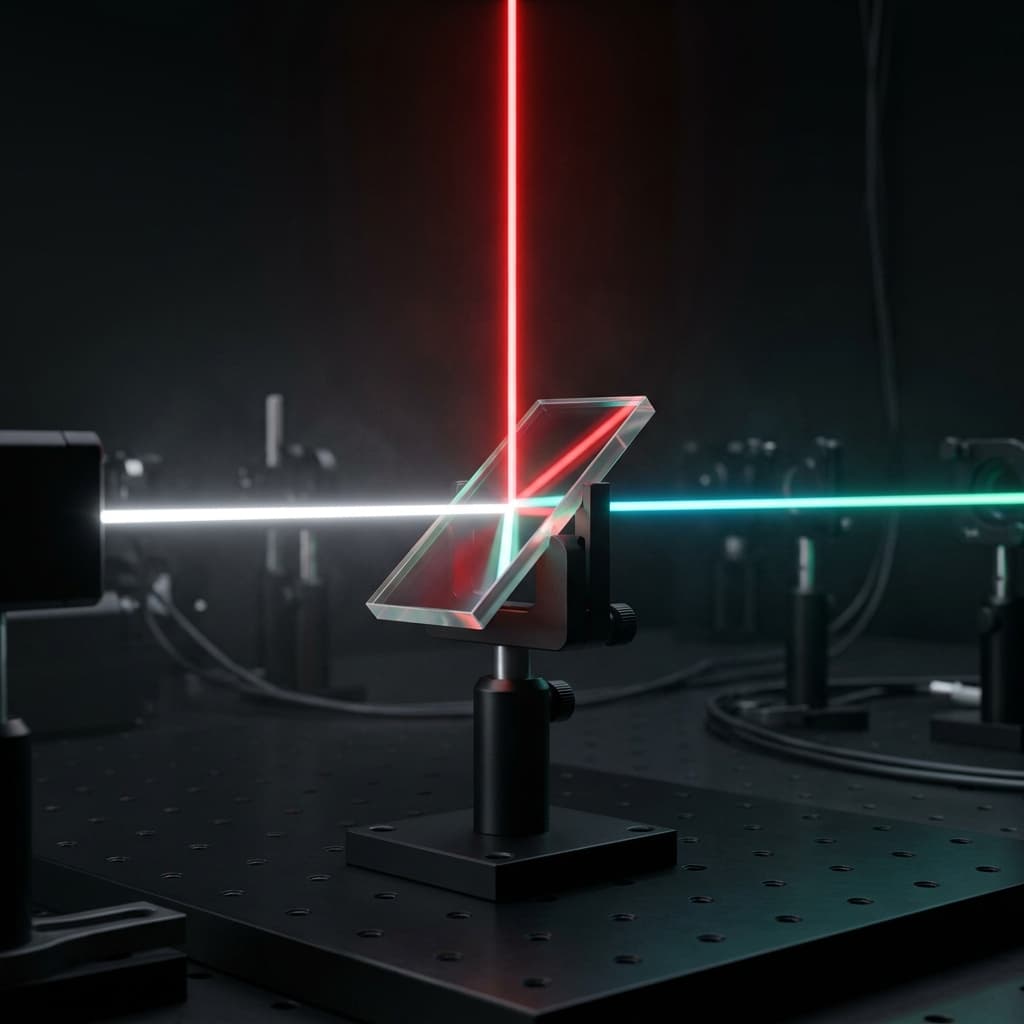
Research-grade interference filters for fluorescence microscopy, spectroscopy, and laser beam routing. Specify edge position, transition width, optical density, angle of incidence, polarization, wavefront error, and substrate quality instead of choosing by color alone.
Catalogue
Optics, filters & coatings
Stocked filters and standard optics with their specifications and a datasheet for each category. Sizes, coatings and wavelengths outside the tables are quoted on request.
Filters
Notch Filters
→Notch filters for Raman spectroscopy and fluorescence instrumentation, mainly used in biochemical laser systems, fluo…
Laser Clean-up Filters
→Laser clean-up filters provide up to 90% peak transmission with a centre-wavelength tolerance of 0.5 nm.
Long-pass Edge Filters
→Long-pass edge filters combine high transmission in the pass band with high blocking in the reject band.
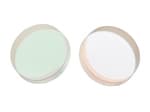
Dichroic Filters
→Dichroic filters are designed for use at a 45° angle of incidence and separate light by transmitting one band and ref…
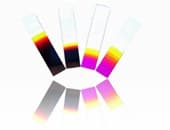
Linear Variable Long-Wave-Pass Filter
→The coating thickness varies along the filter, so the long-wave-pass cut-off wavelength changes gradually across its …
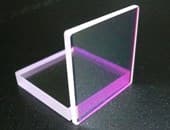
Raman Spectroscopy Filter Sets
→Filter sets that transmit the Raman-scattered spectrum while blocking the high-intensity excitation laser: a laser cl…
Lenses, mirrors & prisms
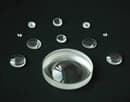
Spherical Lenses
→Spherical lenses supplied with anti-reflection or high-reflection coatings on the surface.
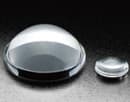
Aspheric Lenses
→Aspheric lenses have a radius of curvature that changes with distance from the central axis, which maintains good abe…
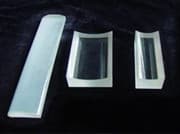
Cylindrical Lenses
→Cylindrical lenses provide one-dimensional magnification and can effectively reduce spherical and chromatic aberration.
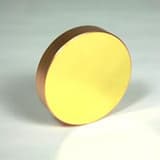
Metallic Mirrors
→Metallic mirrors with gold, protected-silver or aluminium coatings (UV-enhanced or protected aluminium) on K9 or fuse…
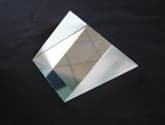
Prisms
→Right-angle, roof and Powell prisms in K9 or fused silica for telescopic, imaging and range-measurement systems.
Polarizers, films & crystals
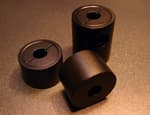
Glan Polarizers
→Glan polarizers made from select-grade calcite prism pairs with the interface angles optimised for minimum insertion …
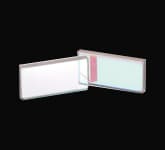
Polarization & RGB Combiner Films
→Polarization (P&S) combiner films for 445, 473, 532, 635, 660 and 808 nm, each available for a 45° or 57° angle of in…
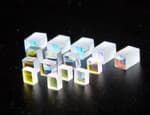
Laser & Nonlinear Crystals
→Laser crystals with high-damage-threshold coatings, supplied in quantity to OEM and R&D customers, and nonlinear crys…
Precise Wavelength Selection
Narrowband, long-pass, short-pass, notch, and dichroic designs with controlled passband ripple, blocking level, and edge slope.
Durable Coatings
Ion-assisted and magnetron-sputtered hard coatings form dense oxide stacks with low water uptake, high laser resistance, and stable spectra.
High Transmission
Low absorption dielectrics and anti-reflection back-side coatings maximize photon budget while suppressing ghost beams and autofluorescence.
Featured Products
Dichroic Mirrors
Dichroic beamsplitters are specified by spectral edge, incidence angle, polarization state, and blocking requirement. We help match these parameters to your optical train.
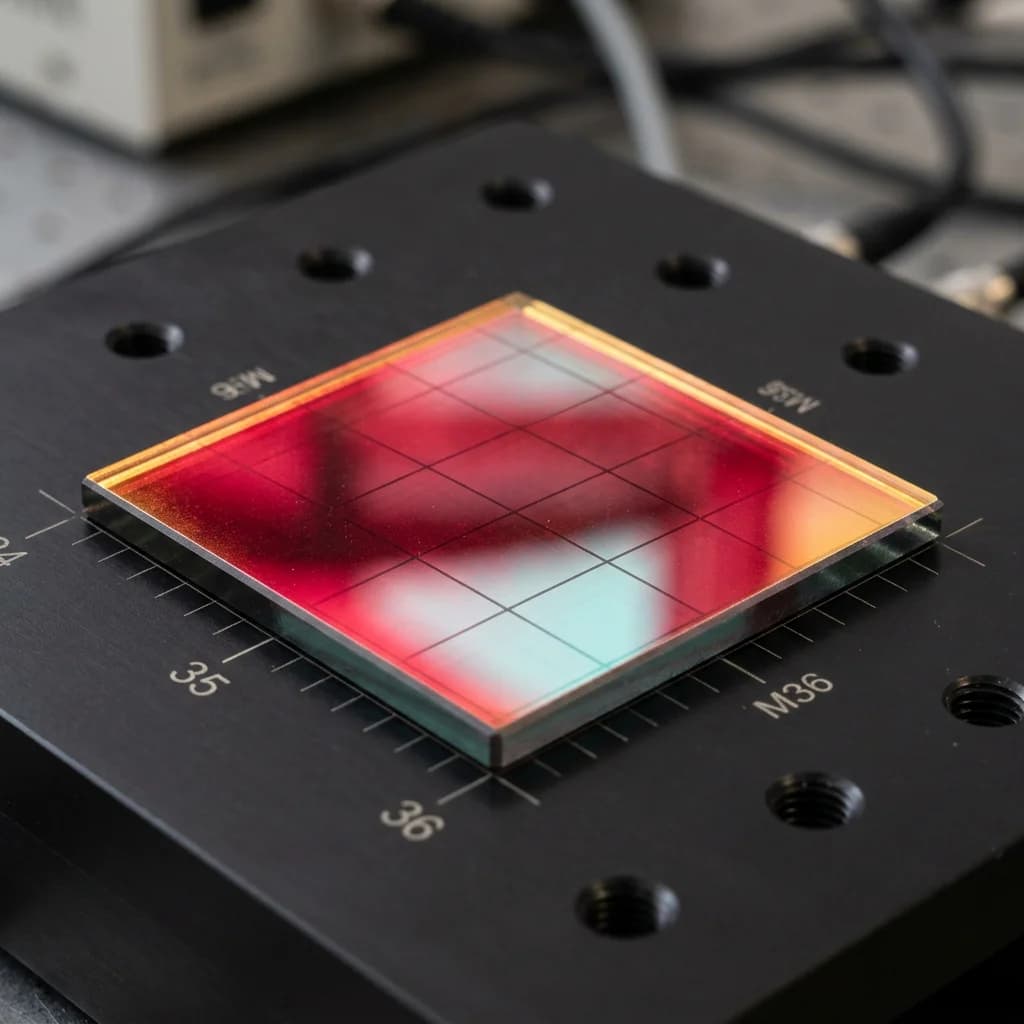
Red Reflecting Dichroic
Long-wavelength reflection design for separating red emission channels from shorter excitation or imaging bands. Useful when channel crosstalk and emission tail leakage are limiting the signal-to-background ratio.
- • Typical reflection band: 600-700 nm
- • Transmission: shorter visible bands
- • Specify: AOI, s/p polarization, edge slope
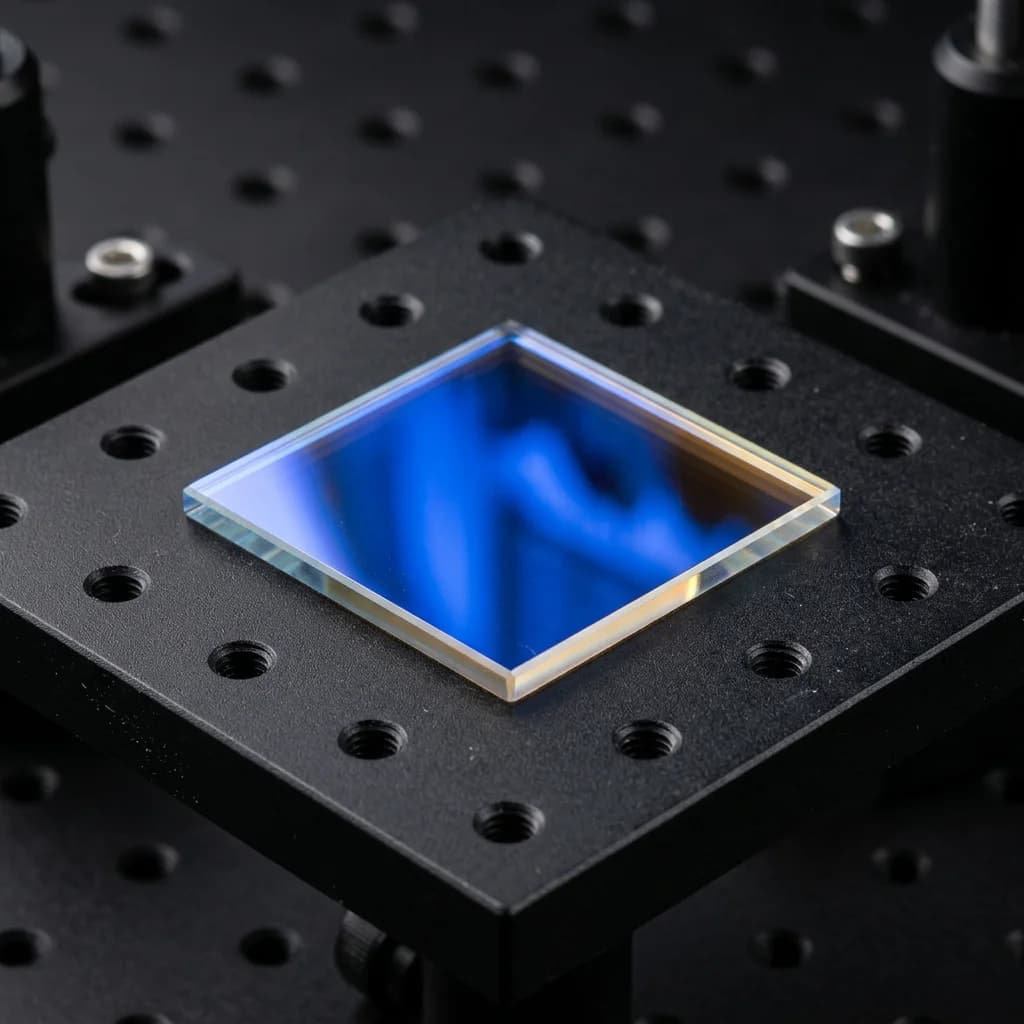
Blue Reflecting Dichroic
Short-wavelength reflection design for blue excitation delivery, multi-laser combining, and spectral imaging modules where visible throughput must remain high downstream.
- • Typical reflection band: 400-500 nm
- • Transmission: green and red bands
- • Control: UV edge shift and scatter
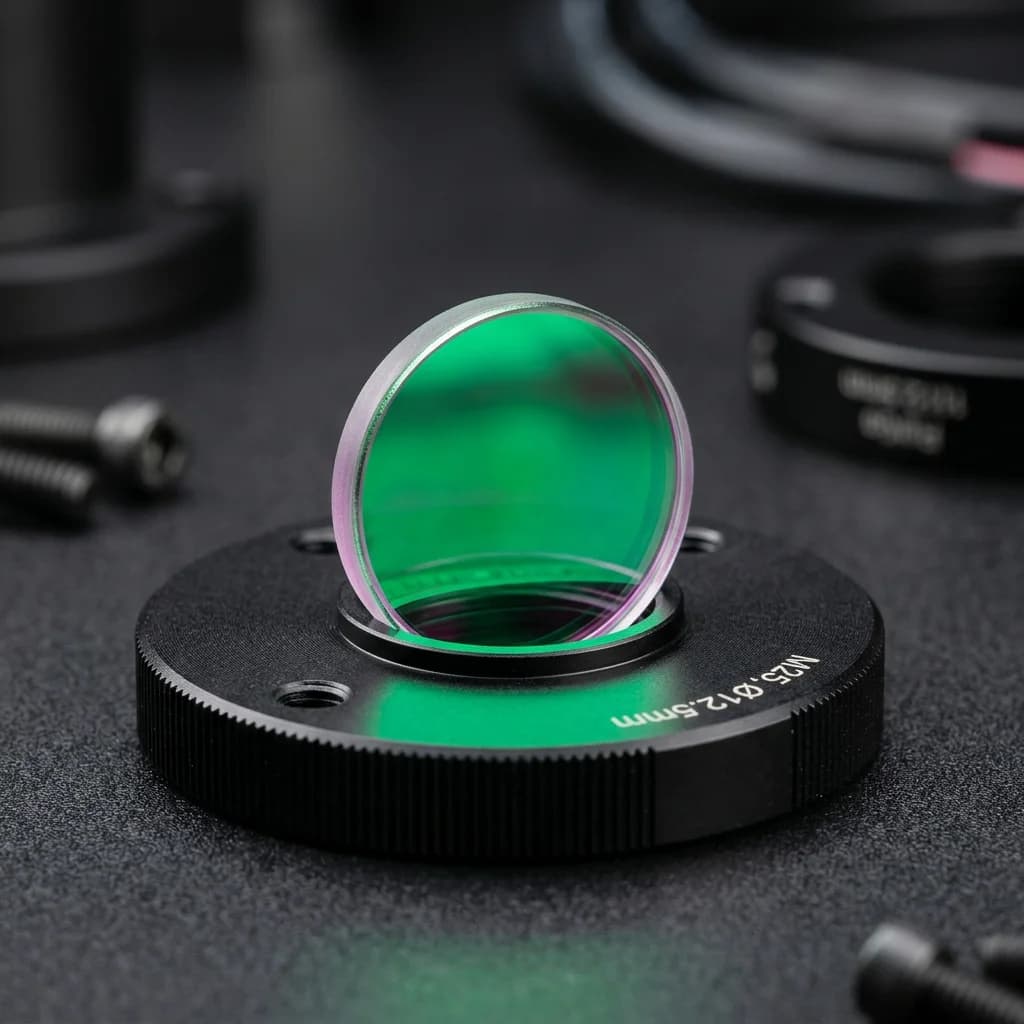
Green Reflecting Dichroic
Mid-band reflection design for green laser routing or emission channel splitting. Coating design balances high reflection in-band with steep transitions on both neighboring colors.
- • Typical reflection band: 500-570 nm
- • Transmission: blue and red windows
- • Check: wavefront error after mounting
Technology
How Dichroic Mirrors Work
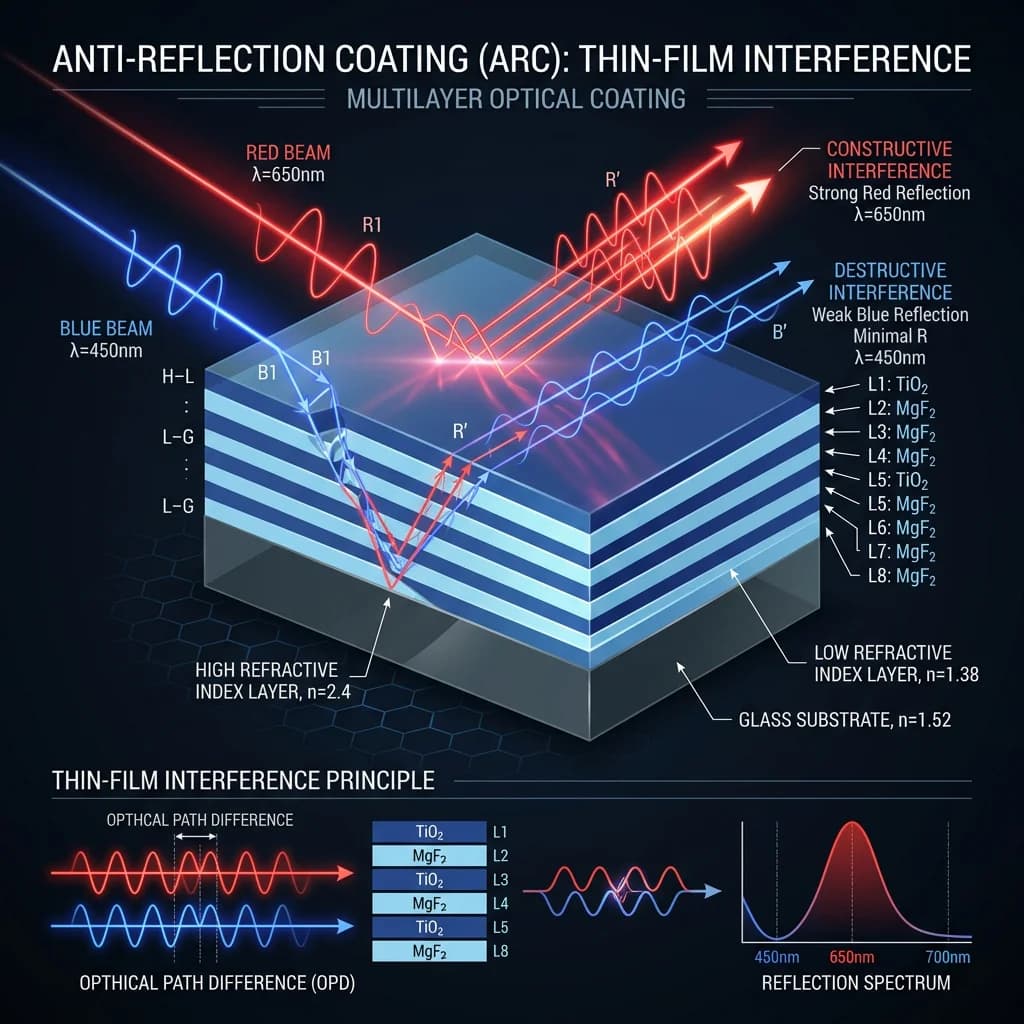
A dichroic mirror is a deterministic interference device: tens to more than one hundred dielectric layers are deposited with optical thicknesses near quarter-wave or non-quarter-wave optimized values. Alternating high- and low-index materials create wavelength-dependent phase accumulation, so reflected fields add constructively in the stopband while transmitted fields add in the passband.
- Edge wavelength shifts to shorter wavelengths at higher angle of incidence, with different shifts for s and p polarization.
- Passband ripple and group-delay dispersion are consequences of the layer admittance profile, not cosmetic specifications.
- Blocking is expressed as optical density, typically OD4 to OD6 where fluorescence background or laser rejection is critical.
- Absorption should be low; losses are mainly scatter, residual absorption, and imperfect destructive interference.
Manufacturing
How Research-Grade Filters Are Manufactured
The useful performance of a filter is set as much by the coating process as by the nominal center wavelength. For PhD-level optical experiments, the important question is not only "what wavelength does it pass?", but how the layer stack was designed, deposited, monitored, and verified.
Spectral Design
The coating is modeled with transfer-matrix calculations using the complex refractive index n + ik of each material. The merit function includes passband transmission, stopband OD, transition steepness, angle shift, polarization splitting, thermal drift, and manufacturability.
Substrate Preparation
Fused silica, borosilicate, or low-autofluorescence glass is polished to the required flatness and surface quality, then cleaned to remove particulates, organics, and adsorbed water before vacuum loading.
Vacuum Deposition
Dense dielectric layers such as SiO2, Ta2O5, Nb2O5, TiO2, or HfO2 are deposited by ion-assisted evaporation, plasma-assisted deposition, or magnetron sputtering. Layer thickness control is typically optical, quartz-crystal, or hybrid monitored.
In-Situ Monitoring
During growth, monitoring wavelengths track turning points in transmission or reflection. This corrects deposition rate drift and prevents cumulative phase error across a many-layer stack.
Anneal, Cut, Mount
Hard coatings may be thermally stabilized, then diced or edged. Mounted filters are checked for stress-induced bending, wedge, clear aperture, orientation, and beam deviation.
Metrology
Final inspection measures spectra at the requested angle and polarization, plus cosmetic defects, transmitted wavefront error, parallelism, laser damage threshold where relevant, and environmental stability.
What to Specify
Parameters That Matter in a Real Experiment
AOI and polarization
45 degree dichroics behave differently from normal-incidence filters; s/p splitting can move the effective edge by several nanometers.
Blocking range
Define the full wavelength range that must be rejected, not only the laser line. Fluorescence leakage often comes from tails and harmonics.
Wavefront and flatness
A filter in an imaging path can add aberration or focus shift. Specify transmitted wavefront error for collimated or image-forming beams.
Substrate fluorescence
For weak-signal fluorescence, substrate and coating autofluorescence can dominate background even when spectral OD looks sufficient.
Thermal and power load
High irradiance laser systems require low absorption, good heat sinking, and a coating design qualified for the expected fluence.
Scientific Selection
Read a Filter Like an Optical Physicist
The most useful datasheet plots are measured transmission and reflection at the actual use angle. A nominal 532 nm notch or 560 nm edge is incomplete without angle, polarization, bandwidth, and blocking-range context.
| Specification | Why it matters | Typical question to ask |
|---|---|---|
| Center wavelength / edge | Sets the fluorophore, laser, or detector channel separation. | Is this specified at 0 degrees or at my 45 degree dichroic geometry? |
| FWHM / transition width | Controls spectral selectivity and channel bleed-through. | How steep is the edge between excitation and emission? |
| Peak transmission | Determines photon budget and exposure time. | What is the measured transmission across the full passband? |
| Optical density | Defines rejection of laser lines, background, and unwanted fluorescence. | Is OD guaranteed only at one line or across the whole stopband? |
| Wavefront error | Protects image quality in infinity spaces and collimated beam paths. | Will this filter sit in an imaging path or only illumination? |
| Surface quality and scatter | Limits haze, stray light, and coherent laser speckle. | Is scatter low enough for single-molecule, Raman, or dark-field work? |
Use Cases
Applications
Dichroic mirrors and optical filters are selected differently depending on whether the limiting factor is photon throughput, laser rejection, wavefront quality, or background fluorescence.
Fluorescence Microscopy
Separate excitation and emission bands while controlling autofluorescence, OD leakage, and channel bleed-through
Laser Systems
Combine or separate laser lines with attention to AOI shift, polarization, power density, and back-reflections
Raman & Spectroscopy
Reject excitation lines while preserving weak Stokes or anti-Stokes signals close to the laser wavelength
Hyperspectral Imaging
Use bandpass stacks and order-sorting filters to define spectral channels and suppress detector aliasing
Before you specify
Guides where filtering decides the result
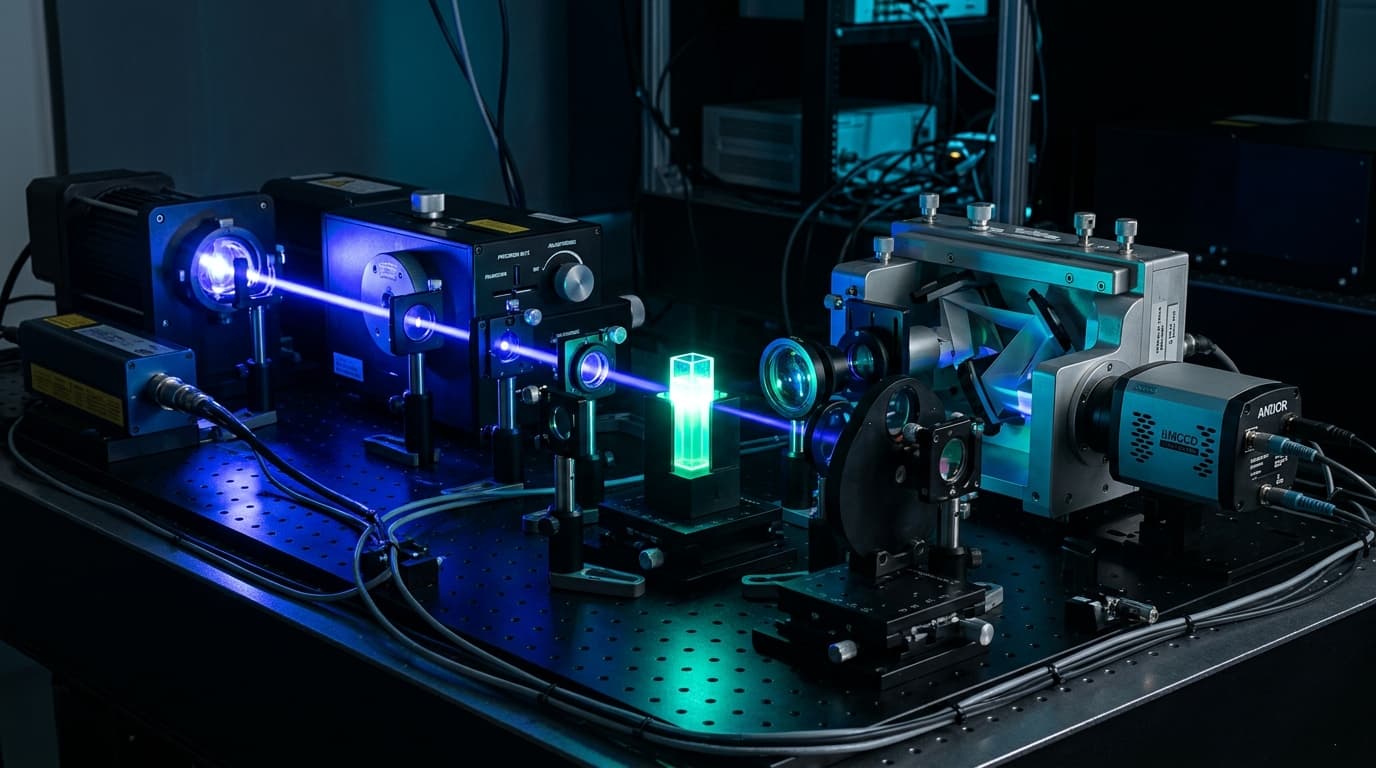
Fluorescence spectrometer design, Raman excitation, and CARS microscopy — where filter selection dictates detection limits.
 Spectroscopy
How to Design a Fluorescence Spectrometer: Source, Filters, Monochromator & Detector
Translate fluorophore bands, Stokes shift, and sample state into a defensible excitation source, optical filters, collection geometry, monochromator, and detector architecture.
Open guide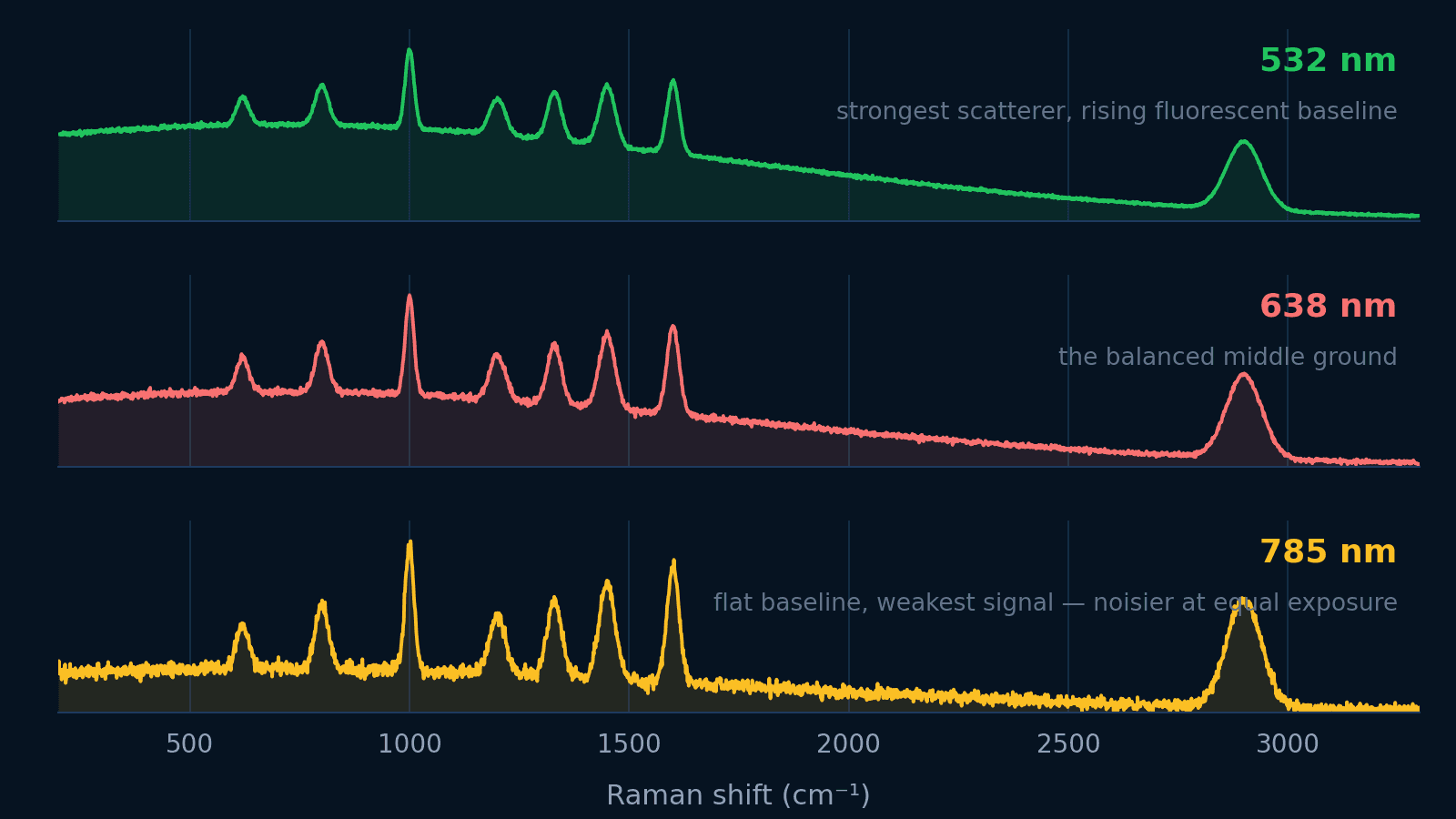 Raman spectroscopy
Choosing a Raman excitation wavelength
Balance the ν⁴ signal law, fluorescence background, silicon detector cutoff, and spatial resolution across 532, 638, and 785 nm.
Open guide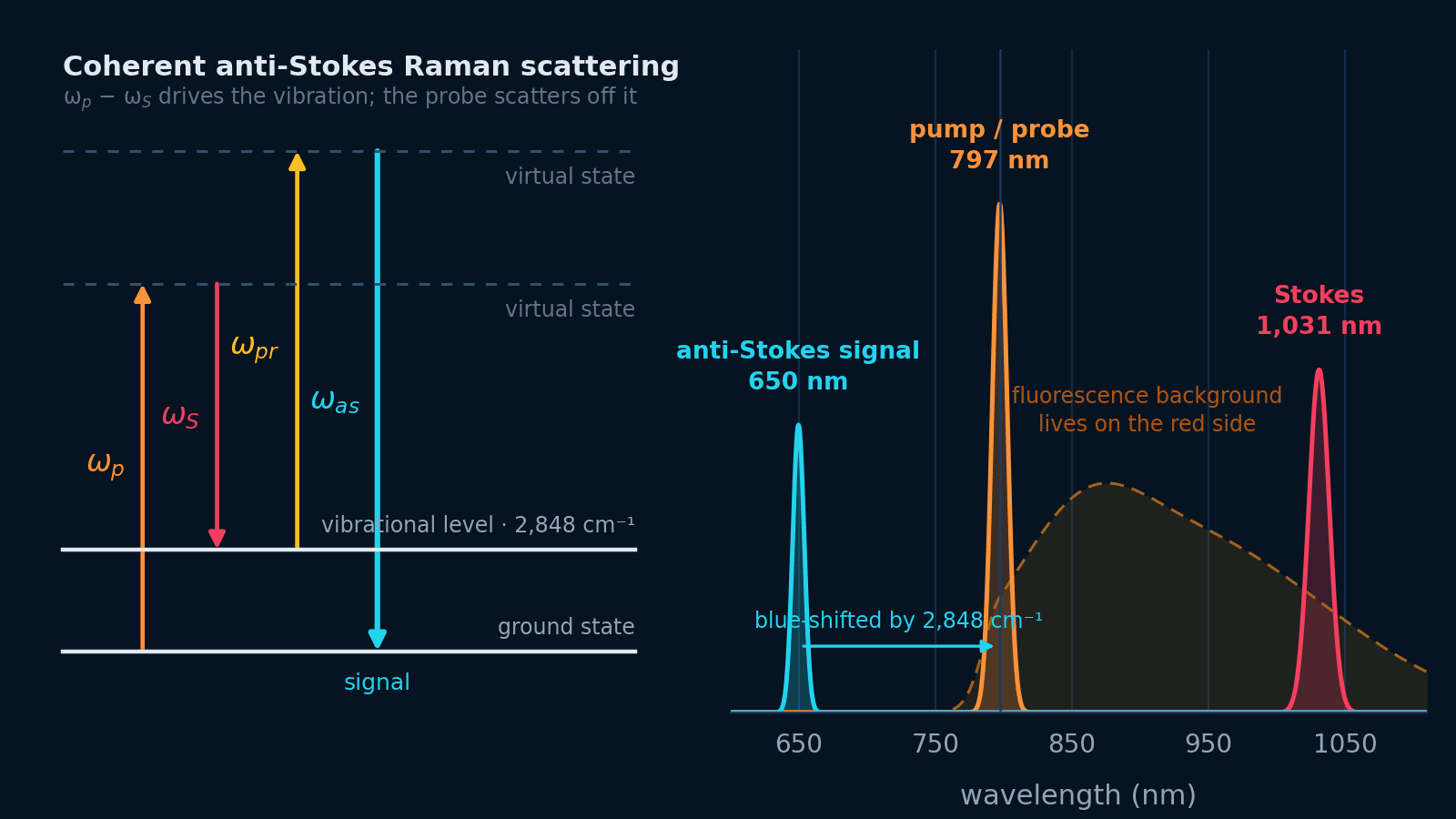 Coherent Raman imaging
Building a CARS microscope
Coherent anti-Stokes Raman scattering, from the four-wave-mixing physics to the hardware: excitation schemes, pulse width versus linewidth, the delay line that carries the spectral axis, and the detection chain.
Open guide