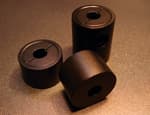
Glan-Taylor polarizer
| Parameter | Value |
|---|---|
| Material | a-BBO, Calcite, YVO4 |
| Wavelength Range | a-BBO: 220-3000nm; Calcite: 350-2300nm; YVO4: 500-4000nm |
| Extinction Ratio | <5×10⁻⁶ |
| Surface Quality | 20/10 scratch and dig |
| Beam Deviation | < 3 arc minutes |
| Wavefront Distortion | λ/4@632.8nm |
| Damage Threshold | > 10 MW/cm² |
| Coating | Single Layer MgF2@1064nm |
| Mount | Black Anodized |
Glan-Laser polarizer
| Parameter | Value |
|---|---|
| Material | a-BBO, Calcite, YVO4 |
| Wavelength Range | a-BBO: 220-3000nm; Calcite: 350-2300nm; YVO4: 500-4000nm |
| Extinction Ratio | <5×10⁻⁶ |
| Surface Quality | 20/10 scratch and dig |
| Beam Deviation | < 3 arc minutes |
| Wavefront Distortion | λ/4@632.8nm |
| Damage Threshold | >500MW/cm² |
| Coating | Single Layer MgF2@1064nm |
| Mount | Black Anodized |
Glan-Thompson polarizer
| Parameter | Value |
|---|---|
| Material | Calcite |
| Wavelength Range | 400-2300nm |
| Extinction Ratio | <5×10⁻⁶ |
| Surface Quality | 20/10 scratch and dig |
| Beam Deviation | < 3 arc minutes |
| Wavefront Distortion | λ/4@632.8nm |
| Damage Threshold | > 10MW/cm² |
| Coating | Single Layer MgF2@1064nm |
| Mount | Black Anodized Aluminum |
Technical FAQ
Configuration questions for Glan Polarizers
What wavelengths does the Glan Polarizers cover?
Wavelength Range: a-BBO: 220-3000nm; Calcite: 350-2300nm; YVO4: 500-4000nm. Check the specification at your angle of incidence. Coating bands and grating efficiency curves are quoted at a reference angle, and both shift as that angle changes.
How much optical power can the Glan Polarizers take?
Damage Threshold: > 10 MW/cm². Damage thresholds are quoted for a pulse duration, wavelength and beam diameter. Scale them to your own conditions rather than reading the headline figure as a rating.
What is the Glan Polarizers made from?
Material: a-BBO, Calcite, YVO4 · Surface Quality: 20/10 scratch and dig. Substrate and coating decide thermal behaviour and cleaning method as much as optical performance. Confirm both before the optic enters a high-average-power or vacuum path.