See the spatial distribution
Inspect two-dimensional intensity maps, three-dimensional beam profiles and transverse intensity sections to assess spot shape and alignment.
Medium-power series
CN0615VIS-NIR-M medium-power series beam profiler. Spectral range: 340-1100 nm/ 1100-1350 nm. Beam-spot range: 32 μm to 15 mm; TEM00 limit: 11 mm. Check power, attenuation and interface conditions for the selected configuration.
This configuration has a documentation discrepancy. Read the configuration notes below and confirm the required specification before selecting it.
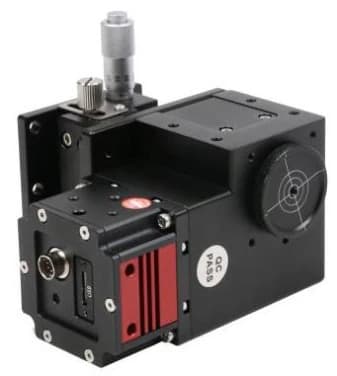
Compare the details
Compare the listed configurations and match the specifications to your setup.
20 specification rows.
| Parameter | Specification |
|---|---|
| Model | CN0615VIS-NIR-M |
| Spectral Range | 340-1100 nm/ 1100-1350 nm |
| Sensor size | 21.1 mm*15.8 mm |
| Min. beam diameter | 32 μm [1] |
| Max. beam diameter | 15 mm [2] |
| Max. receiving angle | Collimated Light: ±2.5° Converge Light:: NA0.08 |
| Min. Power | 1 mW |
| Max. Power | 50 W |
| Max. energy density | 20J/cm² |
| Detection Time | ≤2minutes@50 W |
| Defocus Range | 0.05 mm |
| Laser incident direction | Vertical, other direction on request. |
| Attenuator | OD0/OD1/OD2/OD3/OD4(340-1100 nm) OD1/OD2/OD3(1100-1350 nm) |
| Interface | USB3.0 |
| External Trigger | Yes |
| Operating Environment | Temperature: 0-35°C [3] , Relative humidity<60% |
| Operational Conditions | Operating system: Windows 10/11, 64-bit, pre-installed MS Office or WPS. Hardware: ≥8G RAM, CPU I5 or above (≥2.5GHz, Core ≥4), recommended display resolution is 1920*1080. |
| Weight | <1 Kg |
Scroll within the table to view every row.
| Parameter | Specification |
|---|---|
| X-axis maximum travel | 13 mm |
| Exposure and gain control | Manual / automatic real-time exposure and gain adjustment |
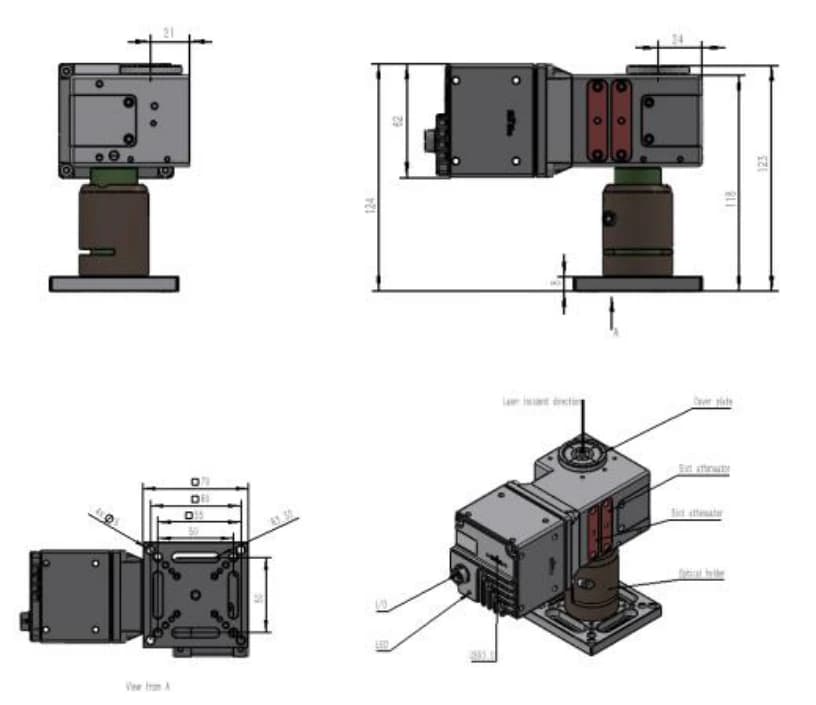
From image to measurement
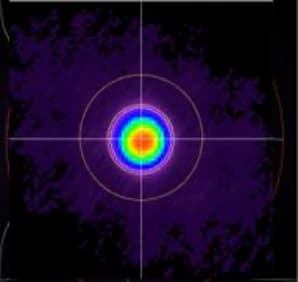
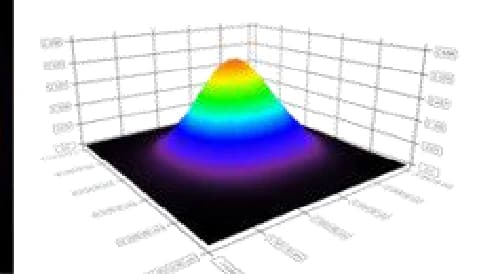
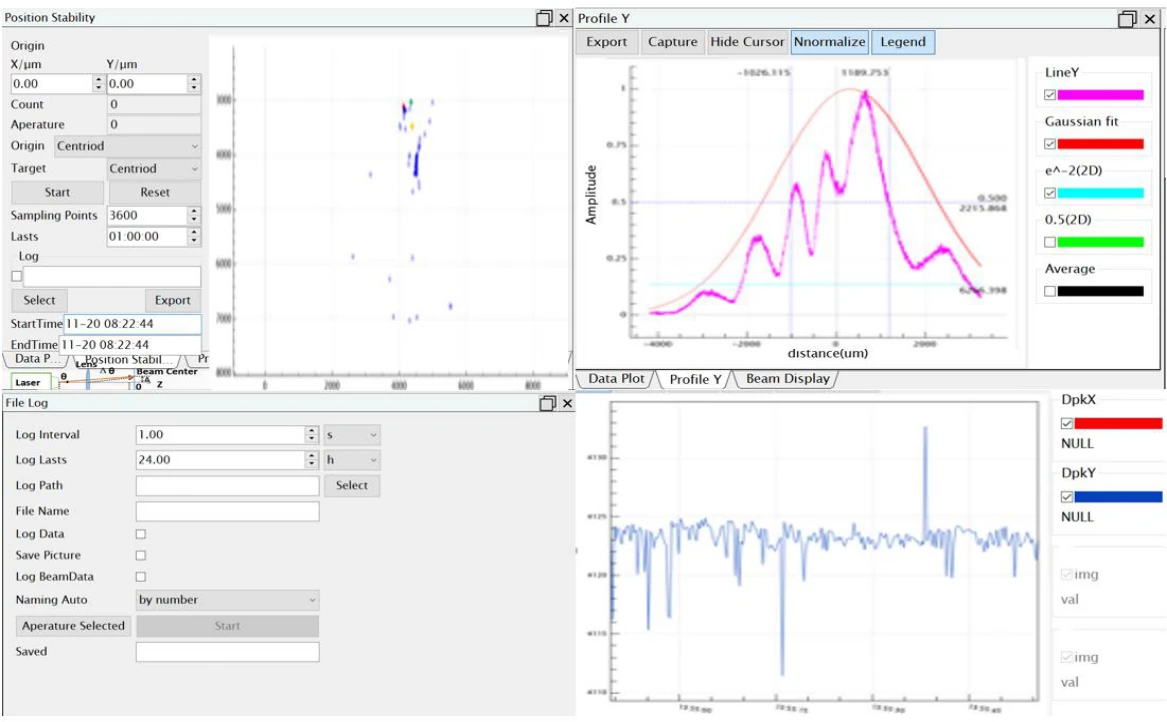
Illustrative software output. Results, analysis functions and acquisition rates depend on the selected hardware, software and beam conditions.
Inspect two-dimensional intensity maps, three-dimensional beam profiles and transverse intensity sections to assess spot shape and alignment.
Analyse beam diameter, ellipticity and position. Suitable configurations support multi-spot monitoring, image stitching and pointing-stability analysis; acquisition and processing rates are model dependent.
Check exposure, shutter and external-trigger support for your timing requirements. The 1000 W system specifies beam analysis and optional automatic M² workflows; these capabilities require the stated software and hardware configuration.
01
Choose the exact detection band and the attenuation or window configuration. A family range combines different models; it does not make every instrument broadband.
02
Compare the minimum detectable spot with the maximum usable beam size. Sensor pixel size, optical magnification and quoted measurement resolution describe different quantities. Gaussian TEM00 limits may be smaller than the sensor aperture.
03
Read total power, irradiance and pulse-energy-density limits together. Include pulse duration, repetition rate, beam diameter, cooling and the permitted measurement time. Attenuation conditions belong to the quoted limit.
04
Match USB or GigE, trigger support, software requirements and beam-entry geometry. Divergence needs measurements at known axial positions; automated M² analysis requires the appropriate scan hardware and software configuration.
Technical FAQ
No. The rating depends on wavelength, beam diameter, attenuation, cooling and operating time. For example, the 500 W configurations distinguish 200 W, 300 W and 500 W operation by focused-spot size and measurement time. The 1000 W model specifies continuous operation with water cooling.
Not always. Several models give a smaller TEM00 or 1/e² beam limit than the geometric sensor range. Read the model footnotes and central-incidence conditions alongside the main table.
A single profile gives the transverse distribution at one plane. Divergence and M² require measurements along the propagation axis, suitable optics and a defined analysis method. Confirm the translation, attenuation and software configuration for that workflow.
Most listed models specify Windows 10 or 11, 64-bit, with MS Office or WPS, at least 8 GB RAM and a processor of at least 2.5 GHz with four or more cores. USB3.0, GigE, 10GigE and trigger availability vary by model; use its exact specification.
Keep the optical, electrical, mechanical and operating specifications together for your configuration.
DatasheetInclude wavelength, beam size, CW or pulsed operation, pulse energy, repetition rate, power, exposure time, cooling and the measurements you need.