Automated scanning and mapping
Step-and-acquire across areas far wider than a single field of view.
Opto-Mechanics · Fiber Alignment Stages
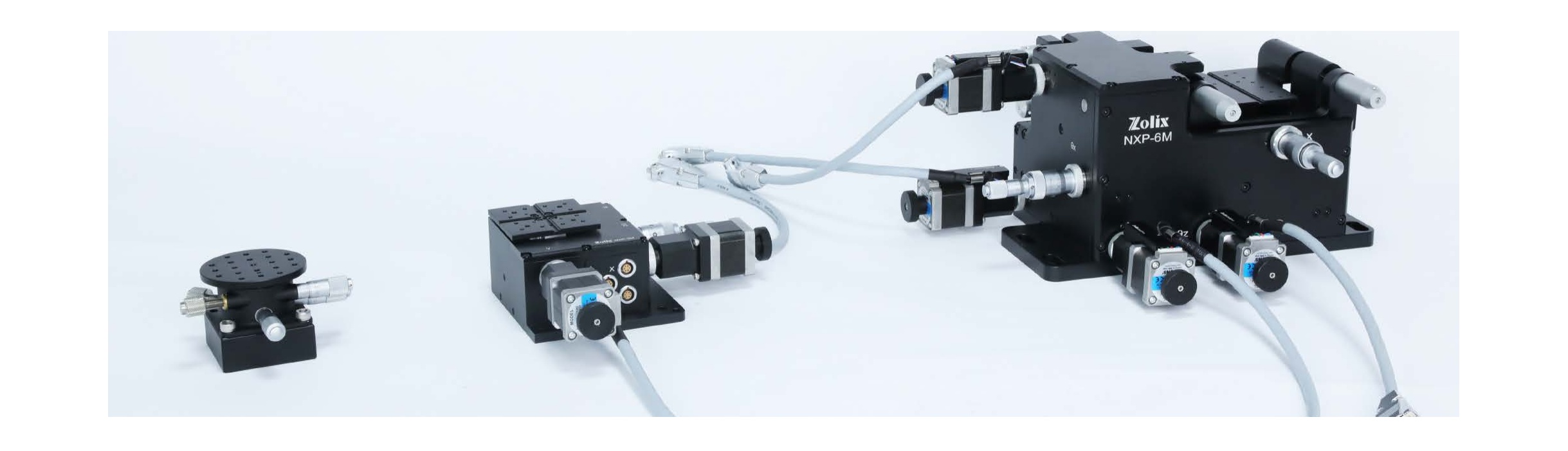
NXP-6M-L parallel-flexure coupling platform
6-axis parallel-flexure optical coupling platform with no sliding bearings. The monolithic architecture minimizes backlash and accumulated stack error and accepts interchangeable manual or motorized DNXP drivers.
Datasheet (PDF) ↗Catalog context
NXP-6M-L is listed as NXP-6M-L parallel-flexure coupling platform in the Fiber Alignment Stages family. The local catalog record provides these first selection fields: Degrees of freedom: X / Y / Z / Rx / Ry / Rz; Linear travel: 4 mm on X, Y, and Z; Angular travel: Rx / Ry / Rz: ±4° (70 mrad).
| Degrees of freedom | X / Y / Z / Rx / Ry / Rz |
|---|---|
| Linear travel | 4 mm on X, Y, and Z |
| Angular travel | Rx / Ry / Rz: ±4° (70 mrad) |
| Rotation centre | Common centre; maximum crosstalk 100 µm |
| Architecture | Parallel flexure; no guide bearings or sliding interfaces |
| Drive orientation | Left-hand |
| Compatible drivers | DNXP-M manual or DNXP-A motorized; sold separately |
| Maximum load | 1 kg |
| Resonant frequency | >130 Hz (±10%) |
| Thermal stability | 1 µm/°C |
Application context
Application guidance is derived from the product family and tied to the model-specific selection fields above.
Step-and-acquire across areas far wider than a single field of view.
Move parts between fixed stations with closed-loop encoders holding position over long shifts.
Coordinate several axes from software for processing, inspection and test sequences.
System integration
Use these checks to connect NXP-6M-L to the surrounding optical, mechanical and control system. Every value shown is taken from this model's own specification record.
Technical FAQ
Linear travel: 4 mm on X, Y, and Z · Angular travel: Rx / Ry / Rz: ±4° (70 mrad). Adjuster pitch sets the sensitivity you can actually work at. Confirm whether the stated figure is a total range or a per-revolution increment, and whether the mechanism is locked after adjustment.
Maximum load: 1 kg. Use the stated geometry and mass to fix beam height, clearance and the load carried by whatever this part is bolted to. These are the numbers that decide whether adjacent components physically collide.
Model selection
Compare NXP-6M-L with the closest available models in the Fiber Alignment Stages family. Confirm option-dependent values on the final configuration before ordering.
| Selection parameter | NXP-6M-L (current) | NXP-3NP | NXP-6M-R |
|---|---|---|---|
| Optic accepted | Confirm for this model | Confirm for this model | Confirm for this model |
| Adjustment | 4 mm on X, Y, and Z | 4 mm on X, Y, and Z | 4 mm on X, Y, and Z |
| Mounting interface | Confirm for this model | Confirm for this model | Confirm for this model |
| Material | Confirm for this model | Confirm for this model | Confirm for this model |
Before you specify
Engineering context for choosing this class of component, with the tradeoffs worked through on real specifications.
 Photonics
Single-mode fiber does not preserve polarization. Pin the state, erase it with a scrambler, or maintain it in PM fiber — which one your measurement needs, and the response time and extinction ratio that decide it.
Open guide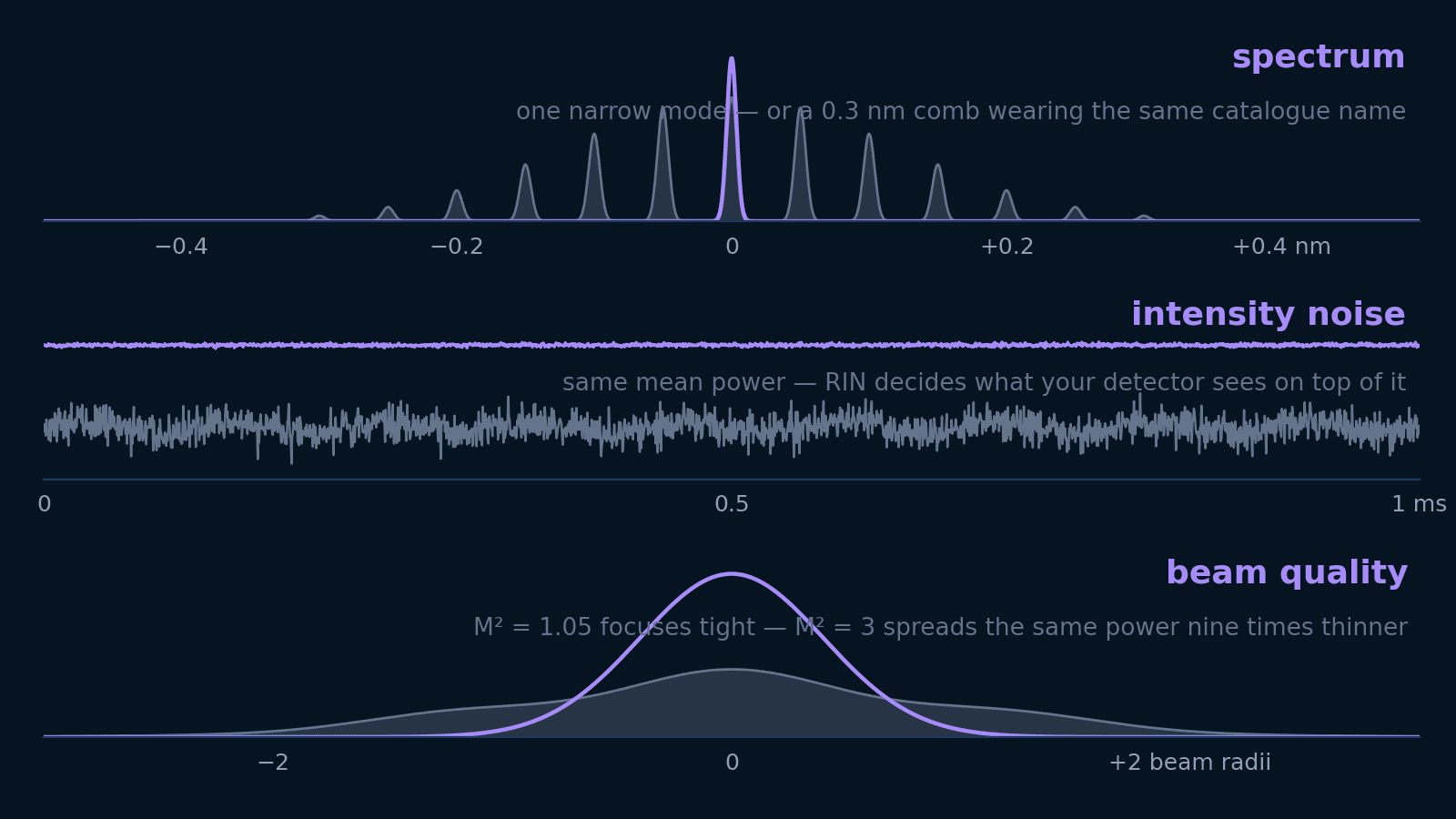 Photonics
Linewidth, spectral width, RIN, M², and coherence length answer five different questions. Translate each into the units your experiment is designed in — and learn which ones not to pay for.
Open guide