Amplified Fiber Optical Detector: 0.8-1.7µm, 100MHz
Amplified Fiber Optical Detector: 0.8-1.7µm, 100MHz
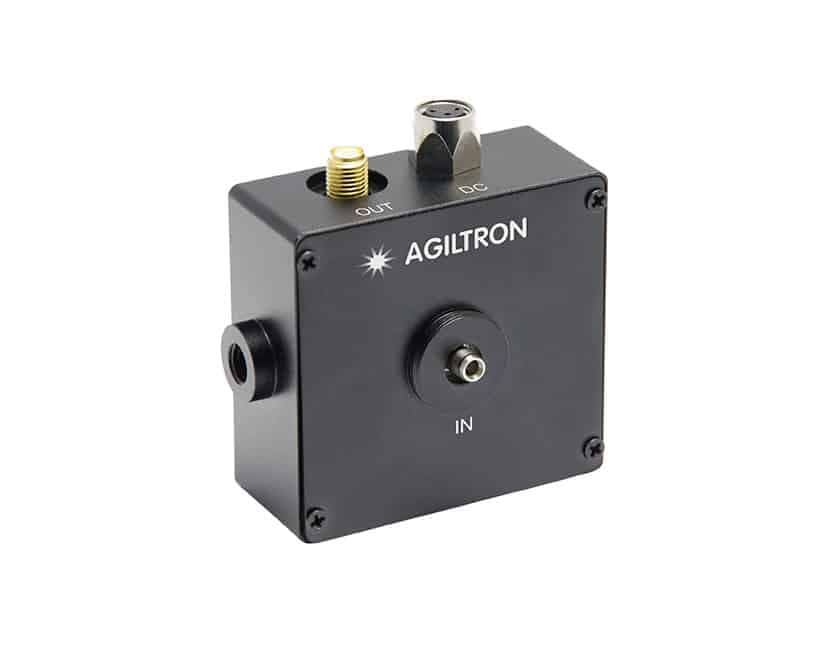
The AFOD series detectors offer a user-friendly photodiode package with an integrated high-gain, low-noise analog transimpedance amplifier, optimized for applications requiring high bandwidth and ultra-fast response times (<1 ns). These detectors feature a manually switchable gain with four settings: 660, 1020, 2000, and 20000, to maximize the signal-to-noise ratio, ideal for detecting low-level optical beat signals at frequencies up to 100 MHz. The AFOD detectors come with fiber optical FC inputs and an M4 tapped hole in the housing for easy post mounting. Each unit includes a low-noise ±12 V linear power supply, with replacements available separately.
Configuration options
Build & quote
Configure the options below and add your exact build to the enquiry — we confirm the part number and availability.
Part number: AFOD-101001111
Type: InGaAs · Bandwidth: 100MHz · Grade: Regular · Package: Regular · Power Supply: Included
System integration
Integration and compatibility
Use these checks to connect Amplified Fiber Optical Detector: 0.8-1.7µm, 100MHz to the surrounding optical, mechanical and control system. Every value shown is taken from this model's own specification record.
- Control interface
- Power Supply: Included, None, Replacement
- Match supply voltage, analog or digital command range, connector pinout and default optical state to the instrument interlock. Confirm the unpowered state explicitly — it decides what happens to the link on a power failure.
Technical FAQ
Integration questions for Amplified Fiber Optical Detector: 0.8-1.7µm, 100MHz
Does the Amplified Fiber Optical Detector: 0.8-1.7µm, 100MHz require a controller?
Power Supply: Included, None, Replacement. Match supply voltage, analog or digital command range, connector pinout and default optical state to the instrument interlock. Confirm the unpowered state explicitly — it decides what happens to the link on a power failure.
Need this configured?
Share your wavelength, fiber type, connector, power handling and control requirements and we will qualify the matching configuration and part number.