Lasers · Laser applications
Confocal and fluorescence microscopy
405, 488, 561, 637, 640 nm common lines | CW with TTL or analog modulation, SM or PM fiber | Microscopy benefits from compact multi-line combiners with stable fiber output and line-by-line electronic control. | Ask for microscope input fiber, power after fiber, modulation bandwidth, number of channels, and control interface. | application-systems | cw-dpss-diode
Cataloguscontext
De plaats van Confocal and fluorescence microscopy in het assortiment
Confocal and fluorescence microscopy staat vermeld binnen de familie Laser applications. Gebruik de productfamiliepagina en eventuele modelspecifieke downloads op deze pagina om de vereiste configuratie te bevestigen.
Specifications
Full specifications for this product are available on request. Contact us for the datasheet.
Related products
Raman spectroscopy
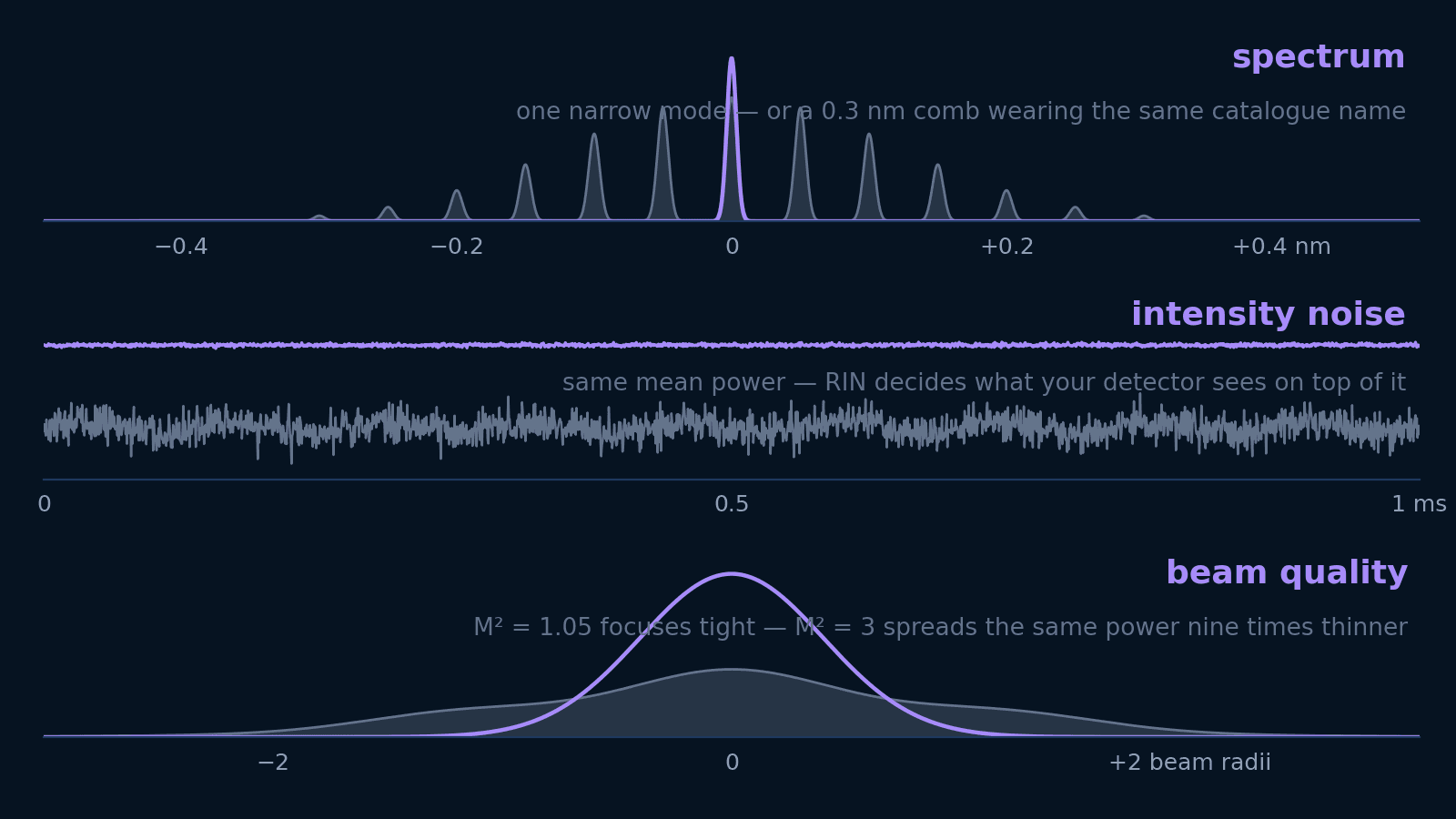
320, 360, 405, 442, 457, 473, 514.5, 532, 633, 660, 671, 785, 808, 830, 1064 nm | CW, narrow-linewidth, single-frequency where required | Narrow linewidth and high spectral purity protect Raman resolution and reduce background in low-wavenumber and micro-Raman setups. | Ask for excitation wavelength, target Raman shift range, linewidth target, output mode, sample power limit, and required filtering. | single-frequency | cw-dpss-diode | spectrum-measurement
Flow cytometry
349, 375, 405, 488, 532, 561, 633, 640, 808 nm | CW, low noise, free-space or fiber output | Multi-line excitation packages need stable power, low amplitude noise, fast warm-up, and clean beam delivery for repeatable cell and particle analysis. | Ask for fluorophore set, number of lines, power per line, beam size, fiber interface, modulation, and control protocol. | application-systems | cw-dpss-diode
Particle image velocimetry
532 nm core options, 375-830 nm light sheet options | CW or pulsed line beam | PIV needs a uniform, stable light sheet with enough power or pulse energy for flow-field illumination and synchronized imaging. | Ask for field size, sheet thickness, pulse or CW mode, camera timing, wavelength, safety enclosure, and beam delivery constraints. | application-systems | nanosecond-pulsed | cw-dpss-diode
Optical tweezers
1064 nm common trap wavelength | CW, low noise, TEM00 | Stable near-IR trapping minimizes photodamage while power stability, pointing stability, and beam quality set force stability. | Ask for trap geometry, power at sample, objective NA, pointing stability, noise target, and expansion or isolation optics. | cw-dpss-diode | fiber-lasers