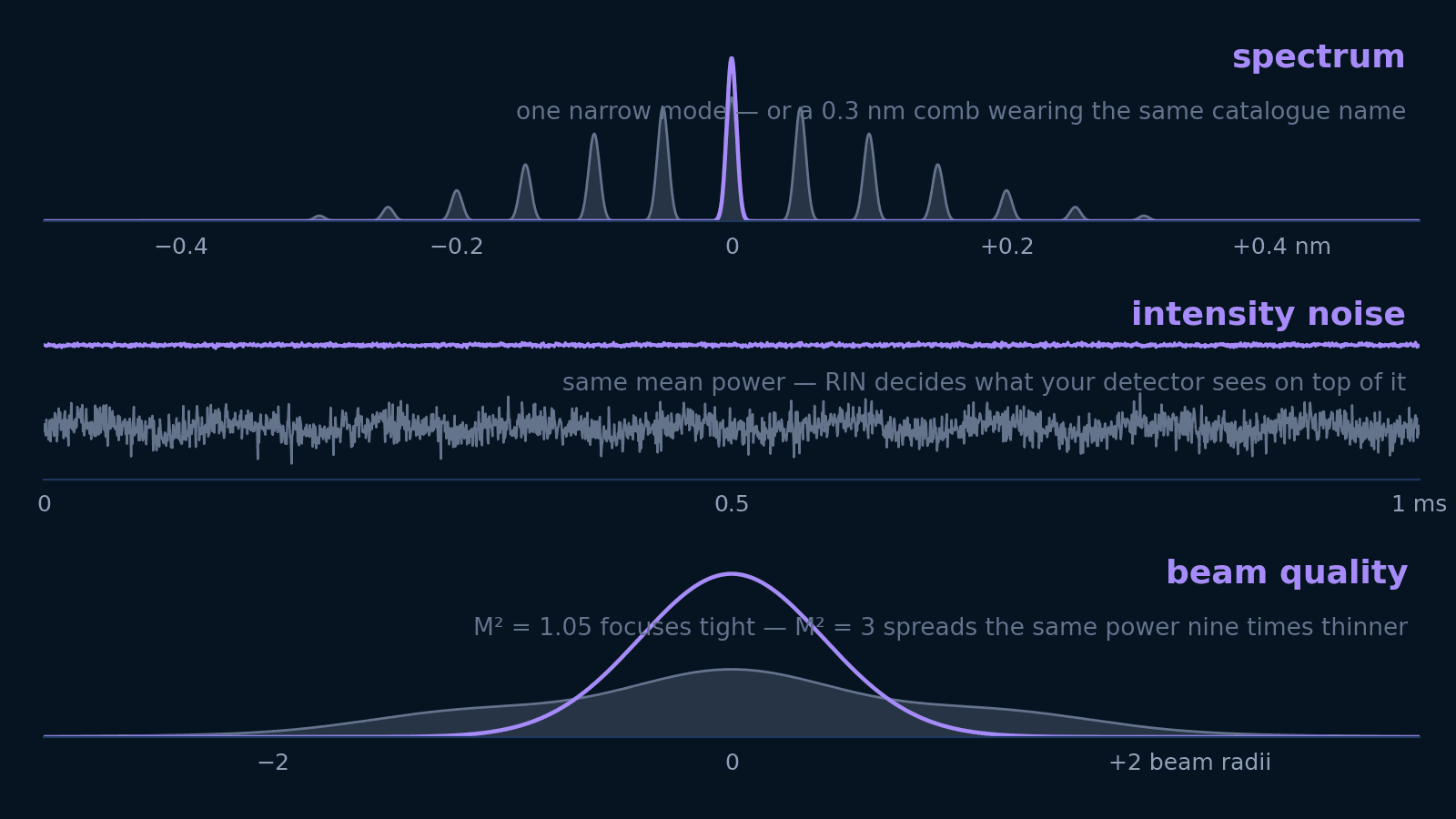
Power stability, linewidth, beam quality
YL-I-455454 nm blue high-power CW laser
454 nmThe YL-I-455 is a 454 nm continuous-wave direct diode laser. Electrical current creates optical gain in a semiconductor junction, and the diode generates the laser light directly. Optical feedback selects the oscillating modes, while drive current and junction temperature affect output power and wavelength. The TTL and analog modulation options control different things: TTL gates the beam on and off, while analog control varies its intensity. Modulation bandwidth sets how quickly the source can follow a changing command. The specified fiber connection delivers the generated light to the experiment; its core size, numerical aperture and connector need to match the receiving optics.
Specifications
YL-I-455
16 specification rows
| Output / average power | 1~40 W |
|---|---|
| Beam / notes | Laser |
| Operating mode | CW |
| Fiber Core Diameter (um) | 100, 200, 400, 600, 0.22NA |
| Fiber Connector | SMA905, FC/PC optional |
| Fiber lengths | 1m |
| Fiber Jacket | PVC, Metal optional |
| Power stability (rms, 4 hours±3℃) | <2%, <1% |
| Cooled method | Air cooled |
| Warm-up time (minutes) | <5 |
| Operating temperature (℃) | 0-30 |
| Operating voltage (VAC) | 100-240 |
| Expected lifetime (hours) | >10000 |
| Wavelength (nm) | 455±5 |
| Output power (W) @ after 400um fiber | 1-40 |
| Modulation option | DC-1kHz, 1kHz-10kHz, 10kHz-30kHz optional; TTL and Analog optional |
What do you need?
Tell us the output power, beam quality and beam delivery you need, and we'll reply with the matching configuration and lead time.
Model selection
Nearby series comparison
Compare YL-I-455 with the closest available models in the CW Lasers family.
| Selection parameter | YL-I-455 (current) | MLL-III-454L | MLL-III-454 |
|---|---|---|---|
| Wavelength | 454 nm | 454 nm | 454 nm |
| Optical power / pulse energy | 1~40 W | 1~80 mW | 1~800 mW |
| Operating mode / pulse width | CW | CW | CW |
Related cw lasers
Compare the YL-I-455 with nearby cw lasers across the wavelength range.