Communication
MLL-III-1250-SM: 1250 nm emission must sit inside the fiber-component passband used for Communication; connector polish, fiber mode, linewidth and back-reflection tolerance should be specified as one optical interface.
Power stability, linewidth, beam quality
MLL-III-1250-SM is a 1250 nm CW laser. Used for communication, spectrum analysis, measurement, flow cytometry. Laser. Key specifications: output / average power 1~40 mW. View specifications, datasheet and enquiry options from Precisometer.
Specifications
2 specification rows
| Wavelength | 1250 nm |
|---|---|
| Output / average power | 1~40 mW |
| Beam / notes | Laser |
Series-level technical context
This model has no standalone PDF and only a small number of model-specific rows. The values below are traceable context from 12 wavelength-near cw lasers records; they define the parameters to qualify, but are not substituted for an order-specific datasheet.
Nearby series records state M²: <1.1, Beam divergence, full angle (mrad): <1.5, and Beam divergence, full angle (mrad): <3.0. These are series context, not guaranteed values for MLL-III-1250-SM; confirm them on the order-specific datasheet.
Application context
Typical uses for this laser type, with the selection logic tied to the model record.
MLL-III-1250-SM: 1250 nm emission must sit inside the fiber-component passband used for Communication; connector polish, fiber mode, linewidth and back-reflection tolerance should be specified as one optical interface.
MLL-III-1250-SM: 1250 nm emission sets the excitation and detector-band choice for Spectrum analysis; linewidth and wavelength stability determine how cleanly weak spectral features can be separated from the laser line.
MLL-III-1250-SM: Measurement benefits from a stable, focusable source. 1250 nm emission fixes the compatible coatings and detector response, while M², divergence and pointing stability should be confirmed for the intended beam path.
MLL-III-1250-SM: 1250 nm emission can be matched to the absorption or excitation band used in Flow cytometry. Power stability and beam pointing should be confirmed because both affect quantitative image or fluorescence intensity.
Share wavelength, operating mode, output power or pulse energy, linewidth or pulse width, delivery, control, and safety requirements and we will qualify the matching configuration and lead time.
Model selection
Compare MLL-III-1250-SM with the closest available models in the CW Lasers family. Confirm option-dependent values on the final configuration before ordering.
| Selection parameter | MLL-III-1250-SM (current) | TEM-LN-1250 | MLL-III-1268-SM |
|---|---|---|---|
| Wavelength | 1250 nm | 1250 nm | 1268 nm |
| Optical power / pulse energy | 1~40 mW | 1~40 mW | 1~10 mW |
| Operating mode / pulse width | Confirm for this model | CW | CW |
| Beam quality | Confirm for this model | TEM00 | TEM00 |
Compare the MLL-III-1250-SM with nearby cw lasers across the wavelength range.
Choosing a laser
Which specifications decide the experiment, and which ones cost money without changing the result.
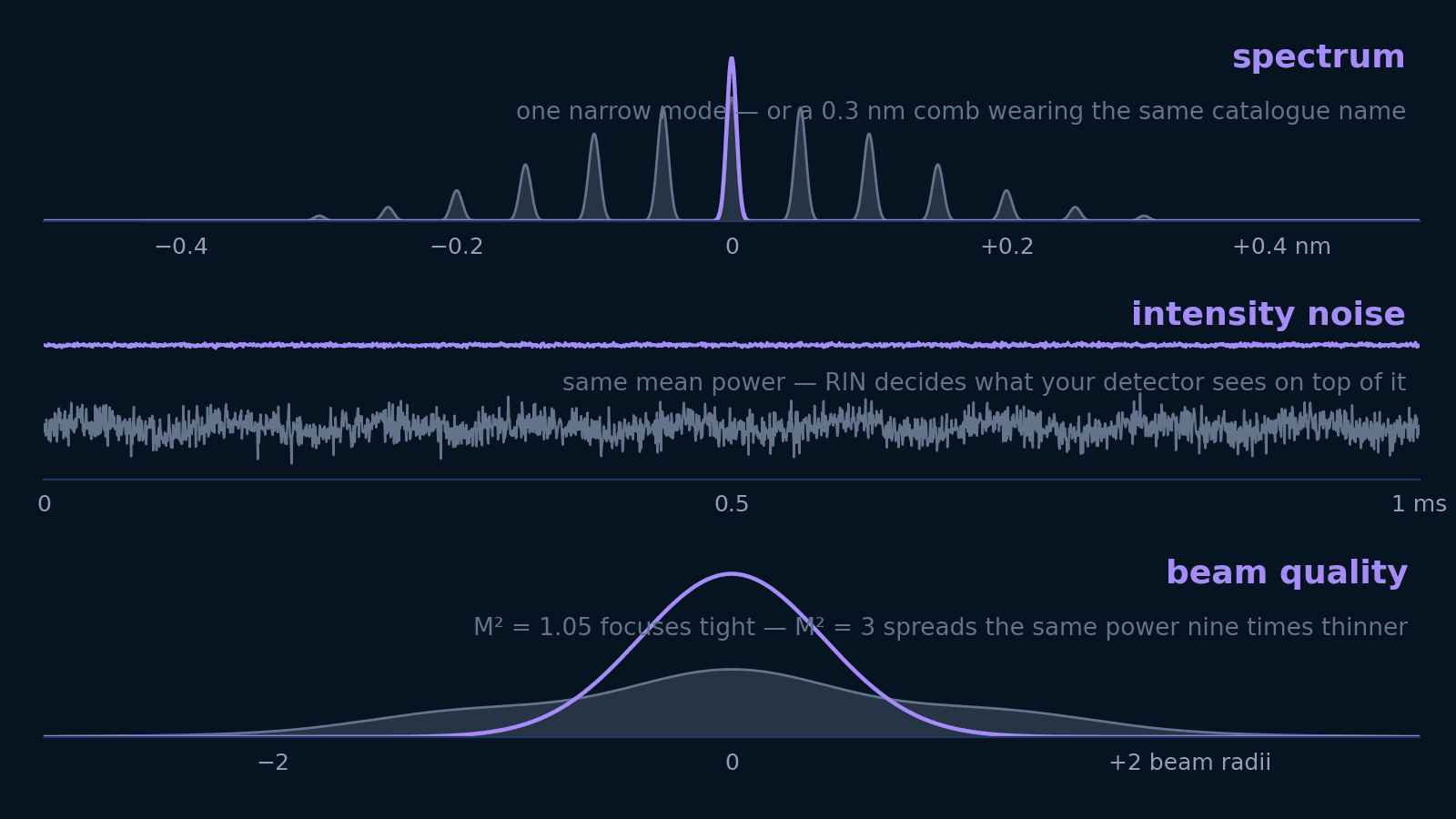
PhotonicsLinewidth, spectral width, RIN, M², and coherence length answer five different questions. Translate each into the units your experiment is designed in — and learn which ones not to pay for.
Open guide
Optical trappingWhy wavelength is decided by photodamage, focal heating, and detector bandwidth rather than trapping force — and what laser noise costs you in piconewtons.
Open guide
Confocal microscopyConnect fluorophores, pinhole size, Airy units, spatial sampling, scan timing, modulation, and power after the fiber in one practical design workflow.
Open guide