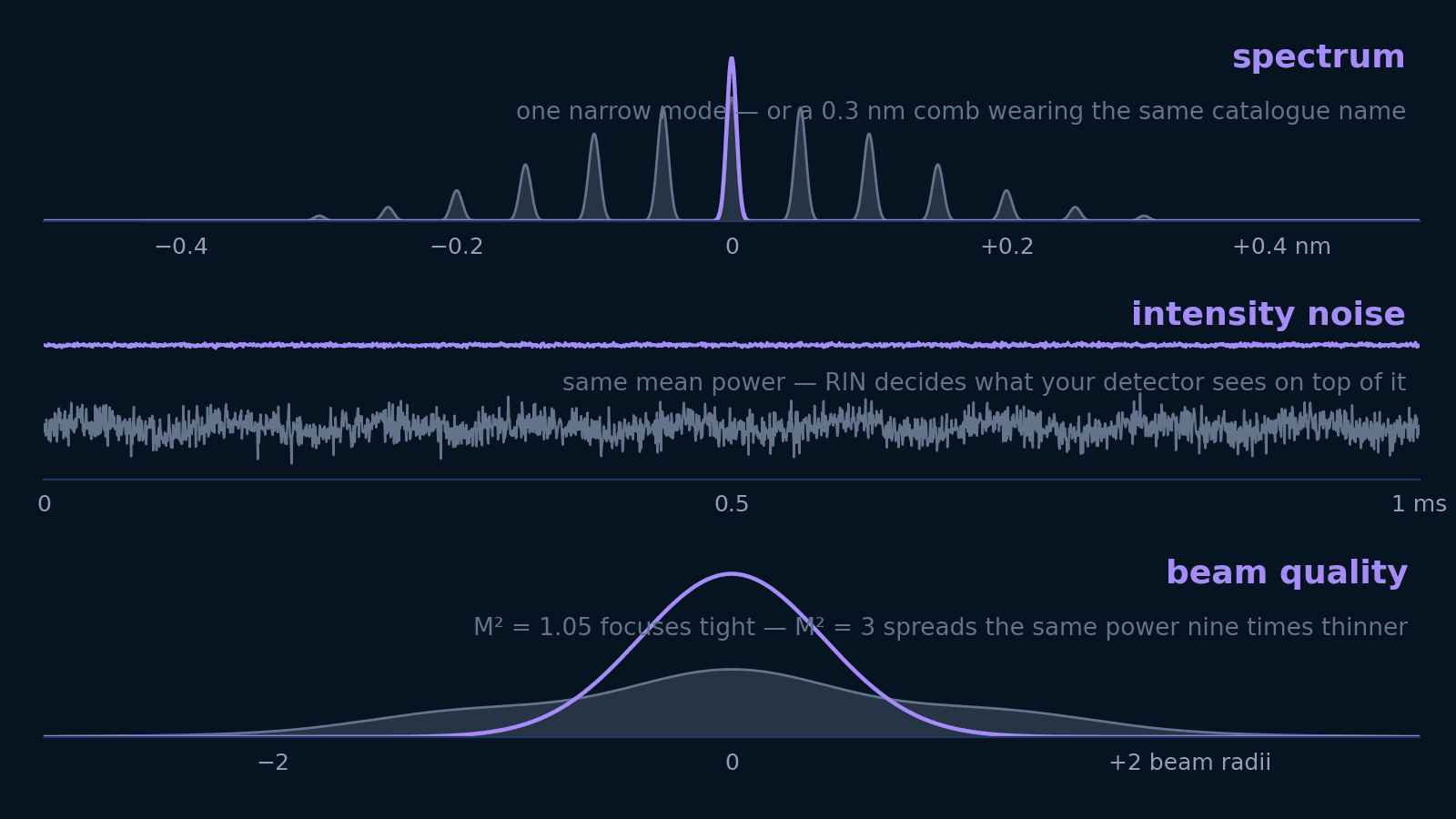
Power stability, linewidth, beam quality
MGL-S-577577 nm yellow CW laser
577 nmThe MGL-S-577 is a 577 nm continuous-wave diode-pumped solid-state laser. Laser diodes optically pump a solid gain medium inside a resonator. The pump supplies the energy; repeated passes through the gain medium amplify the laser light. The TTL and analog modulation options control different things: TTL gates the beam on and off, while analog control varies its intensity. Modulation bandwidth sets how quickly the source can follow a changing command.
Specifications
MGL-S-577
22 specification rows
| Output / average power | 1~30 mW |
|---|---|
| Beam / notes | Laser |
| Operating mode | CW |
| Transverse mode | TEM00 |
| Beam diameter at the aperture (1/e2, mm) | <1.0 |
| Beam divergence (mrad) | <1.5 |
| Warm-up time (minutes) | <5 |
| Shock tolerance (6ms) | 7g laterally, 15g vertically |
| Modulation optional | DC-1kHz, 1kHz-10kHz, 10kHz-30kHz optional; TTL and Analog optional |
| Expected lifetime (hours) | >10000 |
| Wavelength (nm) | 577±2 |
| Power stability (rms, 4 hours ±3°C) | <3%, <2%, <1% |
| M² | <1.2 |
| Polarization ratio | >100:1, Horizontal (Vertical optional) |
| Pointing stability (μrad) (over 2 hours after warm-up and ±3°C) | <50 |
| Pointing stability over temperature (μrad/°C) | <8 |
| Beam height from base plate (mm) | 19 |
| Power consumption (W) | <30 |
| Max. heat dissipation of head (W) | 4W@25°C |
| IP rating | IP65 |
| Operating temperature (℃) | 10-35 |
| Power supply (100-240VAC) | PSU-A-F/ PSU-A-D |
What do you need?
Tell us the output power, beam quality and beam delivery you need, and we'll reply with the matching configuration and lead time.
Model selection
Nearby series comparison
Compare MGL-S-577 with the closest available models in the CW Lasers family.
| Selection parameter | MGL-S-577 (current) | MSL-FN-577 | MLL-U-577 |
|---|---|---|---|
| Wavelength | 577 nm | 577 nm | 577 nm |
| Optical power / pulse energy | 1~30 mW | 1~300 mW | 1~200 mW |
| Operating mode / pulse width | CW | CW | CW |
| Beam quality | <1.2 | <1.2 | <1.2 |
Related cw lasers
Compare the MGL-S-577 with nearby cw lasers across the wavelength range.